
All articles
Every guide published on Melatonin UK, grouped by the question it answers. Cornerstone guides are the best place to begin; the rest go deeper into specific situations. New articles are added every Monday, Wednesday and Friday.
Latest articles

Better Sleep
How does sleep affect your mood?
Sleep supports emotional wellbeing, and poor sleep can leave you feeling more irritable, worried or overwhelmed. The relationship works both ways: stress and low mood can also disturb sleep. Melatonin helps signal biological night, but it should not be presented as a general mood booster.
5 min readRead the guide →

Better Sleep
Natural ways to boost your own melatonin
The best-supported natural approach is to give your body a clear contrast between daytime light and evening darkness: spend time outdoors during the day and reduce bright light as bedtime approaches. These habits support the timing of your own melatonin rather than guaranteeing higher levels; no particular food or bedtime ritual reliably produces a meaningful boost.
5 min readRead the guide →
Sleep Questions
Melatonin for falling asleep: how it helps you drift off at the right time
Melatonin can help some people fall asleep a little sooner, particularly when their body clock is out of step with their intended bedtime. Research suggests the average benefit is modest: it supports the body's night-time signal rather than forcing sleep, and its effects depend on the sleep problem and timing.
5 min readRead the guide →
Research & Safety
Is more melatonin better? Why higher amounts are not always more effective
No — more melatonin does not reliably mean better sleep. Some studies have linked higher amounts with greater improvements in certain sleep measures, but the relationship is not consistent: timing, release type and the sleep problem being studied also matter.
5 min readRead the guide →
Melatonin Basics
What is melatonin used for? The main everyday uses explained
Melatonin is used to help reduce jet lag, address certain sleep-timing problems and support sleep in some adults with sleep difficulties. Its benefits depend on the situation: evidence is stronger for jet lag than for shift-work sleep, while improvements in general sleep difficulties are usually modest.
5 min readRead the guide →
Research & Safety
Does melatonin work? What the research actually shows
Yes, melatonin can work, but its benefits depend on the sleep problem: research supports its use for jet lag and suggests it can help with some body-clock timing difficulties. For general difficulty falling asleep, the average improvement is usually modest, and evidence is less convincing for staying asleep throughout the night.
5 min readRead the guide →
Start with the cornerstones

Melatonin Basics
What is melatonin?
Melatonin is a hormone produced mainly by the pineal gland in the brain, released in response to darkness. It signals to the rest of the body that it is night-time, helping to time sleep rather than force it. It is not a sedative, and it does not knock you out the way a sleeping tablet might.
7 min readRead the guide →
The Body Clock
Why does light affect melatonin?
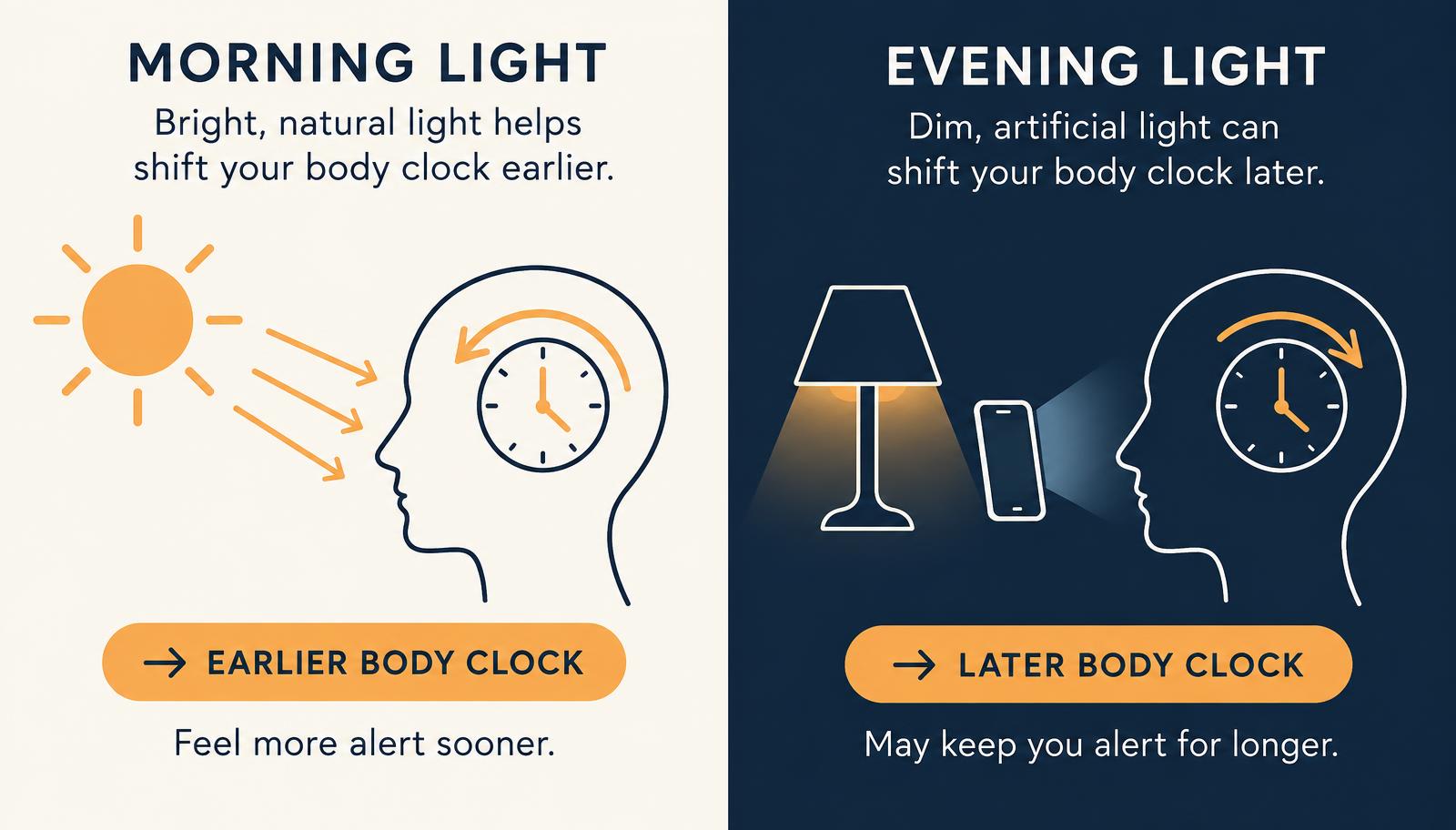
Light is the single strongest signal your body uses to time melatonin release. Specialised cells in the eye detect brightness, quite separately from normal vision, and pass that information to the brain's master clock, which controls the pineal gland. Brightness, timing and duration of light exposure all matter, not just its colour.
6 min readRead the guide →
The Body Clock
Melatonin and jet lag: understanding the connection
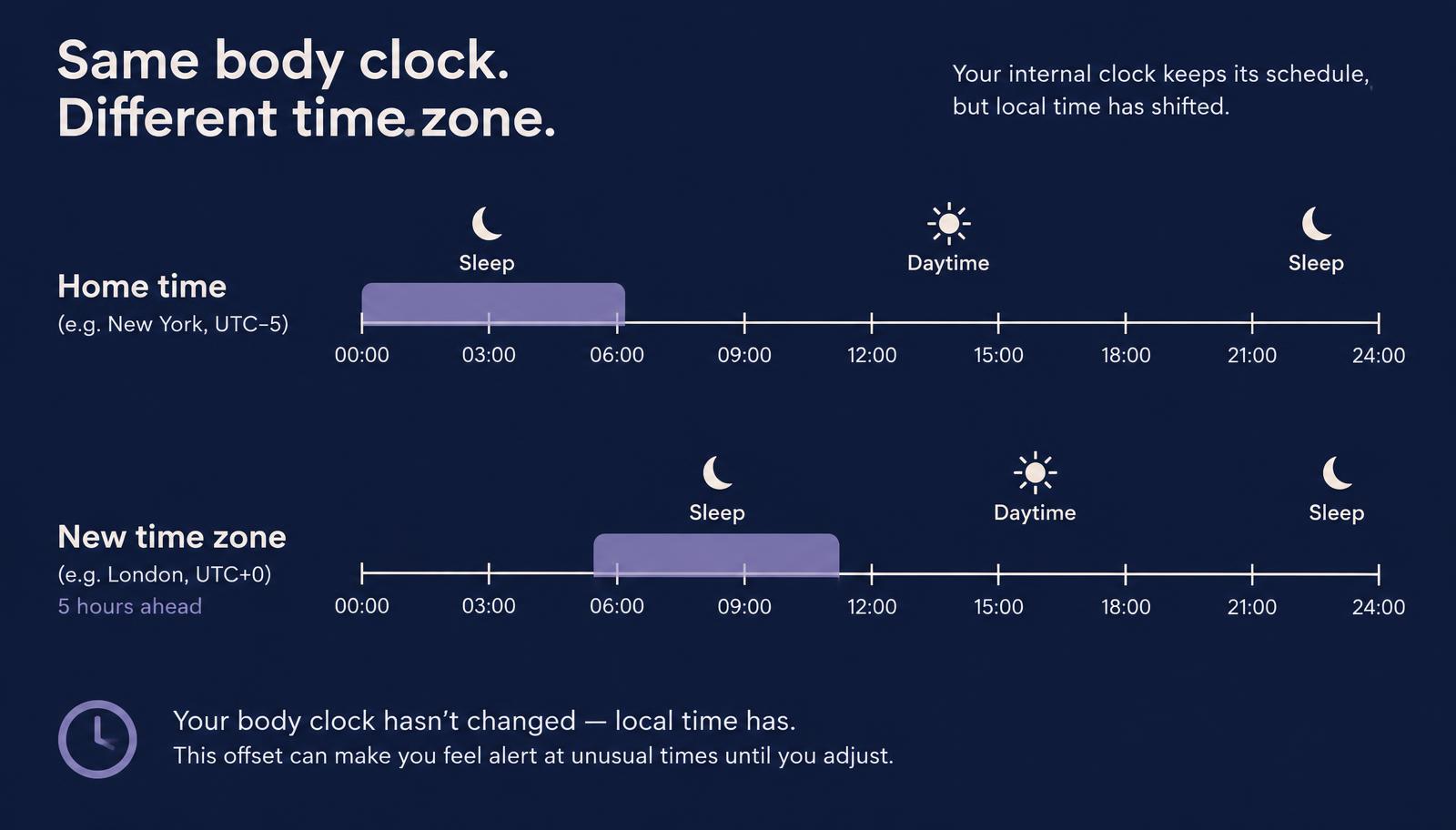
Jet lag happens because your internal body clock stays set to your home time zone while the outside world has moved on. Melatonin is one of the signals your brain uses to keep that clock synchronised, which is why researchers have studied it in relation to jet lag. The evidence is mixed and depends heavily on timing, so it's worth understanding the underlying biology rather than treating melatonin as a simple fix.
6 min readRead the guide →
Sleep Questions
Why do I struggle to fall asleep?
Difficulty falling asleep usually comes from a mismatch between several systems: how much sleep pressure has built up, how alert or wound-up your mind and body are, and whether your body clock is timed for sleep at that hour. Caffeine, alcohol, and worry about sleep itself can all make things worse. Working out which factor fits you best is more useful than assuming a single cause.
7 min readRead the guide →
Research & Safety
What has research studied about melatonin and sleep?
Melatonin has been researched most extensively for jet lag, shift work adjustment, delayed sleep timing, and helping some people fall asleep faster. The evidence is stronger and more consistent in some of these areas than others, and important questions remain about long-term use, ideal timing, and how much individual response varies. Understanding the strength and limits of this research helps set realistic expectations.
6 min readRead the guide →
Better Sleep
What is sleep hygiene, and what does it actually do?
Sleep hygiene is the umbrella term for the habits, routines and bedroom conditions that make good sleep more likely, such as a consistent schedule, a dark quiet room, and sensible caffeine and alcohol use. It helps most people some of the time, but it is not a treatment for persistent insomnia on its own, where the evidence points more strongly towards addressing racing thoughts, conditioned wakefulness and irregular schedules directly.
6 min readRead the guide →
Sleep Questions
Does melatonin help you sleep?
Melatonin can help some people, but mainly by adjusting the timing of sleep rather than forcing it. Research shows the clearest benefits in situations where the body clock is out of step, such as jet lag and delayed sleep timing, and some benefit for certain older adults. For general insomnia in adults, average effects are modest, and UK guidance puts other approaches first.
7 min readRead the guide →
Browse every article
Better Sleep
How does sleep affect your mood?
Sleep supports emotional wellbeing, and poor sleep can leave you feeling more irritable, worried or overwhelmed. The relationship works both ways: stress and low mood can also disturb sleep. Melatonin helps signal biological night, but it should not be presented as a general mood booster.
5 min readRead the guide →
Better Sleep
Natural ways to boost your own melatonin
The best-supported natural approach is to give your body a clear contrast between daytime light and evening darkness: spend time outdoors during the day and reduce bright light as bedtime approaches. These habits support the timing of your own melatonin rather than guaranteeing higher levels; no particular food or bedtime ritual reliably produces a meaningful boost.
5 min readRead the guide →
Sleep Questions
Melatonin for falling asleep: how it helps you drift off at the right time
Melatonin can help some people fall asleep a little sooner, particularly when their body clock is out of step with their intended bedtime. Research suggests the average benefit is modest: it supports the body's night-time signal rather than forcing sleep, and its effects depend on the sleep problem and timing.
5 min readRead the guide →
Research & Safety
Is more melatonin better? Why higher amounts are not always more effective
No — more melatonin does not reliably mean better sleep. Some studies have linked higher amounts with greater improvements in certain sleep measures, but the relationship is not consistent: timing, release type and the sleep problem being studied also matter.
5 min readRead the guide →
Melatonin Basics
What is melatonin used for? The main everyday uses explained
Melatonin is used to help reduce jet lag, address certain sleep-timing problems and support sleep in some adults with sleep difficulties. Its benefits depend on the situation: evidence is stronger for jet lag than for shift-work sleep, while improvements in general sleep difficulties are usually modest.
5 min readRead the guide →
Research & Safety
Does melatonin work? What the research actually shows
Yes, melatonin can work, but its benefits depend on the sleep problem: research supports its use for jet lag and suggests it can help with some body-clock timing difficulties. For general difficulty falling asleep, the average improvement is usually modest, and evidence is less convincing for staying asleep throughout the night.
5 min readRead the guide →
Better Sleep
How does sleep help your memory and learning?
Sleep supports both your ability to take in new information and the brain processes that help memories last. Melatonin helps signal biological night, but taking it is not an established way to improve memory or learning.
5 min readRead the guide →
Better Sleep
Can you catch up on sleep at the weekend?
Extra sleep at the weekend can ease tiredness after a short night, but it does not reliably undo all the effects of repeatedly missing sleep. The most helpful balance is enough sleep throughout the week, with room for occasional recovery rather than relying on a big weekend reset.
5 min readRead the guide →
Sleep Questions
How much sleep do adults need?
Most adults need around seven to nine hours of sleep a night, but eight hours is not a rule for everyone. Feeling reasonably refreshed and staying alert during the day are useful clues alongside the number of hours you sleep.
5 min readRead the guide →

Better Sleep
Are daytime naps good for you?
A short daytime nap can help adults feel more alert and less sleepy, but it is a top-up rather than a replacement for a full night's sleep. Whether a nap helps overall depends on its length, its timing and whether it makes falling asleep at night harder.
5 min readRead the guide →
The Body Clock
How can I sleep better when the clocks change?
When the clocks change, your body clock may take a little time to catch up with the new timetable. Small changes to your routine, regular daylight and protecting your sleep time can help ease the transition; melatonin is not an automatic fix for the clock change.
5 min readRead the guide →
Better Sleep
How do you keep a sleep diary?
A sleep diary is a short daily record of your sleep timings, how your night felt and how you felt during the day. Keeping one for a week or two can help you notice patterns and give you a clearer picture to share if you seek support for sleep difficulties.
5 min readRead the guide →
Melatonin Basics
What is melatonin?
Melatonin is a hormone produced mainly by the pineal gland in the brain, released in response to darkness. It signals to the rest of the body that it is night-time, helping to time sleep rather than force it. It is not a sedative, and it does not knock you out the way a sleeping tablet might.
7 min readRead the guide →
Melatonin Basics
How does melatonin work?
Melatonin works as part of a chain reaction that starts with light-detecting cells in the eyes, passes through the brain's master clock, and ends with the pineal gland releasing melatonin into the bloodstream. Darkness allows melatonin to rise, which helps signal that night-time conditions have arrived, while bright light suppresses it.
6 min readRead the guide →
The Body Clock
Melatonin and the circadian rhythm
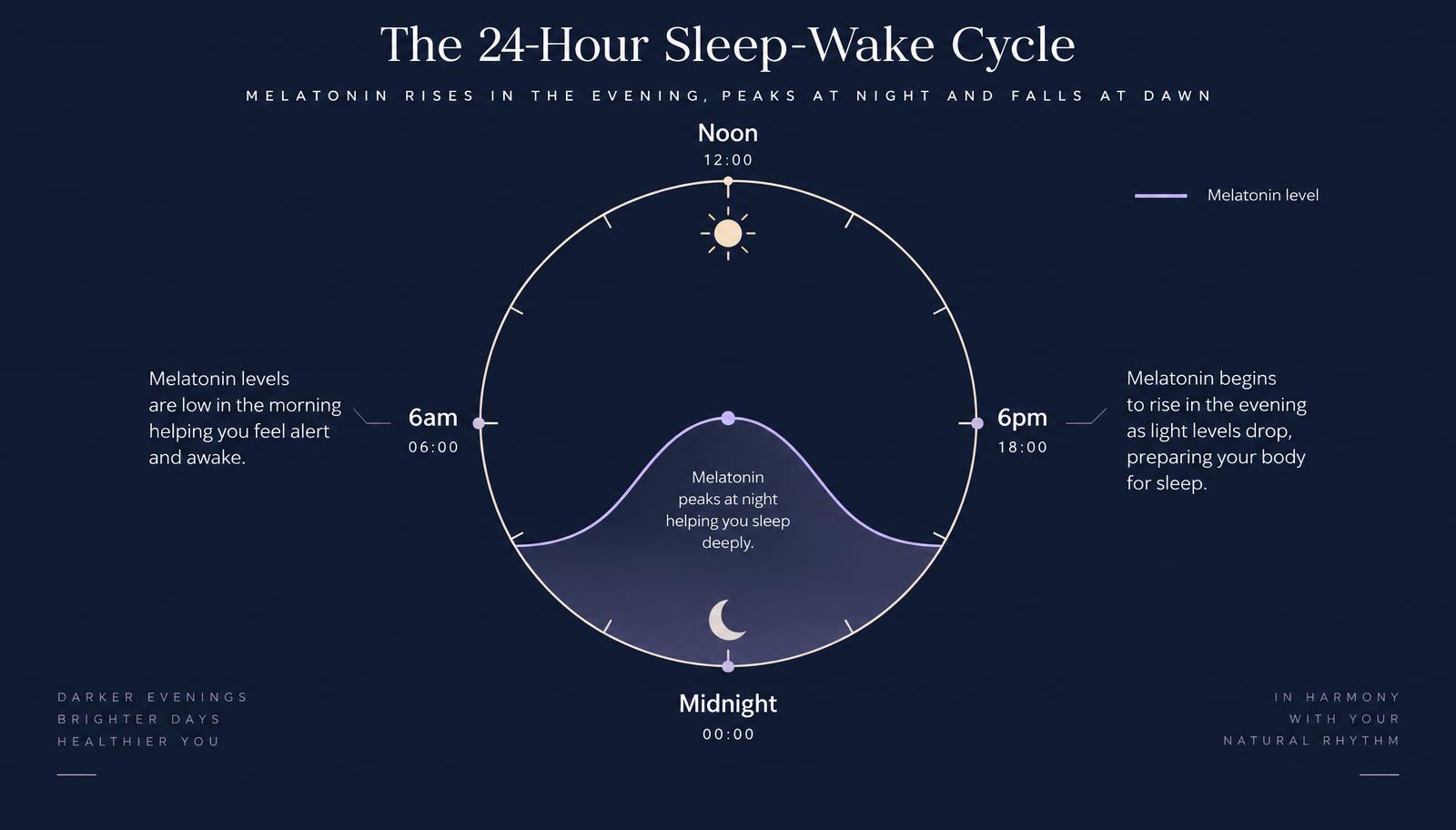
A circadian rhythm is the roughly 24-hour internal cycle that governs when the body expects to be awake or asleep, alert or drowsy. Melatonin is one of the key signals used to keep this rhythm aligned with day and night, and the rhythm itself can gradually shift earlier or later depending on light exposure and routine.
6 min readRead the guide →
Melatonin Basics
When does the body produce melatonin?
For most people, melatonin begins rising in the evening as light fades, stays elevated through much of the night, and falls again before or around waking. Researchers sometimes measure the exact starting point of this rise, known as dim-light melatonin onset, to understand an individual's body clock timing. The precise timing varies from person to person and is influenced by chronotype, age, and light exposure.
6 min readRead the guide →
Melatonin Basics
Melatonin versus sleepiness: what is the difference?
Melatonin and sleepiness are related but distinct: melatonin is a timing signal from the body clock indicating that night has arrived, while sleepiness largely reflects sleep pressure, a build-up driven by how long you have been awake. In a well-aligned body clock these two usually rise together in the evening, but they can fall out of step, which is why you can feel exhausted yet strangely alert, or vice versa.
6 min readRead the guide →
The Body Clock
Why does light affect melatonin?
Light is the single strongest signal your body uses to time melatonin release. Specialised cells in the eye detect brightness, quite separately from normal vision, and pass that information to the brain's master clock, which controls the pineal gland. Brightness, timing and duration of light exposure all matter, not just its colour.
6 min readRead the guide →
The Body Clock
Morning light and your body clock
Morning daylight is one of the strongest signals for anchoring your body clock, helping set the timing for alertness during the day and melatonin release later that night. It is especially useful because it comes early in the light-sensitive window the body clock relies on. UK winters make this harder, but there are realistic ways to get more usable light.
6 min readRead the guide →

The Body Clock
Evening light, screens, and sleep
Evening light can delay the rise of melatonin and shift the body clock later, particularly when it is bright and prolonged. The evidence for screens specifically is more mixed than commonly assumed, and factors like stimulating content and general arousal often play as large a role as the light itself. Both light and what you are doing on the screen are worth considering.
6 min readRead the guide →
The Body Clock
What happens when your sleep schedule shifts?
When sleep and wake times change from day to day, such as with weekend lie-ins or late shifts, the body clock and its light cues fall out of step with the actual clock time. This mismatch, sometimes called social jet lag, can leave you feeling tired and out of sorts even without crossing time zones. Because the body clock adjusts gradually, resetting it typically takes several days of consistent cues rather than happening overnight.
6 min readRead the guide →
Better Sleep
How to build a more consistent sleep schedule
A more consistent sleep schedule is usually best built gradually, anchored around a fixed wake time rather than a fixed bedtime, supported by consistent light exposure. Small, sustainable adjustments over days or weeks tend to work better than sudden changes. The goal is a rhythm the body clock can rely on, not a single perfect night.
6 min readRead the guide →
The Body Clock
Melatonin and jet lag: understanding the connection
Jet lag happens because your internal body clock stays set to your home time zone while the outside world has moved on. Melatonin is one of the signals your brain uses to keep that clock synchronised, which is why researchers have studied it in relation to jet lag. The evidence is mixed and depends heavily on timing, so it's worth understanding the underlying biology rather than treating melatonin as a simple fix.
6 min readRead the guide →
The Body Clock
Why jet lag feels different when travelling east or west
Flying east asks your body clock to move forward in time, known as a phase advance, while flying west asks it to move backward, a phase delay. Most people's internal clocks find it easier to delay than to advance, which is why eastward travel is usually reported as harder to adjust to.
6 min readRead the guide →
The Body Clock
How to adjust to a new time zone
Adjusting to a new time zone is easier when you work with your body clock using light exposure, meal timing and consistent sleep habits, rather than against it. The right approach also depends on whether you're staying for a few days or several weeks.
6 min readRead the guide →

The Body Clock
Sleep and shift work: understanding the body-clock challenge
Shift work, especially night and rotating shifts, asks the body to be alert and asleep at times that conflict with its natural light-driven rhythm. This creates ongoing challenges for both sleep quality and daytime functioning, and while some habits around light and routine can help, persistent problems are worth discussing individually with a health professional.
7 min readRead the guide →
Sleep Questions
Why do I struggle to fall asleep?
Difficulty falling asleep usually comes from a mismatch between several systems: how much sleep pressure has built up, how alert or wound-up your mind and body are, and whether your body clock is timed for sleep at that hour. Caffeine, alcohol, and worry about sleep itself can all make things worse. Working out which factor fits you best is more useful than assuming a single cause.
7 min readRead the guide →
Sleep Questions
Why do I wake up during the night?
Waking briefly during the night is a normal part of how sleep is structured and most people do not remember it happening. Problems tend to arise when those wakings become long, frequent, or hard to settle back from, which can be influenced by alcohol, needing the toilet, or a body clock nudging you towards early waking. Understanding which pattern fits your situation helps point towards what might help.
6 min readRead the guide →
Sleep Questions
Insomnia or a shifted body clock?
Insomnia and a shifted body clock can both cause difficulty sleeping, but they are different problems with different explanations. Insomnia involves trouble sleeping even when the opportunity and timing are right, while a shifted body clock means the timing itself is out of step with the schedule you are trying to keep. Telling them apart matters because the approaches that help each one are not the same.
6 min readRead the guide →
Sleep Questions
What affects sleep quality?
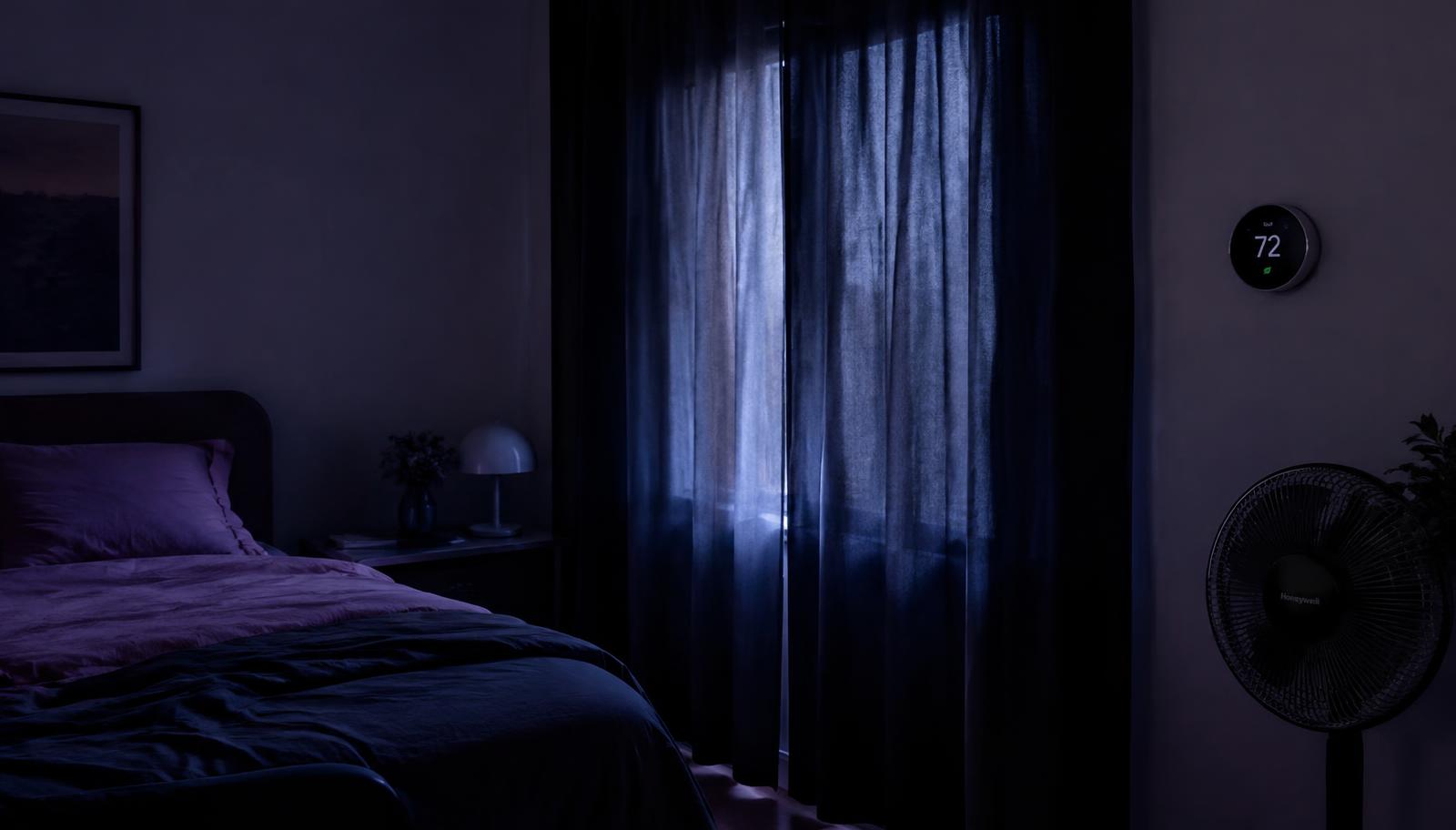
Sleep quality is not just about how many hours you get; it depends on how continuous that sleep is, whether it is timed well against your body clock, the conditions you sleep in, your general health, stress levels, and substances like caffeine and alcohol. Because several factors usually contribute, improving sleep quality often means looking across all of them rather than fixing one thing alone.
6 min readRead the guide →

Sleep Questions
What to do when sleep problems continue
When sleep problems persist for weeks despite reasonable habits, the next steps usually involve keeping a sleep diary and speaking to a GP or pharmacist. UK guidance recommends cognitive behavioural therapy for insomnia, known as CBTi, as a first-line approach for ongoing insomnia, ahead of medicines. Knowing what a GP appointment involves can make that step feel less daunting.
6 min readRead the guide →
Research & Safety
What has research studied about melatonin and sleep?
Melatonin has been researched most extensively for jet lag, shift work adjustment, delayed sleep timing, and helping some people fall asleep faster. The evidence is stronger and more consistent in some of these areas than others, and important questions remain about long-term use, ideal timing, and how much individual response varies. Understanding the strength and limits of this research helps set realistic expectations.
6 min readRead the guide →
Research & Safety
Melatonin side effects: what is commonly reported
Commonly reported effects associated with melatonin include next-day grogginess, headache, dizziness, and mild nausea, though not everyone experiences these and reports vary between individuals and studies. Differences in dose, timing, formulation, and personal sensitivity all help explain why. Anyone considering melatonin, or experiencing unwanted effects, should speak to a GP or pharmacist for advice specific to their situation.
6 min readRead the guide →
Research & Safety
Melatonin and other medicines: what to check
Melatonin can interact with a range of other medicines, so any decision about taking it should involve a pharmacist or GP who can see your full medical picture. Certain categories of medicine are particularly worth mentioning, and the safest approach is to prepare a complete, honest list before you ask.
6 min readRead the guide →
Research & Safety
Melatonin in pregnancy and breastfeeding
Research into melatonin use during pregnancy and breastfeeding is limited, which means this question cannot be answered generally or safely from an article. It is a decision that should always be made with a GP, midwife, or specialist who knows your individual circumstances.
6 min readRead the guide →

Research & Safety
Melatonin and sleep in older adults
Sleep patterns and the body's internal clock naturally shift with age, often leading to earlier bedtimes, lighter sleep, and more frequent waking. Research has looked at melatonin in this context, but daylight exposure and a consistent routine remain central, well-supported parts of the picture, and any decision about supplements should involve a GP or pharmacist.
6 min readRead the guide →

Research & Safety
Melatonin and children's sleep
Whether melatonin is appropriate for a child is always a decision for a GP or paediatric specialist, never something to decide independently as a parent. There is a great deal parents can do around bedtime routine and light exposure in the meantime, and persistent difficulty is a good reason to seek professional advice.
6 min readRead the guide →
Research & Safety
Melatonin myths and misconceptions
Melatonin is widely misunderstood, from the idea that it is a sedative, to the belief that more is always better, that natural means risk-free, or that it single-handedly cures jet lag. Understanding what melatonin actually does helps separate reasonable expectations from popular myths.
6 min readRead the guide →
Research & Safety
Questions to ask a pharmacist about melatonin
A pharmacist is a good first port of call for questions about melatonin, particularly around interactions and general suitability, but they will sometimes need to refer you to a GP. Preparing your medical history and a clear list of questions makes the conversation far more useful.
5 min readRead the guide →

Better Sleep
Caffeine and sleep: why timing matters
Caffeine blocks a chemical called adenosine that builds up sleep pressure through the day, and it can remain active in the body for many hours after it is drunk. Cutting off caffeine in the early-to-mid afternoon is a sensible default for most people, though individual sensitivity varies considerably and hidden sources are easy to miss.
6 min readRead the guide →

Better Sleep
Alcohol and sleep quality
Alcohol can make falling asleep feel easier because it is sedating, but sedation is not the same as normal, restorative sleep. As the body processes alcohol overnight, sleep tends to become lighter and more fragmented in the second half of the night, which is why a nightcap often leads to earlier or more frequent waking.
6 min readRead the guide →
Better Sleep
Bedroom light, noise and temperature
A bedroom that is dark, quiet and on the cooler side tends to support better sleep, with temperature and light generally having the clearer effects and noise being more individually variable. None of these factors need to be perfect, but persistent problems with any of them, such as light UK summer mornings, are worth addressing rather than tolerating indefinitely.
6 min readRead the guide →
Better Sleep
An evening routine you can actually maintain
A useful evening routine mainly does one job: lowering physical and mental arousal in a predictable way before bed, so the transition to sleep is not abrupt. The most sustainable routines are short, flexible and built around a couple of anchor habits, rather than a long list of steps that quietly gets abandoned within a fortnight.
6 min readRead the guide →
Better Sleep
Daytime habits that influence sleep
Sleep quality is shaped by the whole day, not just the run-up to bedtime, and daylight exposure and regular movement have some of the clearer effects on the body clock and sleep pressure. Naps and meal timing matter mainly in how and when they are used, and unresolved daytime worry is a common, underrated cause of poor sleep at night.
6 min readRead the guide →
Better Sleep
What is sleep hygiene, and what does it actually do?
Sleep hygiene is the umbrella term for the habits, routines and bedroom conditions that make good sleep more likely, such as a consistent schedule, a dark quiet room, and sensible caffeine and alcohol use. It helps most people some of the time, but it is not a treatment for persistent insomnia on its own, where the evidence points more strongly towards addressing racing thoughts, conditioned wakefulness and irregular schedules directly.
6 min readRead the guide →
Melatonin Basics
Forms of melatonin: tablets, capsules, gummies, drops and more
Melatonin is made in several forms: standard tablets and capsules, prolonged-release (time-release) tablets, sublingual tablets or sprays that dissolve under the tongue, liquid drops or oral solutions, and chewable gummies. The main practical differences are how quickly melatonin is released, how long it stays active, how easily the amount can be measured, and what else the product contains. There is limited research comparing everyday forms head to head, so a pharmacist is the best person to help match a form to your situation.
7 min readRead the guide →
Melatonin Basics
How long does melatonin take to work?
Standard immediate-release melatonin is usually absorbed quickly, with blood levels typically peaking within about an hour, and it is cleared fairly fast. Prolonged-release forms release melatonin gradually over several hours. But "working" depends on more than absorption: melatonin mainly shifts timing, so whether it has an effect also depends on where your body clock is and what is keeping you awake.
6 min readRead the guide →
Research & Safety
Is melatonin safe?
In short-term studies of adults, melatonin has generally been well tolerated, with mostly mild and temporary side effects such as drowsiness, headache or dizziness. The evidence on long-term use is much thinner, product quality varies, and some groups, including children, people who are pregnant or breastfeeding and people taking other medicines, need individual advice. "Safe" therefore depends on the person, the product and how it is used.
6 min readRead the guide →
Research & Safety
How much melatonin have studies used?
Research has used a wide range of melatonin amounts, most often somewhere between 0.5 mg and 5 mg in studies of jet lag and sleep timing, with some studies using more. Reviews have not found that higher amounts reliably work better, and higher amounts are more likely to leave melatonin active into the morning. This page describes research; it is not a recommendation, and what suits an individual is a question for a GP or pharmacist.
6 min readRead the guide →
Research & Safety
Melatonin and next-day grogginess
Next-day drowsiness is one of the side effects most often reported with melatonin. It is usually mild and temporary, and it seems to relate to timing, the amount taken, the release type and individual differences in how quickly the body clears melatonin. Anyone who feels drowsy should avoid driving or operating machinery until it passes and talk to a pharmacist about why it might be happening.
6 min readRead the guide →
Research & Safety
Melatonin and vivid dreams
Vivid or unusual dreams and nightmares are reported by some people who use melatonin, and abnormal dreams appear in UK medicine information as a possible side effect. The evidence is mainly from individual reports rather than large studies designed to measure dreaming, so how often it happens and why is not well understood. One plausible factor is melatonin's relationship with REM sleep, the stage in which most vivid dreaming occurs.
5 min readRead the guide →
Sleep Questions
Does melatonin help you sleep?
Melatonin can help some people, but mainly by adjusting the timing of sleep rather than forcing it. Research shows the clearest benefits in situations where the body clock is out of step, such as jet lag and delayed sleep timing, and some benefit for certain older adults. For general insomnia in adults, average effects are modest, and UK guidance puts other approaches first.
7 min readRead the guide →
Melatonin Basics
Melatonin gummies: what to know
Melatonin gummies are chewable sweets containing melatonin, popular because they are easy to take. Their main drawbacks are that independent testing has found the amount of melatonin in some gummies differs considerably from the label, they often contain sugar and other ingredients, and their sweet-like appearance makes accidental swallowing by children a real concern.
6 min readRead the guide →
Research & Safety
Melatonin, headaches and dizziness
Yes. Headache and dizziness are both listed by the NHS among melatonin's common side effects, and both appear regularly in research reports. They are usually mild and pass once melatonin is stopped. The reasons are not fully understood, and poor sleep, dehydration, caffeine and other medicines can cause the same symptoms, so a pharmacist or GP can help work out what is going on.
5 min readRead the guide →
Melatonin Basics
Melatonin tablets: standard, prolonged-release and sublingual
Melatonin tablets come in three broad types. Standard immediate-release tablets release melatonin quickly. Prolonged-release tablets release it gradually over several hours. Sublingual tablets dissolve under the tongue. The type changes how long melatonin stays active, and prolonged-release tablets in particular should not be split, crushed or chewed unless a pharmacist says it is suitable.
5 min readRead the guide →
Research & Safety
Melatonin versus sleeping pills
Melatonin mainly acts as a timing signal, telling the body clock that it is night. Sleeping pills, known medically as hypnotics, generally act on brain chemistry to promote sedation. As a result they differ in how strongly they cause sleepiness, how they feel the next day, and the risk of tolerance and dependence, which is a recognised concern with many sleeping pills and has not been a prominent finding with melatonin.
6 min readRead the guide →