
Melatonin Basics
Melatonin versus sleepiness: what is the difference?
Melatonin and sleepiness are related but distinct: melatonin is a timing signal from the body clock indicating that night has arrived, while sleepiness largely reflects sleep pressure, a build-up driven by how long you have been awake. In a well-aligned body clock these two usually rise together in the evening, but they can fall out of step, which is why you can feel exhausted yet strangely alert, or vice versa.
6 min read · Published 24 September 2026

In short
- Melatonin is a timing signal from the body clock, not a direct measure of tiredness.
- Sleepiness is largely driven by sleep pressure, which builds the longer you are awake.
- These two systems usually align in the evening but can become mismatched.
- Bright light or stress can keep you feeling alert even with high sleep pressure.
- Understanding the difference helps explain sleep problems that feel confusing or contradictory.
It is a common and confusing experience: feeling utterly exhausted after a long day, yet lying in bed wide awake with your mind racing. Understanding the difference between melatonin and sleepiness helps explain why this happens, and why the two do not always move together.
Melatonin is a timing signal, not a tiredness meter
As explained in What is melatonin?, melatonin is a hormone released mainly by the pineal gland in response to darkness. Its job is to communicate timing information, essentially telling the body that night has arrived and it is an appropriate time to be preparing for sleep. It does this by working with the brain's master clock, described in Why does light affect melatonin?
Crucially, melatonin does not directly cause the physical sensation of tiredness in the way that being awake for many hours does. It supports the conditions for sleep rather than forcing drowsiness the way a sedative might, which is why taking melatonin, where appropriate and discussed with a GP or pharmacist, does not feel like flicking an off switch.
Sleepiness largely reflects sleep pressure
The sensation most people call sleepiness or tiredness comes largely from a separate process often referred to as sleep pressure, or the homeostatic sleep drive. This builds up steadily the longer you have been awake, in a similar way to hunger building the longer you have gone without eating, and it is relieved by sleep itself.
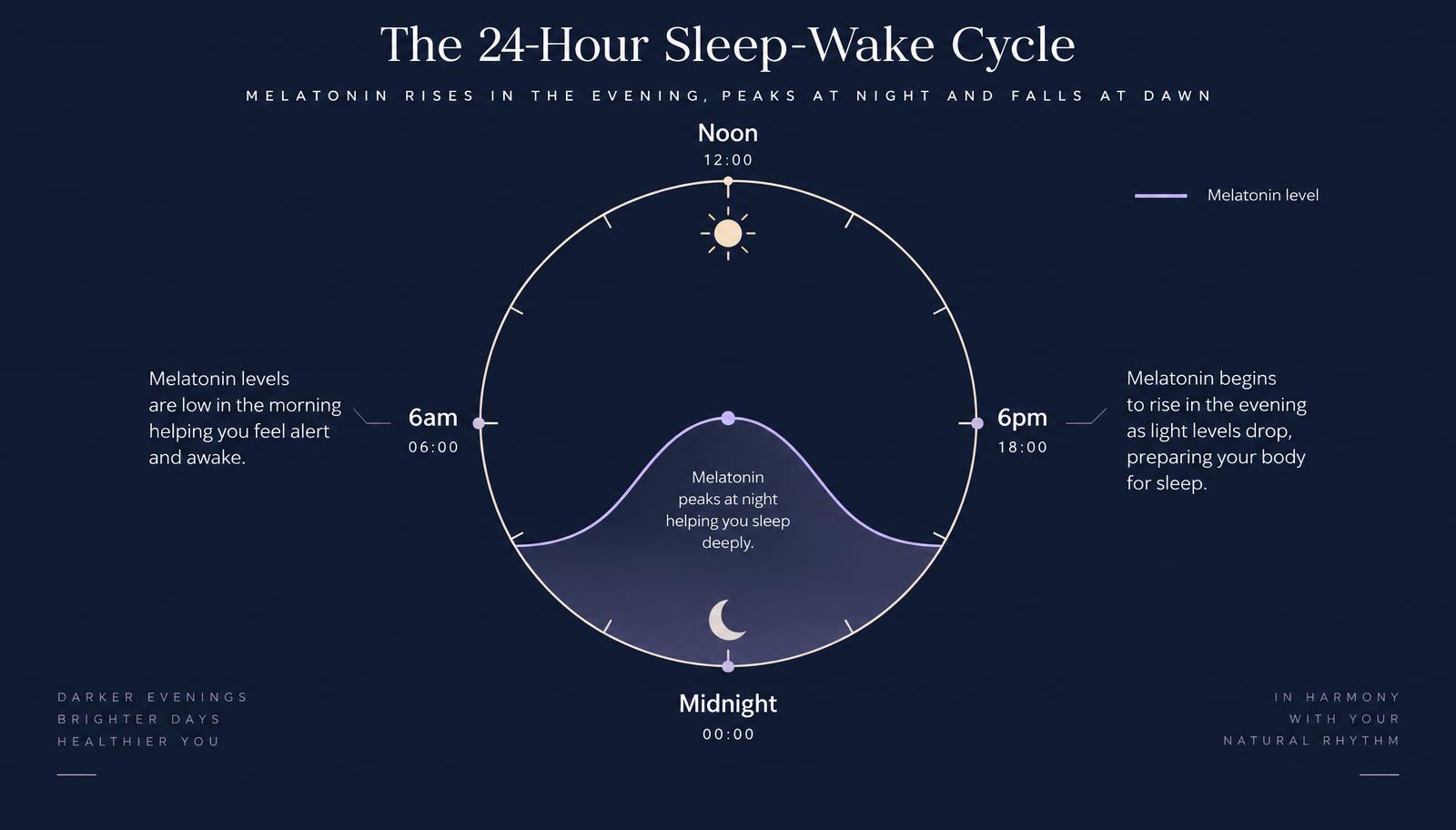
Sleep pressure and the body clock's melatonin-driven timing signal are sometimes described as two separate systems that normally work together. Sleep pressure says "I have been awake a long time and need rest", while the body clock says "it is now night-time, conditions are appropriate for sleep". When both align, falling asleep tends to feel natural and comes fairly easily.
A closer look at how the two systems interact
It can help to think of sleep pressure and the body clock's timing signal as two independent dials that happen to be set up, in most people, to point towards sleep at roughly the same time each evening. Sleep pressure rises in a fairly straightforward way from the moment you wake, climbing steadily through the day and only easing once you sleep. The body clock's signal, expressed largely through melatonin, follows its own roughly twenty-four-hour pattern regardless of how much sleep pressure has built up.
This is why an afternoon nap, for instance, can reduce sleep pressure without changing the timing of the evening melatonin rise at all. Someone who naps for a couple of hours in the afternoon may then find falling asleep at their usual bedtime harder, not because their body clock has changed, but because sleep pressure has been partly relieved ahead of schedule.
When the two signals fall out of step
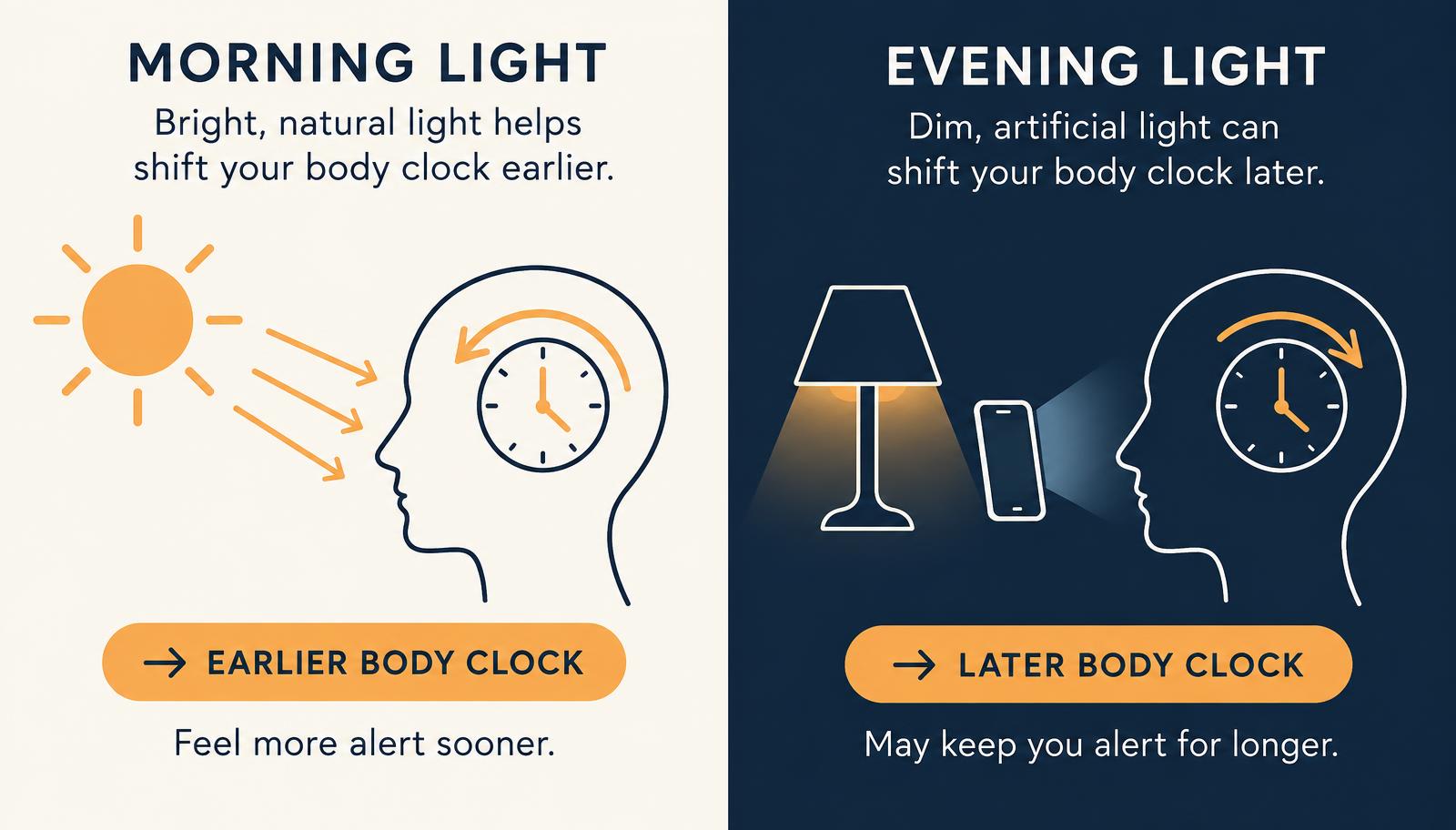
Several everyday situations can pull sleepiness and melatonin timing apart. Bright evening light, discussed in Evening light, screens, and sleep, can delay the rise of melatonin even while sleep pressure continues building normally, leaving you tired but not yet receiving the body clock's night-time signal. Stress or an overstimulated mind can have a similar effect, keeping you feeling alert despite high sleep pressure.
- High sleep pressure with delayed melatonin can produce a tired but wired feeling.
- Jet lag and shift work can separate the two signals substantially, described in What happens when your sleep schedule shifts?
- Napping too close to bedtime can temporarily reduce sleep pressure, making sleep harder despite normal melatonin timing.
- A consistent routine tends to keep both systems working in step over time.
A practical example: the tired but wired evening
Picture someone who has been awake since six in the morning, worked a full day, and spent the evening scrolling on a bright phone screen in a dimly lit room. By ten at night, their sleep pressure is high after sixteen hours awake, yet the bright screen light close to their eyes has been actively working against the evening rise in melatonin. The result is the classic tired but wired feeling: a body that clearly needs rest, paired with a body clock signal that has not yet caught up.
In this scenario, simply trying harder to fall asleep, or going to bed even earlier, does not address the mismatch. Reducing bright light exposure in the hour or so before bed gives the body clock signal a better chance to align with the sleep pressure that has already built up, which is generally a more effective approach than fighting wakefulness directly.
Why this distinction matters practically
Recognising that melatonin and sleepiness are different systems helps explain why simply feeling tired does not guarantee an easy night's sleep, and why aligning both, through consistent light exposure and routine, tends to produce more reliable results than focusing on tiredness alone. This is part of the reasoning behind the gradual, routine-based approach described in How to build a more consistent sleep schedule.
How caffeine fits into this picture
Caffeine adds a further layer to this picture because it works on sleep pressure rather than on melatonin timing. It temporarily blocks some of the signals sleep pressure uses to make you feel drowsy, which is why a coffee in the afternoon can mask rising sleep pressure without doing anything to the evening rise of melatonin. This is one reason caffeine late in the day can leave someone feeling artificially alert even as their body clock signal moves towards night-time, a topic explored further in Caffeine and sleep timing.
A useful framework: the two-process model
Sleep researchers often describe this relationship using what is sometimes called a two-process model: one process is the steadily building sleep pressure already discussed, and the other is the circadian process, largely reflected by melatonin timing, which follows its own roughly 24-hour pattern regardless of recent sleep. Neither process on its own fully explains when someone falls asleep; it is the interaction between the two that matters.
This framework helps explain some otherwise puzzling experiences, such as why an afternoon slump can occur even after a full night's sleep, when sleep pressure should theoretically be low. The circadian process includes a natural dip in alertness in the mid-afternoon for many people, independent of how much sleep debt they are carrying, which briefly aligns with reduced alertness before recovering later in the day.
A worked example: arriving somewhere five hours ahead
Picture someone flying from the UK to a destination five hours ahead. On the first evening, local time might say eleven at night, but their body clock, still running on UK time, is only producing melatonin at a level it would normally reach around six in the evening. Meanwhile, their sleep pressure is genuinely high after a long day of travel. The result is a strange combination: exhausted enough to want to sleep, yet without the accompanying body clock signal that would normally make sleep come easily at that local hour.
Over the following days, as the traveller is exposed to the new local light-dark pattern, their melatonin timing gradually catches up with sleep pressure again, which is part of why jet lag typically eases over several days rather than resolving after one night, a topic covered fully in Melatonin and jet lag.
How alcohol muddles the picture further
Alcohol can make someone feel drowsy quickly, which some people mistake for a sign that their body clock and sleep pressure are well aligned. In reality, alcohol acts as a sedative in the short term but tends to disrupt sleep quality later in the night, and does not genuinely align melatonin timing with sleep pressure the way a consistent routine does. This distinction is explored further in Alcohol and sleep quality.
It is worth remembering this pattern when reaching for a nightcap out of habit rather than genuine relaxation, since the short-term drowsiness it produces can mask, rather than resolve, an underlying mismatch between sleep pressure and the body clock's own timing signal.
Common questions
If I feel exhausted, does that mean my melatonin is high?
Not necessarily. Exhaustion mainly reflects sleep pressure built up from time awake, which is a separate process from melatonin's evening rise. The two often align but are not the same signal.
Why can I feel wide awake late at night despite being tired all day?
This can happen when factors such as bright evening light or mental stimulation delay the body clock's melatonin signal, leaving high sleep pressure without the accompanying night-time cue that normally supports falling asleep easily.
Does taking melatonin remove sleep pressure?
No, melatonin works on timing signals rather than the sleep pressure system, so it does not substitute for the restorative build-up that comes from time spent awake and asleep.
Sources
Written by The Melatonin UK editorial team.
Published 24 September 2026. This article is general information about sleep and the body clock. It is not medical advice, and it does not replace a conversation with your GP or pharmacist.
Read next
Melatonin Basics
What is melatonin?
Melatonin is a hormone produced mainly by the pineal gland in the brain, released in response to darkness. It signals to the rest of the body that it is night-time, helping to time sleep rather than force it. It is not a sedative, and it does not knock you out the way a sleeping tablet might.
7 min readRead the guide →
Melatonin Basics
When does the body produce melatonin?
For most people, melatonin begins rising in the evening as light fades, stays elevated through much of the night, and falls again before or around waking. Researchers sometimes measure the exact starting point of this rise, known as dim-light melatonin onset, to understand an individual's body clock timing. The precise timing varies from person to person and is influenced by chronotype, age, and light exposure.
6 min readRead the guide →
The Body Clock
Why does light affect melatonin?
Light is the single strongest signal your body uses to time melatonin release. Specialised cells in the eye detect brightness, quite separately from normal vision, and pass that information to the brain's master clock, which controls the pineal gland. Brightness, timing and duration of light exposure all matter, not just its colour.
6 min readRead the guide →