
Melatonin Basics
What is melatonin?
Melatonin is a hormone produced mainly by the pineal gland in the brain, released in response to darkness. It signals to the rest of the body that it is night-time, helping to time sleep rather than force it. It is not a sedative, and it does not knock you out the way a sleeping tablet might.
7 min read · Published 24 September 2026
In short
- Melatonin is a naturally occurring hormone, not a medicine you need to survive on daily.
- It is produced by the pineal gland, a small structure deep in the brain.
- Its release is controlled by light and darkness, rising in the evening and falling in the morning.
- Melatonin signals the timing of sleep; it does not force sleep to happen the way a sedative might.
- Levels and timing vary between individuals and change across the lifespan.
Melatonin is a hormone, meaning a chemical messenger that the body produces and releases into the bloodstream to influence how other parts of the body behave. Most of it is made by the pineal gland, a pea-sized structure tucked deep in the middle of the brain. When darkness falls, the pineal gland increases its output of melatonin, and levels then fall away again as morning light arrives.
This rise and fall is not random. It is one of the clearest signals the body uses to keep track of what time of day it is. Because of this, melatonin is often described as the "hormone of darkness" rather than the "sleep hormone", even though that second label has stuck in everyday language.
Where melatonin comes from
The pineal gland sits near the centre of the brain and receives information, indirectly, from the eyes. Specialised cells in the retina detect the general level of light in the environment, quite separately from the cells used for seeing shapes and colours. That light information travels along a pathway to a small area of the brain called the suprachiasmatic nucleus, which acts as the body's master clock, and from there on to the pineal gland.
When this pathway detects darkness, it effectively releases the brake on the pineal gland, allowing melatonin production to rise. When it detects bright light, particularly the blue-toned light common in daylight, it suppresses melatonin production. This is explained in more depth in our guide How does melatonin work?, which walks through the light-to-hormone pathway step by step.
How the body actually makes melatonin
Melatonin is built from a chain of chemical steps that starts with an amino acid called tryptophan, obtained from food. Tryptophan is first converted into serotonin, a chemical messenger with its own wide-ranging roles in mood and body regulation, before a further set of enzyme-driven steps convert serotonin into melatonin itself. This conversion largely happens in the pineal gland, and it is switched on and off by the light signals arriving from the suprachiasmatic nucleus.
This shared chemical pathway is part of why sleep, mood and general daily rhythm are so closely intertwined in everyday experience, even though melatonin and serotonin have distinct roles once produced. It also explains why factors that affect overall wellbeing during the day, such as diet and activity, sit upstream of the melatonin story, even if their influence on melatonin itself is indirect and modest rather than dramatic.
What melatonin actually signals
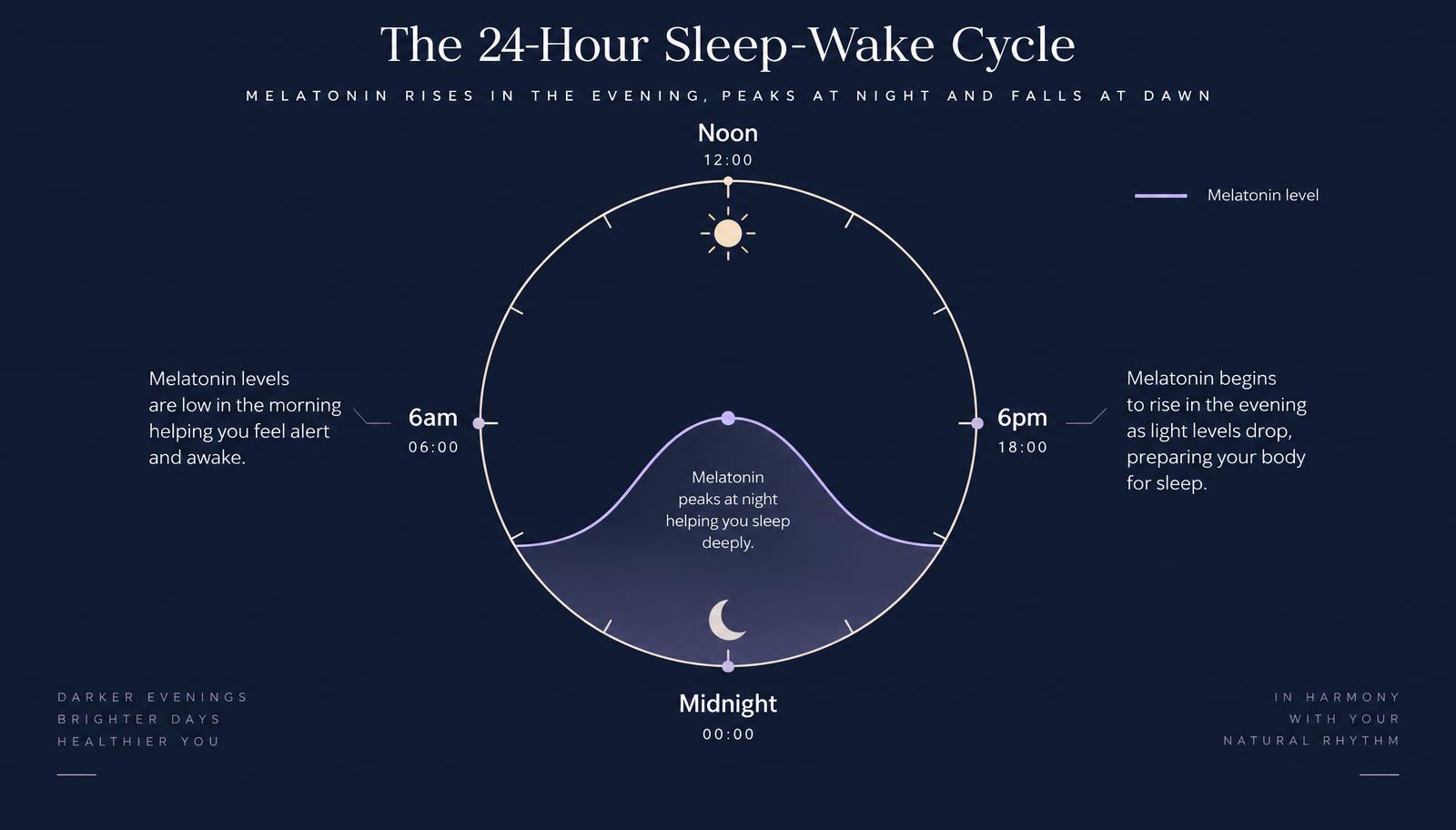
Melatonin's main job is to communicate timing information around the body. Rising melatonin in the evening tells your internal systems that night has begun, which supports the conditions the body needs to wind down and prepare for sleep. This is part of a wider timing system known as the circadian rhythm, covered in detail in Melatonin and the circadian rhythm.
- Melatonin rises in the evening as light levels fall.
- It stays elevated for much of the night in most people.
- It falls in the early morning as light increases.
- Its pattern shifts gradually with age, season, and daily light exposure.
What melatonin is not
A common misunderstanding is that melatonin is a sedative, something that switches the brain off in the way alcohol or a sleeping tablet might. It is not. Melatonin signals that conditions are right for sleep; it does not force the brain into unconsciousness. This is why someone can have plenty of melatonin circulating and still lie awake, particularly if other factors such as stress, noise, or an overstimulated mind are getting in the way.
Melatonin is also easily confused with the broader idea of sleepiness. Sleepiness builds up the longer you have been awake, through a separate mechanism often called sleep pressure. Melatonin and sleepiness usually rise and fall together in a well-aligned body clock, but they are genuinely different signals, as explored further in Melatonin versus sleepiness: what is the difference?
Melatonin's role beyond sleep timing
Because receptors that respond to melatonin exist in tissues well beyond the brain, researchers have studied whether it plays supporting roles elsewhere in the body, including in aspects of the digestive system and the body's antioxidant processes. These areas of research are still developing, and the evidence is far less settled than melatonin's well-established role in timing sleep. It is important not to overstate these wider roles or treat melatonin as a general-purpose remedy, since its best-supported function remains signalling day and night to the body clock.
Why the timing varies between people
Not everyone's melatonin rises at the same clock time. Some people are naturally inclined to feel sleepy and alert earlier in the day, while others lean later; these tendencies are sometimes called chronotypes. Age also plays a role, as the timing and amount of melatonin produced changes gradually from childhood through to older adulthood. Our guide When does the body produce melatonin? looks at this daily pattern and the concept of dim-light melatonin onset in more detail.
Seasonal changes in day length can also have a modest effect on melatonin timing for some people, since the underlying system is built to respond to natural light patterns. This is one reason some people notice their sleep and energy feel slightly different between the darker winter months and the lighter summer months, even without any change in daily routine.
Melatonin, diet and daily habits
Because melatonin is built from tryptophan, some people wonder whether particular foods can meaningfully boost their own melatonin production. In practice, a generally balanced diet supports the normal chemical steps involved, but there is no well-supported evidence that specific foods reliably raise melatonin enough to change sleep in a noticeable way. Consistent light exposure and routine remain far more influential than diet alone for most people.
It is also worth remembering that supplement products containing melatonin are a separate matter from the hormone your own body produces naturally, and questions about whether such a product might be appropriate for a particular person are best directed to a GP or pharmacist rather than answered by general reading alone.
Melatonin across the animal kingdom
Melatonin is not unique to humans. It is found in a very wide range of animals, and even in plants, which suggests it is an ancient chemical signal that evolved long before complex nervous systems did. In animals, its most consistent role across species is still tied to the daily light-dark cycle, marking out night from day even in creatures with very different sleep patterns from our own.
This wide distribution across nature is one reason researchers see melatonin's role in timing as a fundamental biological signal rather than something specific to human sleep. It also explains why animal studies have contributed a good deal to the understanding of how melatonin works, even though translating findings directly to humans requires care.
A worked example of a typical evening
Consider someone who finishes work at half past five, eats dinner in a normally lit kitchen, and then spends the evening watching television with the living room lamps dimmed from around nine o'clock. As natural light fades outside and indoor lighting is deliberately kept lower, their pineal gland gradually increases melatonin output, supporting a feeling of winding down by the time they go to bed around eleven.
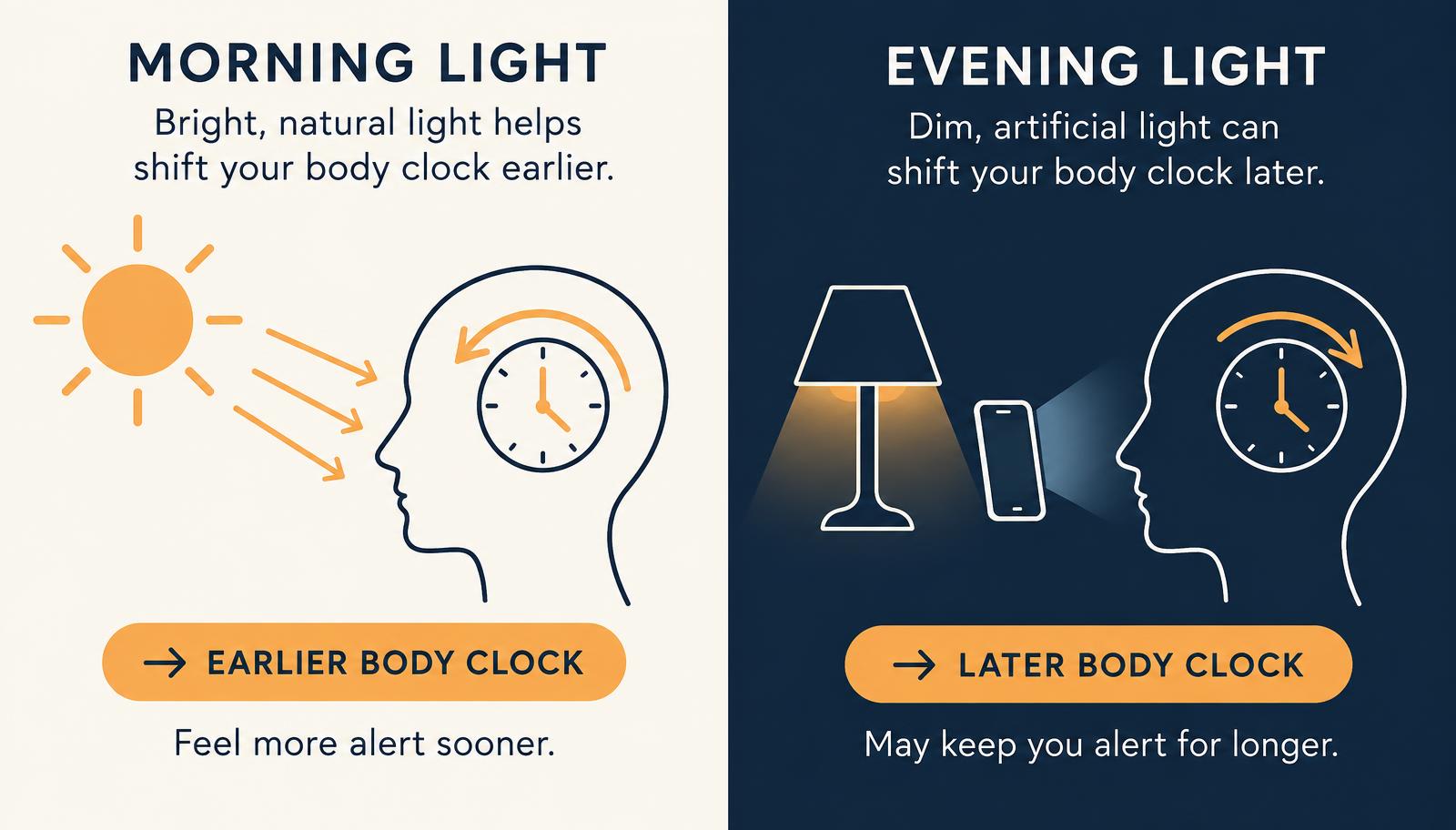
Now compare this with the same person on a night when they stay under bright kitchen and bathroom lighting until just before getting into bed. The later, brighter light exposure works against the natural evening rise, and they may find themselves feeling more alert than usual at eleven o'clock, even though nothing else about their day has changed. Small differences in evening lighting can produce noticeably different experiences of settling down for the night.
How researchers measure melatonin
Because melatonin circulates in the bloodstream and is also present in saliva, researchers can measure it directly using blood or saliva samples taken at set intervals, usually under carefully controlled dim lighting so that the measurement itself does not interfere with the natural pattern being studied. This method is used to establish concepts such as dim-light melatonin onset, discussed in When does the body produce melatonin?, which pinpoints when melatonin starts rising for a given individual.
These techniques are generally reserved for research and specialist sleep clinics rather than routine healthcare, since interpreting the results meaningfully requires controlled conditions that are difficult to replicate at home. For most people, understanding melatonin's role conceptually is more useful day to day than trying to measure their own levels.
Common questions
Does everyone produce melatonin naturally?
Yes, melatonin production is a normal part of human biology and does not depend on taking any product. Light exposure, ageing, and individual differences can all affect how much is produced and when, but the underlying process is present in almost everyone.
Is melatonin the same as a sleeping pill?
No. Melatonin is a naturally occurring hormone involved in timing, whereas sleeping pills generally work through different mechanisms to promote drowsiness. The two should not be thought of as interchangeable.
Can bright light in the evening affect melatonin?
Yes, bright light, especially from screens or overhead lighting, can suppress the evening rise in melatonin and potentially shift its timing later. Evening light, screens and sleep explains this in more detail.
Sources
Written by The Melatonin UK editorial team.
Published 24 September 2026. This article is general information about sleep and the body clock. It is not medical advice, and it does not replace a conversation with your GP or pharmacist.
Read next
Melatonin Basics
How does melatonin work?
Melatonin works as part of a chain reaction that starts with light-detecting cells in the eyes, passes through the brain's master clock, and ends with the pineal gland releasing melatonin into the bloodstream. Darkness allows melatonin to rise, which helps signal that night-time conditions have arrived, while bright light suppresses it.
6 min readRead the guide →
The Body Clock
Melatonin and the circadian rhythm
A circadian rhythm is the roughly 24-hour internal cycle that governs when the body expects to be awake or asleep, alert or drowsy. Melatonin is one of the key signals used to keep this rhythm aligned with day and night, and the rhythm itself can gradually shift earlier or later depending on light exposure and routine.
6 min readRead the guide →

Melatonin Basics
Melatonin versus sleepiness: what is the difference?
Melatonin and sleepiness are related but distinct: melatonin is a timing signal from the body clock indicating that night has arrived, while sleepiness largely reflects sleep pressure, a build-up driven by how long you have been awake. In a well-aligned body clock these two usually rise together in the evening, but they can fall out of step, which is why you can feel exhausted yet strangely alert, or vice versa.
6 min readRead the guide →