
Melatonin Basics
How does melatonin work?
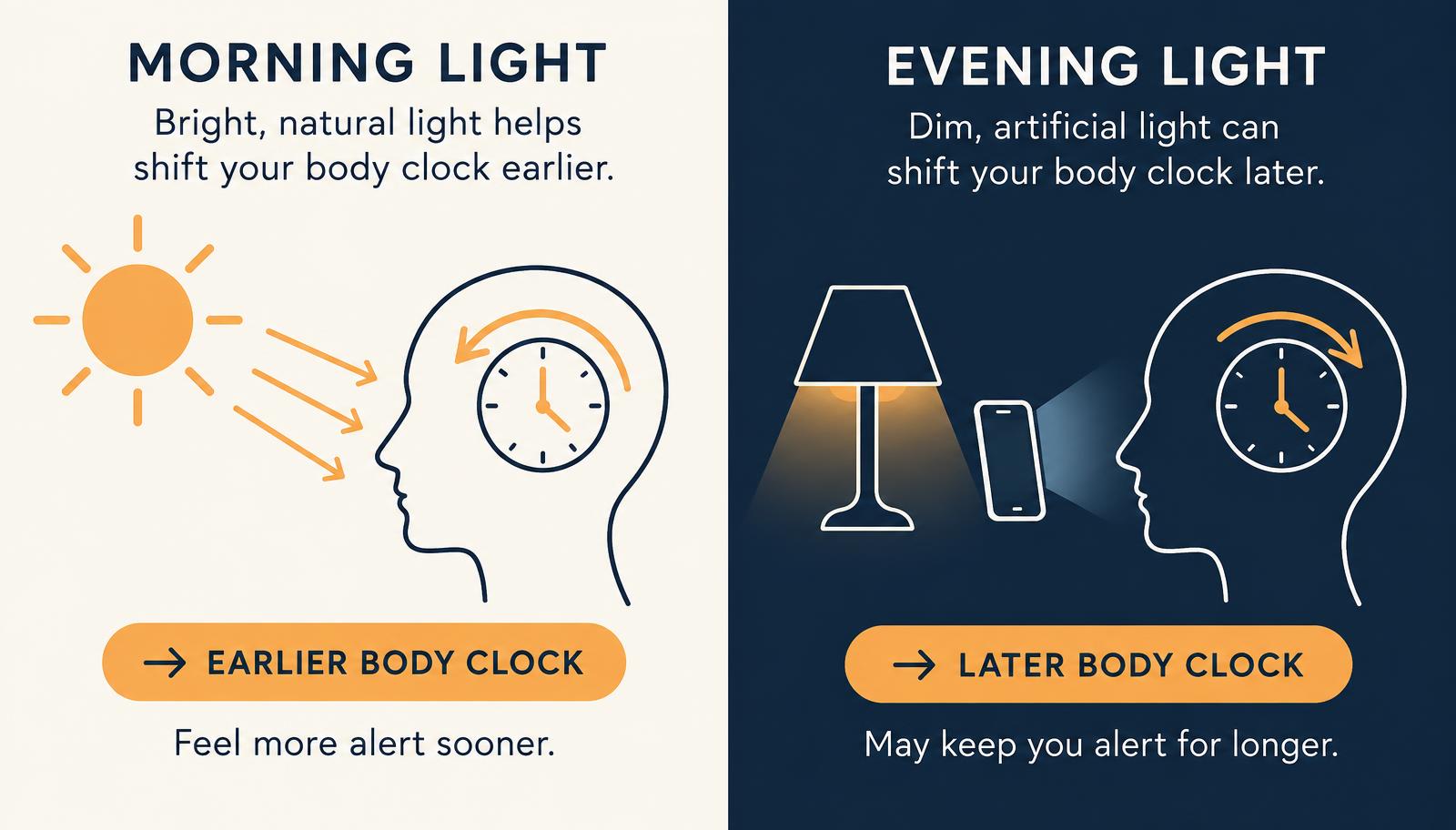
Melatonin works as part of a chain reaction that starts with light-detecting cells in the eyes, passes through the brain's master clock, and ends with the pineal gland releasing melatonin into the bloodstream. Darkness allows melatonin to rise, which helps signal that night-time conditions have arrived, while bright light suppresses it.
6 min read · Published 24 September 2026
In short
- Specialised cells in the eye detect overall light levels, separately from the cells used for seeing images.
- This light information reaches the suprachiasmatic nucleus, the brain's master body clock.
- The master clock controls the pineal gland, which releases melatonin into the bloodstream.
- Darkness allows melatonin to rise; bright light, especially blue-toned light, suppresses it.
- Melatonin then signals timing to other body systems rather than directly causing sleep.
Understanding how melatonin works means following a pathway that begins at the eyes and ends in the bloodstream. It is a useful way to see why light exposure, at almost any time of day, can have such a noticeable effect on how sleepy or alert you feel later on.
Step one: the eyes detect light
Most people think of the eyes purely in terms of vision, but they also contain a separate set of light-sensitive cells in the retina whose job is not to build images but to measure the general brightness of the environment. These cells respond particularly strongly to blue-toned light, the kind found in daylight and in many electronic screens.
This measurement of ambient light is sent, via a dedicated nerve pathway, to a small area of the brain rather than to the visual cortex where images are processed. That means this light-detection system keeps working even if someone's image-forming vision is impaired, which is one reason light exposure remains important for body clock health across the population.
Step two: the suprachiasmatic nucleus
The signal from the eyes arrives at the suprachiasmatic nucleus, a cluster of nerve cells often described as the body's master clock. It sits just above where the optic nerves cross and continuously compares incoming light information with its own internal rhythm, which naturally runs on a cycle close to, but not always exactly, twenty-four hours.
The suprachiasmatic nucleus uses this comparison to keep the body's many internal rhythms roughly aligned with the outside world. This alignment process is the essence of what is called the circadian rhythm, and it is explored more fully in Melatonin and the circadian rhythm.
Step three: the pineal gland responds
The suprachiasmatic nucleus sends signals onward, through a chain of nerve connections, to the pineal gland. During daylight hours, or under bright artificial light, these signals keep melatonin production switched off. Once darkness falls and light input drops away, the inhibitory signal eases and the pineal gland begins releasing melatonin into the bloodstream.
- Bright light during the day: melatonin production stays suppressed.
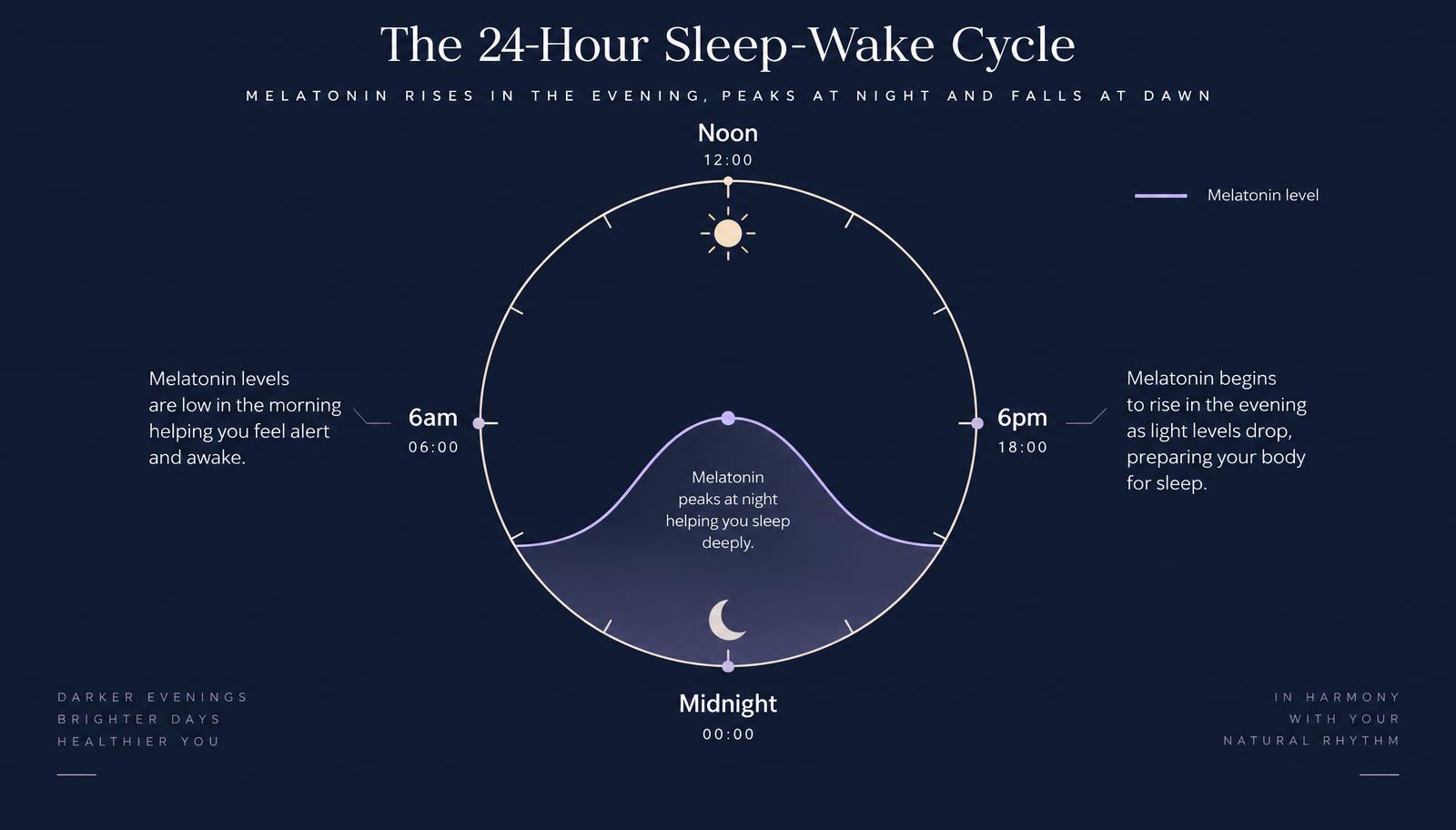
- Dim light in the evening: melatonin production begins to rise.
- Darkness overnight: melatonin typically remains elevated.
- Light exposure in the morning: melatonin production is switched off again.

Step four: melatonin signals the rest of the body
Once released, melatonin travels through the bloodstream and can influence tissues well beyond the brain, since many cells throughout the body carry receptors that respond to it. Its central role, though, is one of timing: it tells the body that biological night has arrived, supporting the internal conditions that make sleep more likely rather than producing sleep directly.
How quickly the pathway responds to change
This entire chain, from light detection to melatonin release, does not reset itself instantly whenever light conditions change. The suprachiasmatic nucleus behaves more like a slow-moving dial than a light switch, gradually shifting its output over repeated exposures rather than snapping into a new pattern after one evening. This is part of why a single late night rarely causes lasting disruption, while a sustained pattern of late nights, or a genuine change such as crossing time zones, can meaningfully move the timing of melatonin release over several days.
It also explains why quick fixes are often disappointing. Someone hoping that one very dark evening will immediately correct weeks of irregular light exposure is usually asking more of the system than it is built to deliver. Small, repeated, consistent signals tend to be more effective than occasional dramatic ones.
What can interfere with the pathway
Several everyday factors can interfere with this light-to-melatonin pathway beyond simple bedroom brightness. Irregular working patterns, frequent travel across time zones, and inconsistent bedtimes all send mixed signals to the suprachiasmatic nucleus, making it harder for the system to settle into a stable rhythm.
- Shift work, which exposes people to bright light at times the body clock expects darkness.
- Long-haul travel, which suddenly shifts the local light-dark cycle relative to someone's internal clock.
- Highly variable bedtimes and wake times, even without travel or shift work involved.
- Very bright bedroom lighting or screens used close to the time someone intends to sleep.
Why the timing can drift
Because this pathway relies so heavily on external light cues, changes in daily routine can shift when melatonin rises and falls. Travelling across time zones, working night shifts, or simply keeping irregular hours can all move the pattern, sometimes leaving melatonin rising at a clock time that no longer matches when someone needs to sleep. Our guide What happens when your sleep schedule shifts? looks at this in more detail.
A simple way to picture the pathway
It can help to picture this pathway as a relay race with four runners: the light-sensing cells in the eye, the suprachiasmatic nucleus, the pineal gland, and finally melatonin itself travelling through the bloodstream. Each runner only passes the baton on once it has received a clear signal from the one before, and the strength of that signal, mainly determined by how bright and how timed the light is, shapes how quickly and firmly the baton moves forward.
This relay does not run in isolation from someone's daily choices. A person who keeps fairly consistent light and dark exposure gives each stage of the relay a clear, repeated signal to work with, whereas someone with a constantly changing pattern of light exposure is effectively asking the same relay team to run under different conditions every single day.
A worked example: following the pathway through one evening
Imagine someone finishing a late shift and arriving home at nine in the evening. As they switch on bright kitchen lighting to cook, the light-sensing cells in their eyes register this as daytime-level brightness, and the suprachiasmatic nucleus keeps the pineal gland's melatonin output suppressed even though it is genuinely late. Once they finish eating, dim the lights, and settle into a quiet room by half past ten, that suppressing signal eases and melatonin can begin rising, roughly ninety minutes later than it might have on an evening with an earlier, dimmer routine.
This example shows why the pathway responds to actual light conditions rather than the clock time itself. Two people going to bed at the same hour can have quite different melatonin timing purely because of what their eyes were exposed to in the preceding couple of hours.
The role of genetics in how the pathway runs
Although every person's melatonin pathway follows the same basic four-step structure, from the eyes to the suprachiasmatic nucleus to the pineal gland to the bloodstream, the exact sensitivity and timing of each step is shaped partly by genetics. This helps explain why some people naturally run on an earlier or later internal clock, and why two people exposed to identical light conditions can still end up with noticeably different melatonin timing.
Genetics is only part of the picture, however. Daily habits and light exposure still have a substantial influence on top of any inherited tendency, which is why consistent routines can meaningfully help someone whose natural rhythm runs later than they would like.
What happens once melatonin reaches the bloodstream
Once released, melatonin does not act on a single target. It circulates throughout the body and interacts with receptors found in many tissues, though its clearest and best-understood role remains signalling night-time to the brain's own sleep-related systems. Melatonin levels typically stay elevated for several hours before gradually declining as morning light returns, rather than switching off abruptly.
This gradual decline mirrors the gradual rise seen earlier in the evening, reinforcing the idea that the whole system is built around smooth transitions rather than sudden switches, which fits with why sleep itself tends to come on gradually rather than instantly for most people.
Common questions
Does melatonin work instantly once released?
Melatonin release and its effects on the body are gradual rather than immediate. It builds and signals over a period of time, which is part of why it functions as a timing cue rather than an instant trigger for sleep.
Can this pathway be disrupted by things other than light?
Light is the dominant influence, but the underlying rhythm can also be affected by irregular routines, certain patterns of activity, and individual differences in how sensitive someone's system is to light. Daytime habits that influence sleep covers some of these wider factors.
Why do some people seem more sensitive to evening light than others?
Sensitivity to light varies between individuals for reasons that are not fully understood, and can also change with age. This is one reason two people can have very different reactions to the same evening screen use or bedroom lighting.
Sources
Written by The Melatonin UK editorial team.
Published 24 September 2026. This article is general information about sleep and the body clock. It is not medical advice, and it does not replace a conversation with your GP or pharmacist.
Read next

Melatonin Basics
What is melatonin?
Melatonin is a hormone produced mainly by the pineal gland in the brain, released in response to darkness. It signals to the rest of the body that it is night-time, helping to time sleep rather than force it. It is not a sedative, and it does not knock you out the way a sleeping tablet might.
7 min readRead the guide →
The Body Clock
Melatonin and the circadian rhythm
A circadian rhythm is the roughly 24-hour internal cycle that governs when the body expects to be awake or asleep, alert or drowsy. Melatonin is one of the key signals used to keep this rhythm aligned with day and night, and the rhythm itself can gradually shift earlier or later depending on light exposure and routine.
6 min readRead the guide →
The Body Clock
Why does light affect melatonin?
Light is the single strongest signal your body uses to time melatonin release. Specialised cells in the eye detect brightness, quite separately from normal vision, and pass that information to the brain's master clock, which controls the pineal gland. Brightness, timing and duration of light exposure all matter, not just its colour.
6 min readRead the guide →