
The Body Clock
Melatonin and the circadian rhythm
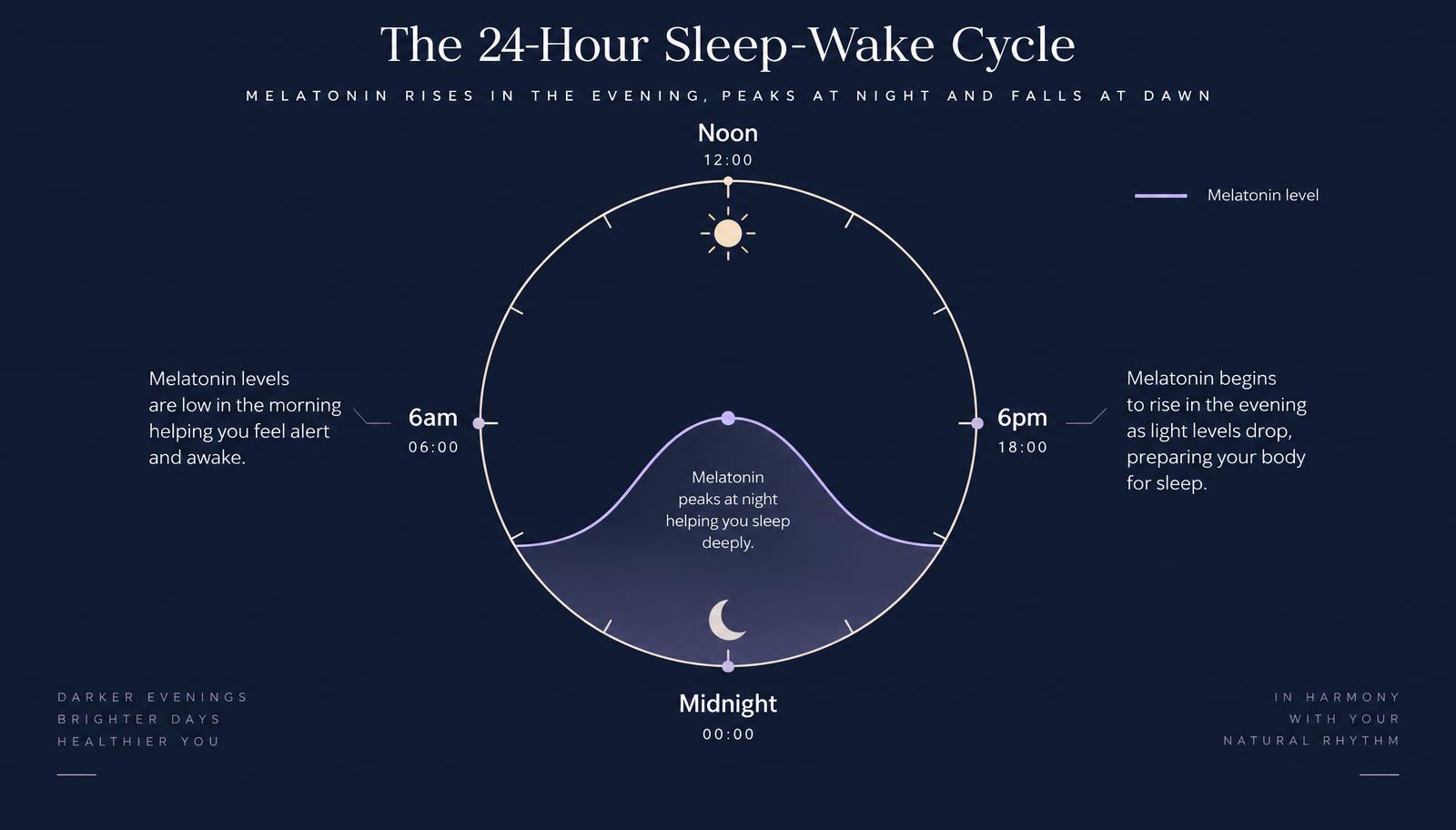
A circadian rhythm is the roughly 24-hour internal cycle that governs when the body expects to be awake or asleep, alert or drowsy. Melatonin is one of the key signals used to keep this rhythm aligned with day and night, and the rhythm itself can gradually shift earlier or later depending on light exposure and routine.
6 min read · Published 24 September 2026
In short
- A circadian rhythm is an internal, roughly 24-hour cycle found throughout the body.
- It is coordinated by the suprachiasmatic nucleus, the brain's master clock.
- Melatonin is one of the main signals the body clock uses to communicate night-time to the rest of the body.
- The circadian rhythm can shift earlier or later depending on light exposure, routine and individual tendencies.
- A misaligned circadian rhythm can make sleep feel harder even when someone is tired.
The term circadian rhythm describes an internal cycle, roughly twenty-four hours long, that shapes when the body expects to be active and when it expects to rest. It affects far more than sleep alone, influencing body temperature, hormone release, digestion and alertness across the day. Melatonin is one of the clearest signals this rhythm produces, which is why the two are so closely linked.
What sets the rhythm
At the centre of this system sits the suprachiasmatic nucleus, a small cluster of cells in the brain that acts as a master clock. Left entirely without external cues, this internal clock would still keep a rough rhythm on its own, but it would gradually drift out of step with the twenty-four-hour day. Light is the strongest cue used to correct this drift and keep the internal clock aligned with the outside world, a process explained step by step in How does melatonin work?
Other cues, sometimes called time-givers, also play a supporting role, including meal timing, physical activity and social routine, though light remains the dominant influence for most people.
Melatonin's role in the rhythm
Melatonin acts as a messenger for the master clock, carrying the signal that biological night has begun out to tissues around the body. Its rise in the evening and fall in the morning reflect the state of the circadian rhythm at that moment, which is why measuring melatonin timing is often used, in research settings, as a marker of where someone's body clock currently sits. Our guide When does the body produce melatonin? explains this daily pattern in more depth.
- The circadian rhythm is the underlying cycle; melatonin is one of its visible signals.
- Light exposure is the main cue that keeps the rhythm aligned with day and night.
- The rhythm influences alertness, temperature and hormone release, not only sleep.
- Melatonin timing can be used as a marker of where the body clock currently sits.
Beyond sleep: what else the rhythm governs
It is easy to think of the circadian rhythm purely in terms of bedtime, but its influence stretches much further through the day. Core body temperature follows its own daily pattern, typically dipping to its lowest point in the early hours and rising gradually through the day. Alertness, reaction times, and even digestive activity all follow a broadly predictable daily curve shaped by the same underlying clock.
This wider reach is part of why disrupting the circadian rhythm, through irregular schedules or persistent jet lag, can produce effects that go beyond simply feeling tired, including a general sense of being "out of sync" with the day, reduced concentration, or digestive discomfort at unusual times. Recognising this helps explain why body clock health is often discussed as something broader than a sleep issue alone.
How the rhythm can shift earlier or later
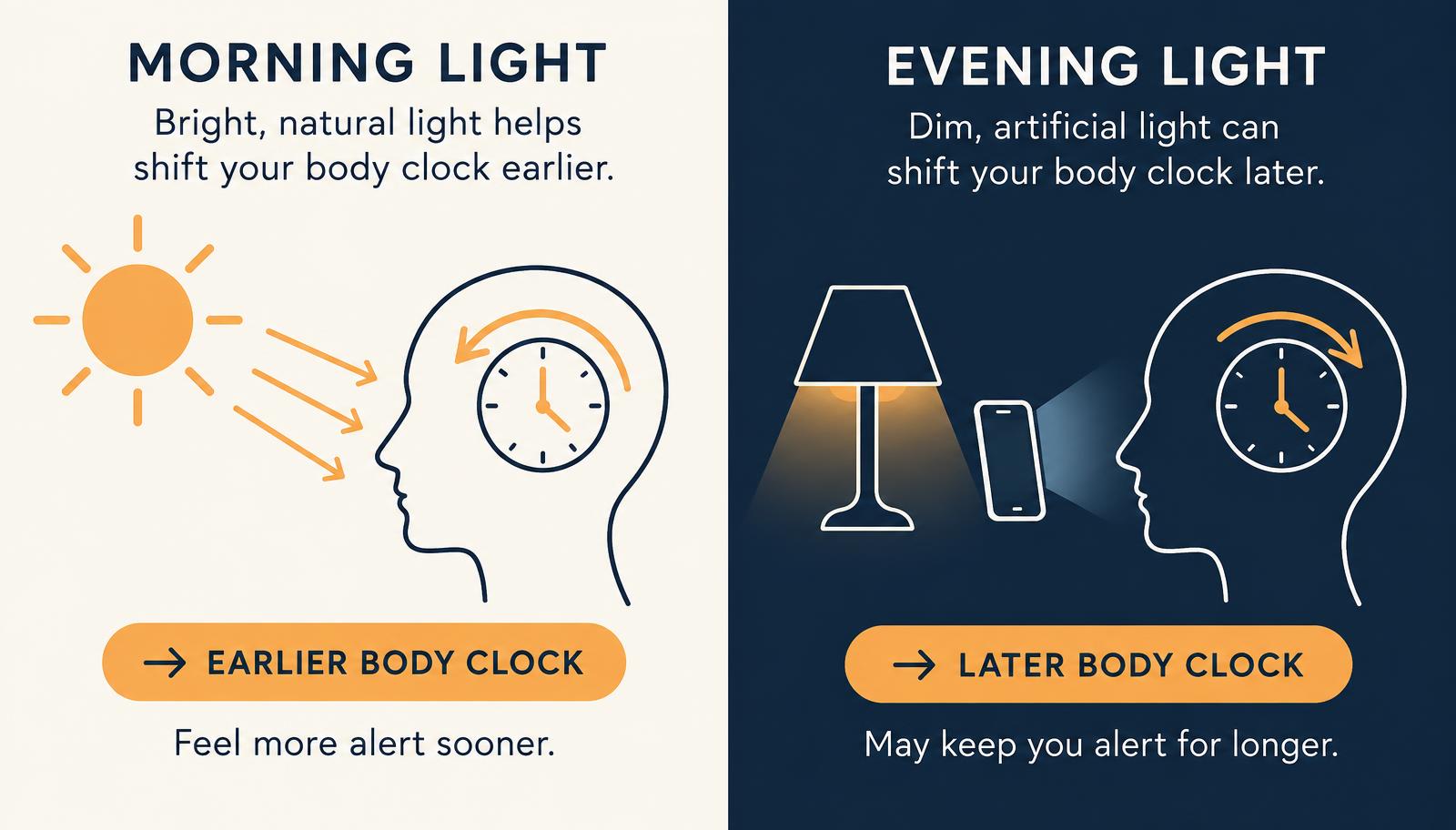
Because the circadian rhythm depends heavily on light exposure and daily routine, it is not fixed in place. Exposure to bright light in the morning tends to encourage the rhythm to shift earlier over time, while bright light in the evening tends to push it later. This is part of why irregular light exposure, such as that experienced during shift work or long-haul travel, can leave the rhythm out of step with local day and night.
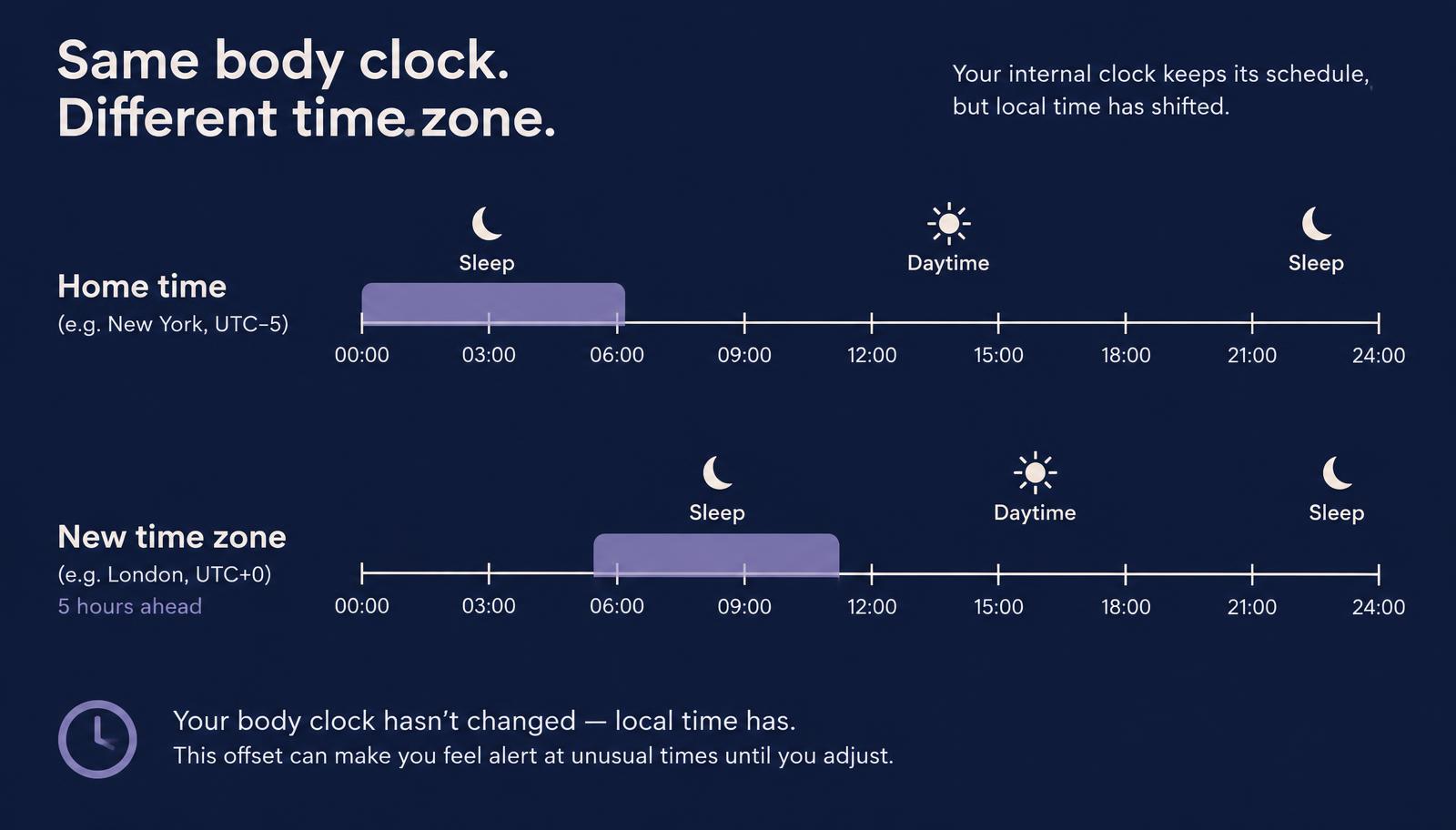
This shifting tendency also varies from person to person. Some people's rhythms naturally sit a little earlier, making them more inclined to early nights and early mornings, while others sit later. These tendencies, often called chronotypes, are one reason a schedule that suits one person can feel completely wrong for another. Melatonin versus sleepiness: what is the difference? explores how this rhythm interacts with the separate build-up of tiredness across the day.
Everyday habits that support a stable rhythm
While the circadian rhythm is driven mainly by light, a handful of everyday habits tend to support keeping it steady over time. These are not medical treatments, simply consistent signals that help the master clock stay predictable.
- Getting outside, or at least near a bright window, reasonably soon after waking.
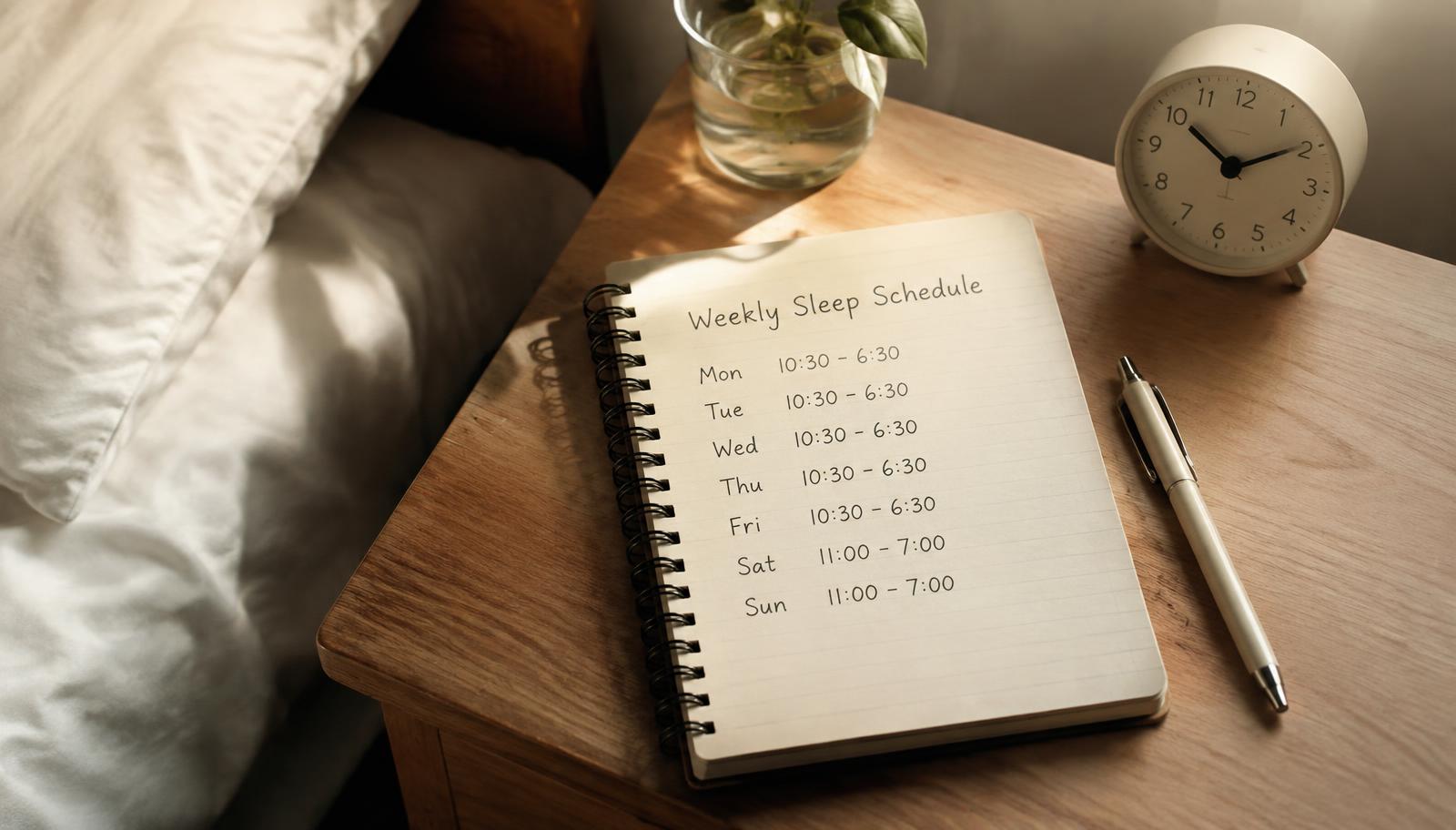
- Keeping wake-up time fairly consistent, even on days off, rather than only fixing bedtime.
- Dimming household lighting in the couple of hours before intended sleep.
- Keeping meals and activity roughly consistent from day to day where practical.
None of these habits work as an instant fix, and none replace addressing an underlying sleep difficulty. Their value lies in giving the suprachiasmatic nucleus clear, repeated information about when day and night begin, which over time supports a more predictable and reliable rhythm.
When misalignment causes problems
When the circadian rhythm and someone's actual daily schedule fall out of step, common experiences include feeling wide awake at bedtime, struggling to wake for the day ahead, or feeling drowsy at unhelpful times such as mid-afternoon. This is different from insomnia in the traditional sense, and the distinction is covered in Insomnia versus shifted body clock. Building a steadier daily rhythm can help realign things over time, as discussed in How to build a consistent sleep schedule.
How the rhythm changes across the lifespan
The circadian rhythm is not fixed from birth. Very young babies have not yet developed a mature rhythm, which is part of why their sleep is spread fairly evenly across day and night rather than concentrated overnight. A more adult-like pattern typically develops over the first months of life. Adolescence often brings a temporary shift towards a later rhythm, while many older adults experience an earlier-shifting rhythm alongside lighter, more fragmented sleep.
These lifespan changes are a normal part of biology rather than a fault to be corrected, though they do mean that sleep advice suited to one age group will not always transfer neatly to another.
A worked example: a week of later nights
Consider someone who normally wakes at seven and starts feeling sleepy around eleven at night. Over the course of a week where they stay up until half past one most nights, exposed to bright indoor lighting and a screen for that extra period, their circadian rhythm does not immediately shift to match. Instead, it moves gradually, perhaps thirty to forty minutes later by the end of the week, leaving them out of step with an alarm still set for seven.
This gradual drift is why a single very late night rarely causes lasting problems, but a sustained pattern of late, bright evenings across a working week can leave someone feeling as though their body clock and their calendar have quietly drifted apart, even without any travel involved.
The link between the rhythm and body temperature
One of the clearest, most measurable outputs of the circadian rhythm is core body temperature, which typically reaches its lowest point in the few hours before a person's usual waking time and rises gradually across the day. This temperature dip is closely tied to the same underlying rhythm that governs melatonin release, and the two tend to move in a broadly coordinated pattern.
This is part of why people often feel their most drowsy and least coordinated in the early hours of the morning, and why the period just before waking can feel like the hardest time to get up, even after a reasonable night's sleep. Recognising this as a normal feature of the rhythm, rather than a personal failing, can be reassuring.
How the rhythm shapes daytime alertness, not just night
It is easy to focus only on the night-time side of the circadian rhythm, but the same underlying clock also shapes patterns of alertness through the day, including a well-documented dip in the mid-afternoon that many people notice regardless of how well they slept the night before. Recognising this as a normal circadian feature, rather than a sign of poor sleep, can be reassuring for people who assume any daytime tiredness must reflect a problem with their night.
Common questions
Is the circadian rhythm exactly 24 hours long?
Not precisely. Left to run without external light cues, most people's internal clocks run slightly longer or shorter than twenty-four hours, which is why regular light exposure is needed to keep the rhythm accurately aligned with the day.
Can the circadian rhythm be reset quickly?
Generally not. Meaningful shifts tend to happen gradually, often over several days, as light exposure and routine consistently reinforce a new pattern rather than through a single change.
Does everyone's circadian rhythm behave the same way?
No. While the underlying mechanism is shared, individual timing, sensitivity to light, and tendency to run earlier or later all vary, which is why sleep advice that works well for one person may need adjusting for another.
Sources
Written by The Melatonin UK editorial team.
Published 24 September 2026. This article is general information about sleep and the body clock. It is not medical advice, and it does not replace a conversation with your GP or pharmacist.
Read next
Melatonin Basics
How does melatonin work?
Melatonin works as part of a chain reaction that starts with light-detecting cells in the eyes, passes through the brain's master clock, and ends with the pineal gland releasing melatonin into the bloodstream. Darkness allows melatonin to rise, which helps signal that night-time conditions have arrived, while bright light suppresses it.
6 min readRead the guide →
Melatonin Basics
When does the body produce melatonin?
For most people, melatonin begins rising in the evening as light fades, stays elevated through much of the night, and falls again before or around waking. Researchers sometimes measure the exact starting point of this rise, known as dim-light melatonin onset, to understand an individual's body clock timing. The precise timing varies from person to person and is influenced by chronotype, age, and light exposure.
6 min readRead the guide →
The Body Clock
What happens when your sleep schedule shifts?
When sleep and wake times change from day to day, such as with weekend lie-ins or late shifts, the body clock and its light cues fall out of step with the actual clock time. This mismatch, sometimes called social jet lag, can leave you feeling tired and out of sorts even without crossing time zones. Because the body clock adjusts gradually, resetting it typically takes several days of consistent cues rather than happening overnight.
6 min readRead the guide →