
Melatonin Basics
When does the body produce melatonin?
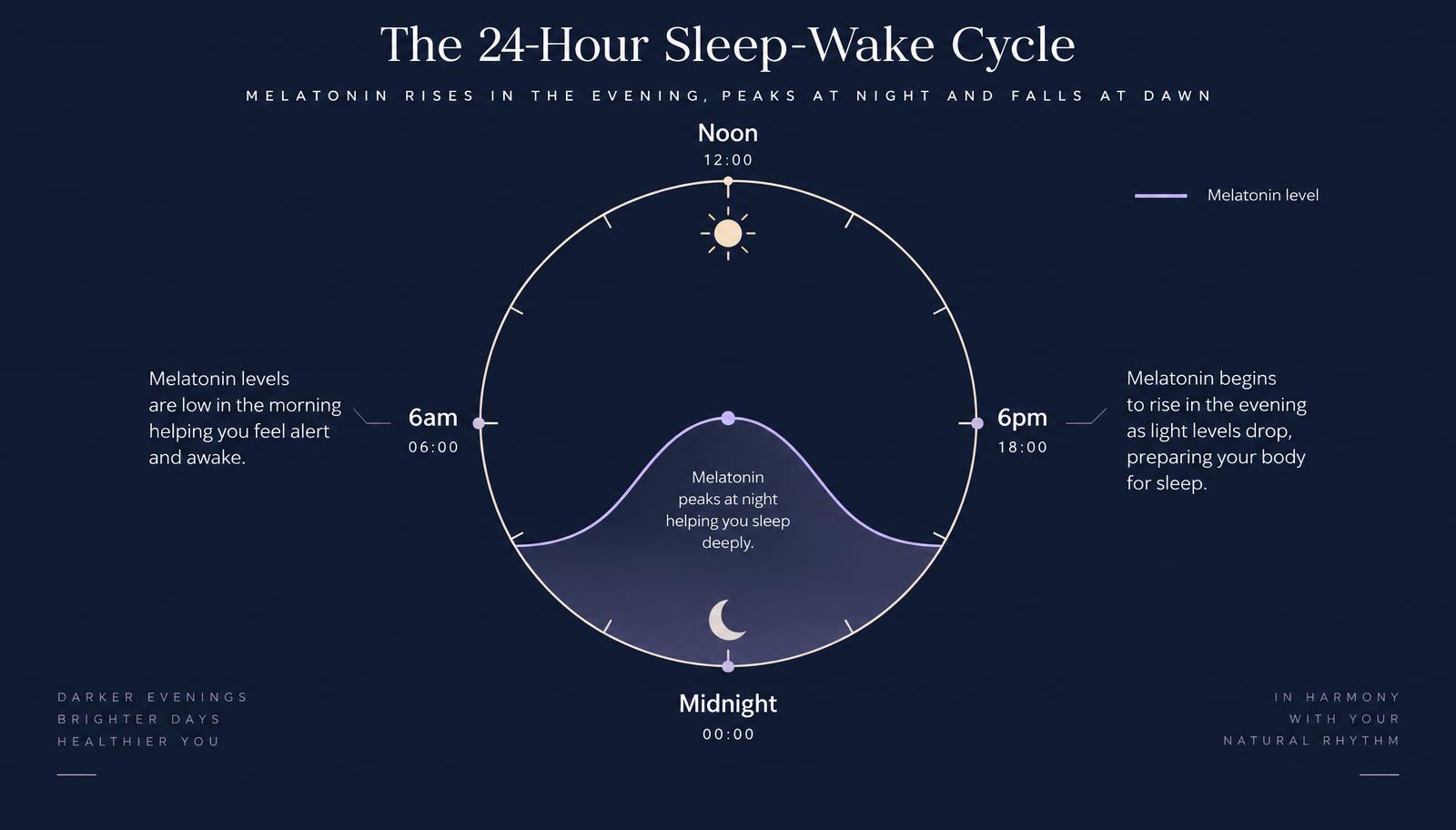
For most people, melatonin begins rising in the evening as light fades, stays elevated through much of the night, and falls again before or around waking. Researchers sometimes measure the exact starting point of this rise, known as dim-light melatonin onset, to understand an individual's body clock timing. The precise timing varies from person to person and is influenced by chronotype, age, and light exposure.
6 min read · Published 24 September 2026
In short
- Melatonin generally begins rising in the evening, several hours before usual sleep onset.
- Levels typically stay elevated through much of the night and fall before or around waking.
- Dim-light melatonin onset is a research measure of when melatonin starts rising in low light.
- Chronotype, or your natural tendency towards earlier or later timing, shifts this pattern for individuals.
- Age and light exposure both influence exact timing, so there is no single normal clock time for everyone.
Melatonin does not appear at a single fixed clock time for everyone; it follows a daily pattern shaped by darkness and light, as introduced in What is melatonin? Understanding the general shape of that pattern, and why it shifts between individuals, helps make sense of why sleep timing itself varies so much from person to person.
The general daily pattern
In most people with a fairly typical schedule, melatonin levels are low during the day, begin rising in the evening as natural light fades, and continue increasing into the first part of the night. Levels usually stay elevated through much of the night before declining again in the hours before or around a person's usual waking time.
This pattern is controlled by the suprachiasmatic nucleus, the brain's master clock, responding to light signals detected in the eye, a process explained fully in Why does light affect melatonin? Because that pathway responds to actual light exposure rather than a fixed clock, the exact timing can shift with the seasons, travel, and daily habits.
What dim-light melatonin onset means
Researchers sometimes need a precise marker for when an individual's melatonin begins to rise, and this is where the term dim-light melatonin onset comes in. It refers to the point, measured under carefully controlled dim lighting in a research or clinical setting, at which melatonin levels start climbing from their low daytime baseline.
This measure is useful because it gives a fairly objective read on an individual's internal body clock timing, separate from when they actually go to bed or feel tired. It is mostly used in research and specialist sleep clinics rather than something people would measure at home, but understanding the concept helps explain why phrases like "my body clock runs late" have a real biological basis.
A worked example of a typical evening pattern
It can help to picture how this might unfold for someone with a fairly average schedule, going to bed around eleven at night and waking around seven in the morning. For this person, melatonin might typically begin rising gently in the couple of hours before nine in the evening, continue climbing through the evening, and reach its higher overnight levels once they are asleep. Levels would then be expected to fall again in the early hours before their usual wake-up time.
This example is illustrative only, since exact timing varies considerably between individuals, and it is not something most people would ever need to measure directly. Its usefulness is in showing that the rise happens well before sleep itself, rather than at the exact moment someone gets into bed, which is one reason going to bed dramatically earlier than usual does not necessarily bring sleep forward to match.
Chronotype and individual variation
Not everyone's melatonin rises at the same relative time before sleep. Some people, often described as having an earlier chronotype, naturally see melatonin rise and feel sleepy earlier in the evening, and wake earlier too. Others, with a later chronotype, see this rise later, along with a natural preference for later bedtimes and wake times.
- Chronotype is a natural tendency, not simply a habit or a preference someone chooses.
- It commonly shifts across life, often trending later through adolescence and earlier in older age.
- Genetics play a meaningful role in an individual's typical chronotype.
- Light exposure and daily routine can nudge chronotype somewhat, but cannot easily override it entirely.
What else can shift the timing
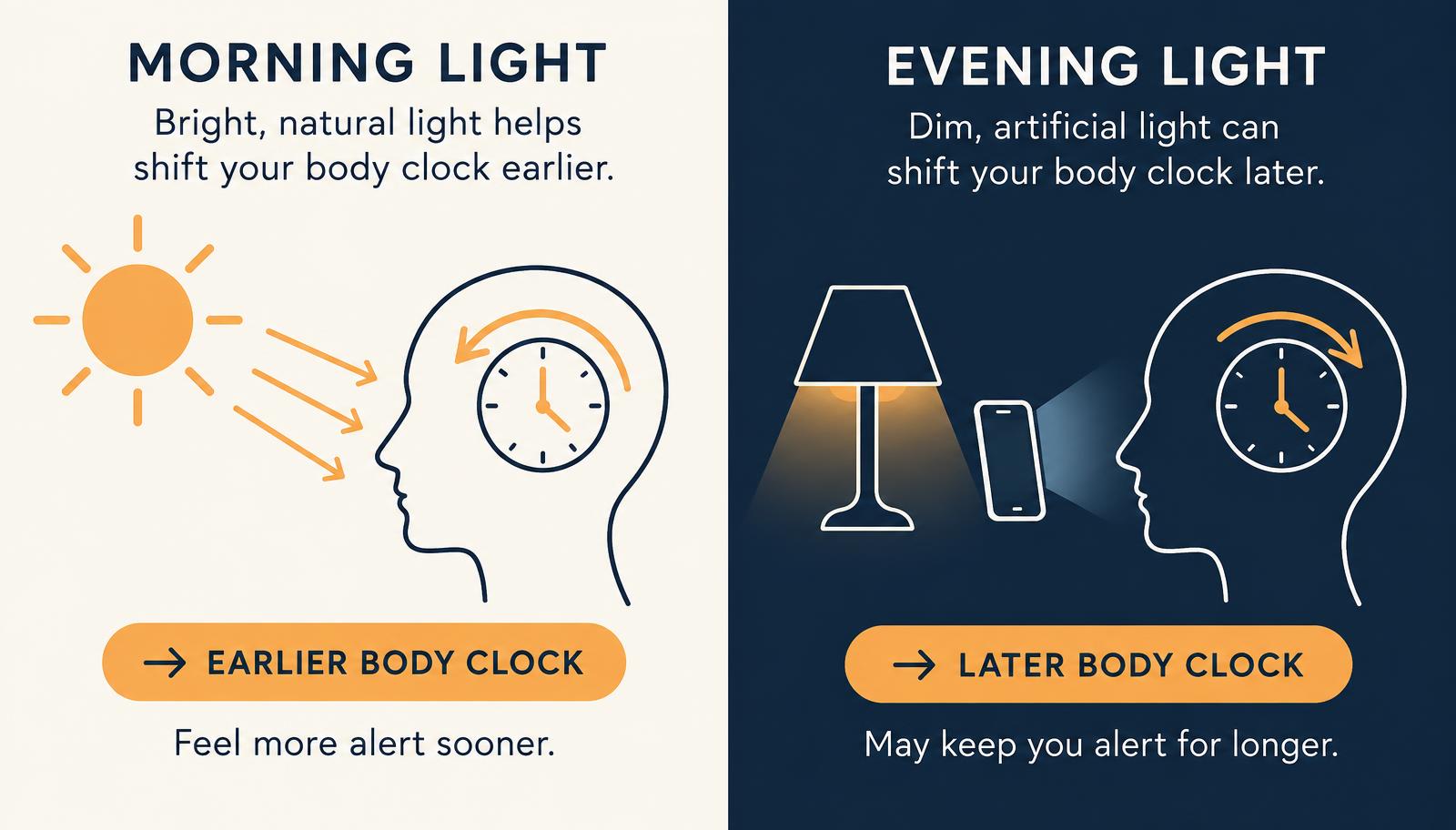
Beyond chronotype, day-to-day and longer-term factors can shift when melatonin rises. Bright light exposure in the evening can delay it, as discussed in Evening light, screens, and sleep, while consistent morning light can help keep it on a more stable, earlier schedule, covered in Morning light and your body clock. Ageing also affects the pattern, with melatonin production tending to decrease and its timing sometimes shifting earlier in older adults.
Seasonal changes and weekend drift
Day length changes across the year can have a modest effect on melatonin timing for some people, since the underlying pathway is built to respond to the natural light-dark cycle. Many people also notice a phenomenon sometimes called social jet lag, where staying up later and sleeping in on weekends shifts melatonin timing slightly, only for the working week to demand an earlier schedule again. This mismatch, repeated week after week, can leave some people feeling perpetually slightly out of step with their own body clock.
Why home testing is not the norm
Some over-the-counter kits claim to measure melatonin or related markers from saliva at home, but these are not the same as the controlled dim-light melatonin onset testing used in specialist research settings. Lighting conditions, timing of sample collection, and individual factors can all affect results outside a controlled environment, so such kits are generally not considered a reliable way to understand your own body clock timing.
For most people, useful information comes not from measuring melatonin directly but from observing patterns of tiredness, alertness and sleep quality over a couple of weeks, which can highlight whether a schedule broadly suits an individual's natural timing.
A second worked example: a night-shift worker
Consider a nurse who regularly works through the night and sleeps during the day. If their bedroom is well darkened and they are consistent with this schedule for several weeks, their melatonin rise can gradually shift to occur before their daytime sleep period rather than in the evening as it would for most people. This demonstrates that the timing of melatonin release follows a person's actual pattern of light and dark exposure, not the clock time written on a wall.
In practice, many night-shift workers never achieve this full shift, because days off, family commitments, and daylight leaking into sleeping hours all interfere with a clean, consistent pattern. This partial adjustment is one reason shift work is so often linked with poorer sleep quality, a topic covered further in Sleep and shift work.
How melatonin timing differs from actual sleep timing
It is worth being clear that the moment melatonin begins rising is not the same as the moment someone falls asleep. Melatonin typically begins increasing a couple of hours before a person's usual bedtime, creating favourable conditions for sleep rather than causing it at that exact moment. Someone can have rising melatonin and still stay awake doing something engaging, just as someone can occasionally fall asleep before their usual rise has properly begun, particularly if sleep pressure is unusually high.
This distinction is explored in more depth in Melatonin versus sleepiness: what is the difference?, which separates the body clock's timing signal from the build-up of tiredness that comes from time spent awake.
Tracking your own pattern informally
While formal dim-light melatonin onset testing is not practical for most people, keeping an informal sleep diary for a couple of weeks can offer a useful, low-effort proxy. Noting roughly when you first start feeling drowsy each evening, what the lighting was like in the hour beforehand, and what time you eventually fell asleep can reveal patterns that are otherwise easy to miss.
- Note the approximate time you first feel drowsy each evening, not just your bedtime.
- Record roughly how bright your surroundings were in the two hours beforehand.
- Track your actual wake time, including on days off, to see how consistent it is.
- Look for patterns over one to two weeks rather than drawing conclusions from a single night.
A brief note on melatonin timing in children
Children, particularly younger ones, often have an earlier natural melatonin rise than adults, which is part of why many manage an earlier bedtime relatively comfortably. This pattern typically shifts later during adolescence, before settling into a more adult-like timing in early adulthood, a natural progression covered further in Melatonin and children.
Common questions
Is there a normal clock time when melatonin should start rising?
There is no single normal time for everyone, since it depends on individual chronotype, light exposure, and daily schedule. A rough general pattern for many adults is a rise starting a couple of hours before their usual bedtime, but this varies considerably.
Can I find out my own dim-light melatonin onset?
This measurement generally requires a specialist research or clinical setting with controlled lighting and repeated saliva or blood sampling, so it is not something typically done at home or needed for everyday sleep concerns.
Does melatonin timing change with age?
Yes, timing and amount both tend to shift across life, often becoming later during adolescence and then gradually shifting earlier, alongside reduced overall production, in older adulthood, a topic explored further in Melatonin and sleep in older adults.
Sources
Written by The Melatonin UK editorial team.
Published 24 September 2026. This article is general information about sleep and the body clock. It is not medical advice, and it does not replace a conversation with your GP or pharmacist.
Read next
Melatonin Basics
What is melatonin?
Melatonin is a hormone produced mainly by the pineal gland in the brain, released in response to darkness. It signals to the rest of the body that it is night-time, helping to time sleep rather than force it. It is not a sedative, and it does not knock you out the way a sleeping tablet might.
7 min readRead the guide →
The Body Clock
Why does light affect melatonin?
Light is the single strongest signal your body uses to time melatonin release. Specialised cells in the eye detect brightness, quite separately from normal vision, and pass that information to the brain's master clock, which controls the pineal gland. Brightness, timing and duration of light exposure all matter, not just its colour.
6 min readRead the guide →

Melatonin Basics
Melatonin versus sleepiness: what is the difference?
Melatonin and sleepiness are related but distinct: melatonin is a timing signal from the body clock indicating that night has arrived, while sleepiness largely reflects sleep pressure, a build-up driven by how long you have been awake. In a well-aligned body clock these two usually rise together in the evening, but they can fall out of step, which is why you can feel exhausted yet strangely alert, or vice versa.
6 min readRead the guide →