
The Body Clock
Melatonin and jet lag: understanding the connection
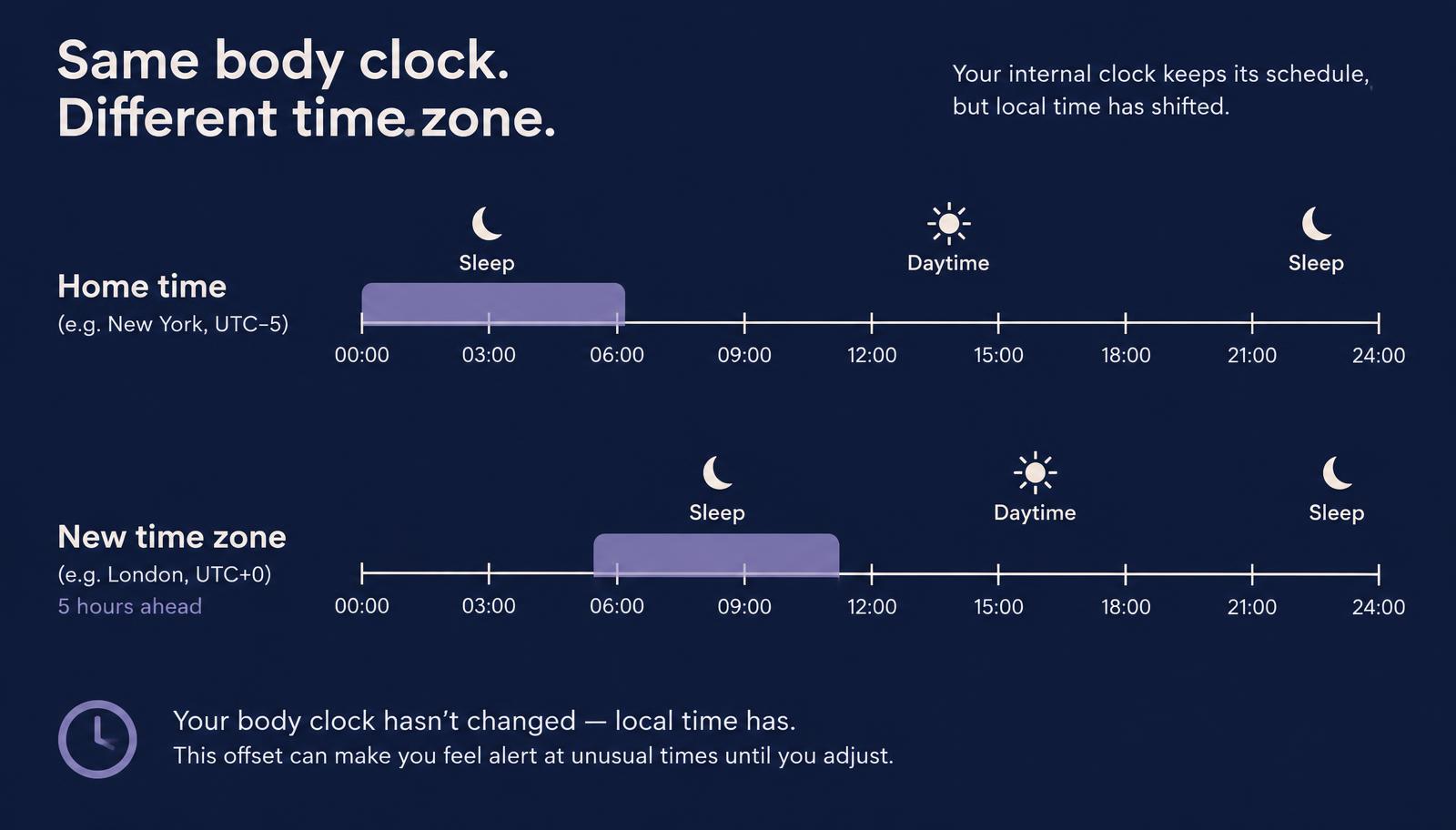
Jet lag happens because your internal body clock stays set to your home time zone while the outside world has moved on. Melatonin is one of the signals your brain uses to keep that clock synchronised, which is why researchers have studied it in relation to jet lag. The evidence is mixed and depends heavily on timing, so it's worth understanding the underlying biology rather than treating melatonin as a simple fix.
6 min read · Published 24 September 2026
In short
- Jet lag is caused by a mismatch between your internal body clock and the local time at your destination.
- Melatonin is a hormone that helps signal night-time to the brain and supports the timing of the body clock.
- A Cochrane review has looked at melatonin and jet lag, but findings vary between studies and are not clear-cut for every traveller.
- When a light or melatonin cue is given matters more than how much is used, because it can shift the clock forward or backward.
- This article does not provide dosing guidance; speak to a pharmacist or GP for individual advice.
Jet lag is a temporary and very common experience for anyone who travels quickly across several time zones. It isn't simple tiredness from a long journey; it's a mismatch between your internal body clock, which is still running on the time of the place you left, and the actual time at your destination. Understanding why this happens helps explain why melatonin has become such a talking point among travellers and researchers alike.
Why crossing time zones desynchronises the clock
Your body clock, also called the circadian rhythm, is a roughly 24-hour internal timer that governs when you feel alert and when you feel sleepy. It is guided mainly by light reaching the eyes, which tells the brain whether it is day or night. This system evolved to match the slow, predictable rotation of the Earth, not the abrupt jumps created by aeroplane travel.
When you fly across several time zones in a matter of hours, your internal clock has no way of updating that quickly. You might land somewhere where it's daytime, but your body is still convinced it's the middle of the night back home. This is what produces the classic symptoms of jet lag: difficulty sleeping at the new local night-time, unwanted sleepiness during the new day, disrupted appetite, and a general feeling of being out of step with your surroundings.
The number of time zones crossed and the direction of travel both influence how severe this mismatch feels, which is covered in more detail in our guide to why jet lag feels different when travelling east or west. In general, the more zones you cross, the longer it tends to take for the body clock to catch up.
Where melatonin fits into the picture
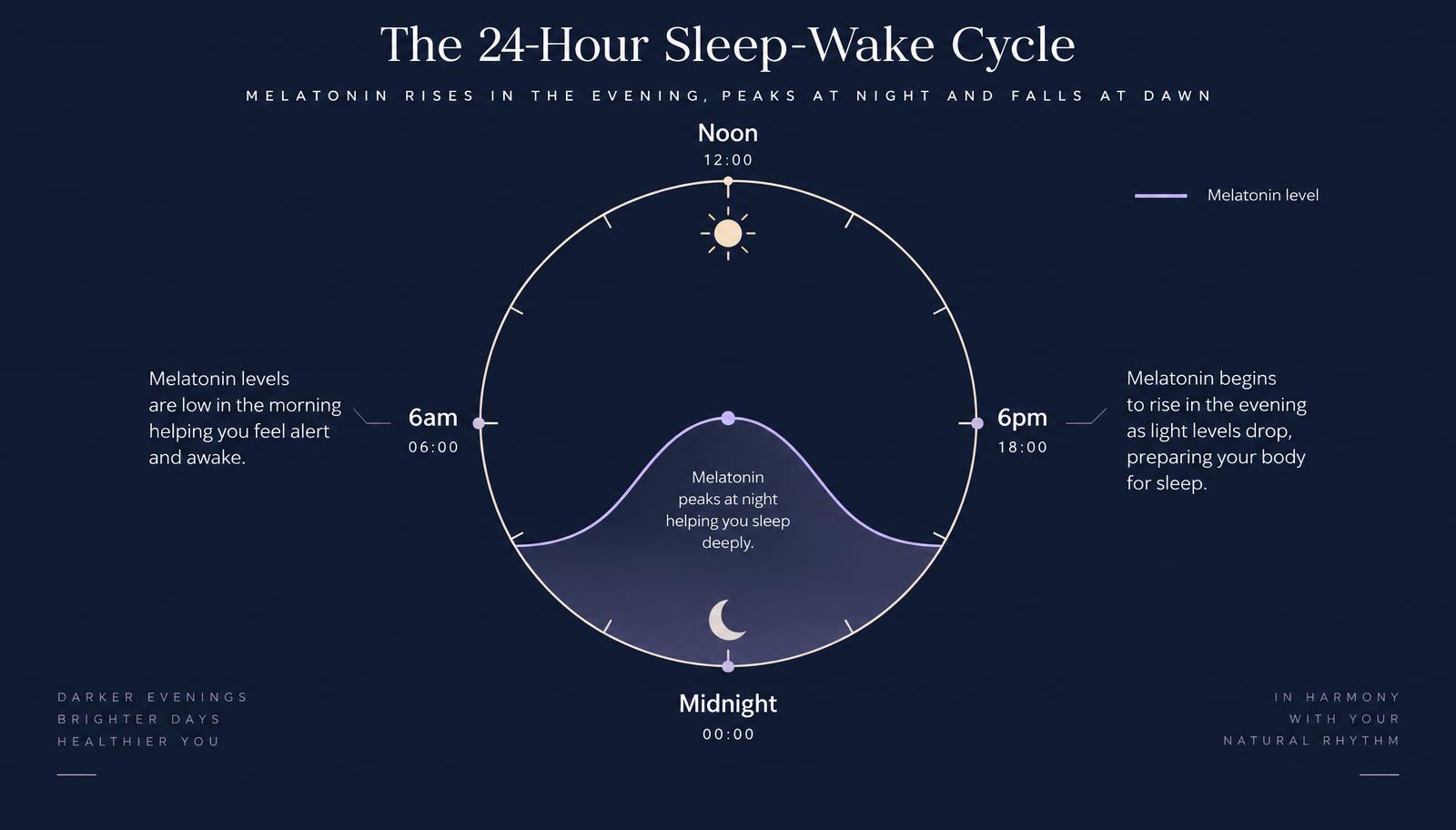
Melatonin is a hormone produced naturally by the brain, and its release is closely tied to darkness. Levels typically begin rising in the evening and fall again around the time you would normally wake up, forming part of the internal signalling that tells the rest of the body what time it is. Because of this role, melatonin has long been of interest to scientists studying how the body clock might be encouraged to adjust more quickly after time-zone travel.
The idea researchers have explored is that taking melatonin at a carefully chosen time might help nudge the body clock towards the new local schedule, rather than leaving it stuck on home time. This is a different idea from melatonin simply making someone feel drowsy in the short term; it's about whether it can influence the underlying timing system itself.

What the Cochrane review looked at
A well-known Cochrane review has examined the available trials on melatonin for the prevention and treatment of jet lag. Cochrane reviews are systematic assessments that pool and critically appraise existing research, rather than presenting a single new study, so they give a sense of the overall state of the evidence rather than one dramatic result.
The review considered a range of studies of varying size and quality, looking at whether melatonin use around the time of travel affected jet lag symptoms. As with many reviews of this kind, the included trials differed in their design, in exactly when melatonin was taken relative to the flight and the new local night, and in how jet lag was measured. This variation is important because it limits how confidently broad conclusions can be drawn, and it's a key reason we won't quote specific figures here without access to the primary review text.
What can be said fairly is that the review reflects a genuinely mixed picture: some included trials reported a benefit for certain symptoms of jet lag, while others were less conclusive, and the overall certainty of the evidence is affected by differences between studies. This is a useful reminder that a hormone with a real biological role in timing does not automatically translate into a dependable, one-size-fits-all remedy.
Why timing matters more than quantity
One of the most consistent themes in body-clock research, not just for melatonin but also for light exposure, is that when a signal is given matters enormously. The same cue delivered at different points in your body clock's cycle can either help shift it in the direction you want or, confusingly, shift it the wrong way or barely affect it at all.
This is part of why melatonin's relationship with jet lag is more complicated than 'take it and you'll adjust faster'. Researchers have to account for each traveller's own body clock position, which depends on their home time zone, the destination, and the direction of travel. Two people on the same flight could, in principle, need different timing strategies to get the same benefit.
- The body clock responds to timed cues, not just their presence or absence.
- Light exposure and melatonin can both influence the clock, sometimes in opposite directions depending on when they occur.
- Individual differences, such as usual sleep timing, can affect how someone responds.
- This complexity is why general advice tends to focus on light and routine alongside any discussion of melatonin.
For practical, non-dosing strategies around light exposure, meals and sleep timing, our guide on how to adjust to a new time zone brings these ideas together in a step-by-step way that applies regardless of whether melatonin is part of someone's routine.
How melatonin's role differs from a sleeping tablet
It is worth being clear about what melatonin is being studied to do in the jet lag context, because it is easy to conflate it with a conventional sleep aid. A typical sleeping tablet works by promoting drowsiness fairly directly, largely regardless of what time it is taken. Melatonin's proposed role in jet lag research is different: it is being explored as a timing signal that might help nudge the body clock itself towards a new schedule, which is why researchers pay such close attention to exactly when it is given relative to the traveller's home and destination time.
This distinction matters for how the research should be read. A study showing that melatonin helped people fall asleep on a particular night is answering a different question from a study asking whether melatonin helped the body clock realign to a new time zone over several days. The Cochrane review is concerned mainly with the second, body-clock question, which is inherently harder to measure than simple sleep onset.
What else researchers consider alongside melatonin
Melatonin is rarely studied, or recommended by health professionals, in complete isolation from other body-clock cues. Light exposure, meal timing and sleep scheduling all interact with the same internal system, and researchers examining melatonin for jet lag typically have to account for participants' light exposure during the study, since bright light at the wrong moment could work against, or alongside, any effect of melatonin being tested.
This is one of the reasons general jet lag advice tends to foreground light, routine and gradual adjustment rather than treating melatonin as a stand-alone answer. Our guide on how to adjust to a new time zone sets out these light and routine-based strategies in practical detail, and they apply whether or not melatonin forms any part of a traveller's own approach.
Talking to a pharmacist before travel
If melatonin is something you are curious about ahead of a trip, a pharmacist is often the most practical first point of contact, since they can discuss your specific itinerary, any other medicines you take, and whether melatonin is an appropriate option for you individually. This conversation is more useful than relying on generic online advice, precisely because the research shows outcomes depend so much on individual timing and circumstances.
Common questions
Does melatonin cure jet lag?
No. Jet lag resolves as the body clock naturally realigns with local time, and melatonin has been studied only as something that might support that process for some people in some circumstances. It is not a guaranteed or instant fix, and the research evidence remains mixed.
Is melatonin the same as feeling sleepy?
Not exactly. Melatonin is a signalling hormone linked to darkness and the timing of the body clock, whereas sleepiness is a broader feeling influenced by many factors, including how long you've been awake. The two are related but are not identical concepts.
Should I take melatonin before a flight?
This article doesn't provide dosing advice, because appropriate use depends on the individual, the specific journey, and other health factors. If you're considering melatonin for travel, it's best to speak to a pharmacist or GP who can discuss whether it's suitable for you.
Sources
Written by The Melatonin UK editorial team.
Published 24 September 2026. This article is general information about sleep and the body clock. It is not medical advice, and it does not replace a conversation with your GP or pharmacist.
Read next
The Body Clock
Why jet lag feels different when travelling east or west
Flying east asks your body clock to move forward in time, known as a phase advance, while flying west asks it to move backward, a phase delay. Most people's internal clocks find it easier to delay than to advance, which is why eastward travel is usually reported as harder to adjust to.
6 min readRead the guide →

The Body Clock
How to adjust to a new time zone
Adjusting to a new time zone is easier when you work with your body clock using light exposure, meal timing and consistent sleep habits, rather than against it. The right approach also depends on whether you're staying for a few days or several weeks.
6 min readRead the guide →
The Body Clock
Melatonin and the circadian rhythm
A circadian rhythm is the roughly 24-hour internal cycle that governs when the body expects to be awake or asleep, alert or drowsy. Melatonin is one of the key signals used to keep this rhythm aligned with day and night, and the rhythm itself can gradually shift earlier or later depending on light exposure and routine.
6 min readRead the guide →