
The Body Clock
How to adjust to a new time zone
Adjusting to a new time zone is easier when you work with your body clock using light exposure, meal timing and consistent sleep habits, rather than against it. The right approach also depends on whether you're staying for a few days or several weeks.
6 min read · Published 24 September 2026

In short
- Light exposure at the right times is one of the strongest tools for shifting the body clock.
- Meal timing can reinforce the new schedule alongside light and sleep habits.
- Adjustments made before you fly can reduce how much realignment is needed after landing.
- Short trips may not be worth fully adjusting for, while longer stays usually benefit from doing so.
- Consistency in the days after arrival matters more than any single action.
Adjusting to a new time zone is essentially about persuading your body clock to catch up with the local time as quickly and comfortably as possible. While the body will eventually realign on its own, there are practical, everyday habits involving light, meals and sleep timing that can make the process smoother, without needing to consider medication.
Before you fly
Some of the most useful adjustment happens before you even board the plane. Gradually shifting your sleep and wake times by small amounts in the days leading up to travel can reduce the size of the jump your body clock has to make once you arrive. If you're heading east, going to bed and waking slightly earlier each day can help; if you're heading west, doing the opposite by staying up and waking slightly later can prepare you for the shift covered in our guide to why jet lag feels different when travelling east or west.
- Shift bedtime and wake time by a small amount each day in the direction you'll need at your destination.
- Adjust meal times gradually to move closer to the destination's schedule.
- Try to arrive as well-rested as possible, since starting a trip already sleep-deprived tends to make adjustment harder.
During the flight
Once you're travelling, it can help to set your watch or phone to the destination time zone as soon as you board, and start thinking in those terms. Try to align your eating and sleeping on the plane with the destination's schedule rather than your home schedule, even if this means eating a meal or resisting sleep at a time that feels unusual.
Light exposure on the plane, or lack of it, can also be used deliberately. Using an eye mask to block cabin lighting when it's night-time at your destination, or seeking out light near a window when it's daytime there, reinforces the direction you want your body clock to move.
After you land
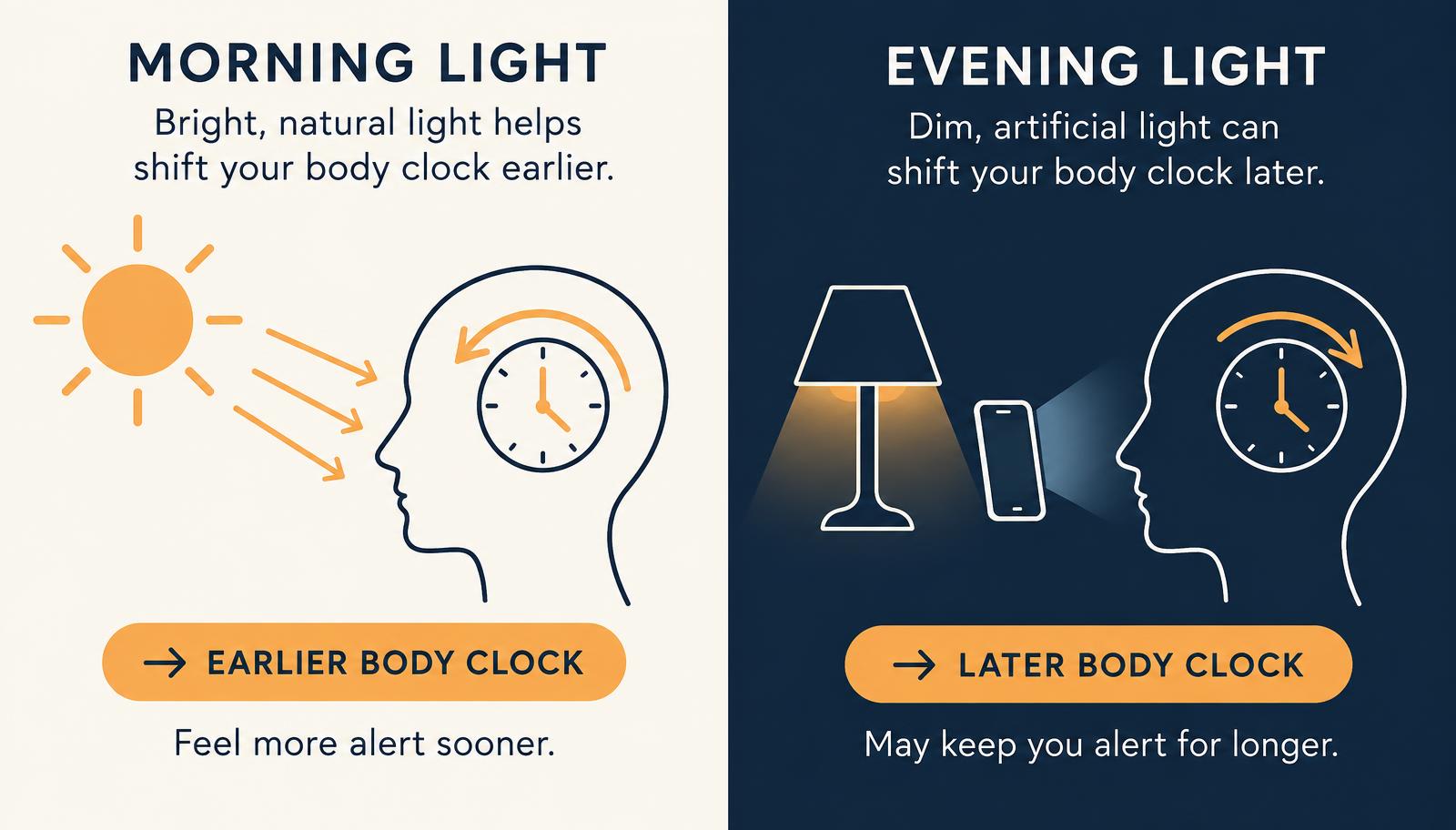
The days immediately after arrival are when most of the visible adjustment happens. Getting outside into natural daylight at the right times, and avoiding bright light at the wrong times, is one of the most effective tools for guiding your body clock in the correct direction, as explained in our article on morning light and your body clock.
If you've flown east and need your clock to advance, seeking bright light in the local morning and avoiding it in the evening tends to help. If you've flown west and need your clock to delay, the reverse applies: seeking light later in the day and being cautious about very early morning brightness.
- Get outside into daylight at a time that supports the direction your clock needs to move.
- Eat meals at local times, even if your appetite doesn't fully agree at first.
- Keep a consistent wake-up time from day one, even if it means an early alarm.
- Limit long daytime naps to short ones if you need to nap at all, so night-time sleep pressure isn't disrupted.
- Dim lights and reduce screen brightness in the local evening to support winding down.
Meal timing as a supporting cue
Light is the dominant signal for the body clock, but regular meal timing appears to act as a secondary cue that can reinforce the new schedule, particularly for the digestive system's own daily rhythm. Eating breakfast, lunch and dinner at local times, even before your appetite has fully caught up, gives your body an additional consistent marker of when the local day begins and ends, alongside light. This is unlikely to work in isolation, but as part of a broader approach it can make the first few days feel more structured and predictable.
A worked example: a business trip from London to Singapore
Consider someone flying from London to Singapore, roughly seven or eight hours ahead, for a week-long work trip. In the three days before departure, they might set their alarm around twenty minutes earlier each morning and get outside shortly after waking. On the overnight flight, they set their watch to Singapore time immediately, eat when a Singapore mealtime would fall, and use an eye mask during what would be Singapore's night hours. On arrival, despite feeling tired, they resist a long nap, get outside into daylight during the Singapore morning, and keep the room dim in the evening. By the third or fourth day, sleep and alertness are typically far closer to the local pattern than they would have been without this preparation.
Short trips versus long stays
How much effort is worth putting into adjustment depends heavily on how long you're staying. For a short trip of only a couple of days, some travellers find it easier to stay loosely on their home time zone's rhythm, especially if most of their activities can flex around that, rather than going through a full realignment that will just need to be reversed almost immediately.
For longer stays, fully adjusting to local time is usually worth the initial discomfort, because it means the majority of the trip is spent functioning well rather than fighting a mismatched body clock. The habits described above, consistent light exposure, meal timing and a steady wake-up time, are most valuable in this longer-stay scenario.
Whichever approach suits your trip, consistency day to day matters more than any single tactic. A body clock responds to repeated, predictable cues, so sticking with a chosen approach for several days tends to work better than switching strategies constantly.
Caffeine and alcohol while adjusting
Travel often comes with a temptation to lean on coffee to get through a groggy local afternoon, or a drink to help unwind after a long day of sightseeing or meetings, but both can work against the adjustment process. Caffeine taken too close to the local evening can make it harder to fall asleep at the new bedtime, undoing some of the benefit of carefully timed light exposure, while alcohol, though it may help you feel drowsy initially, tends to fragment sleep later in the night, exactly when you need consolidated rest most.
This does not mean avoiding either entirely, but being mindful of timing, keeping caffeine to the local morning and treating alcohol as an occasional indulgence rather than a nightly wind-down tool, supports the same goal as the light and meal strategies described above.
Adjusting on the return journey
It is easy to focus all attention on the outbound adjustment and forget that coming home involves a body-clock shift of its own, just in the opposite direction. The same principles apply: gradually shifting sleep and wake times in the days before departure where practical, aligning with home time as soon as you are travelling, and using morning or evening light deliberately once back, depending on whether you need to advance or delay again.
Many people find the return adjustment easier to ignore because normal life resumes immediately, with work or family commitments leaving little time to focus on sleep habits. Giving the return leg even a little of the same deliberate attention as the outbound journey can shorten the period of feeling below par once you are back.
Packing habits that support adjustment
A few small, practical items can make the light and routine strategies above easier to follow in practice. An eye mask and earplugs support both flight-time sleep and a consistent dark sleeping environment once you arrive, while a portable phone charger means you are not tempted to stay near bright screens for longer than necessary while waiting for a device to charge in the evening.
Common questions
Should I try to adjust for a two-day business trip?
Many travellers find it's not worth fully adjusting for very short trips, since the body clock would need to shift again almost immediately for the return journey. Focusing on being well-rested and using light sensibly around key commitments can be more practical than a full realignment.
Does exercise help with adjusting to a new time zone?
Light physical activity at the destination, particularly outdoors during the day, can support alertness and may complement the effects of daylight exposure, though it isn't a substitute for consistent light and sleep timing.
What if I still feel off after a week?
Most people notice significant improvement within the first week for a typical time-zone change, but if sleep problems persist well beyond that or are affecting daily life, it's worth speaking to a GP or pharmacist rather than assuming it will simply resolve on its own.
Sources
Written by The Melatonin UK editorial team.
Published 24 September 2026. This article is general information about sleep and the body clock. It is not medical advice, and it does not replace a conversation with your GP or pharmacist.
Read next
The Body Clock
Melatonin and jet lag: understanding the connection
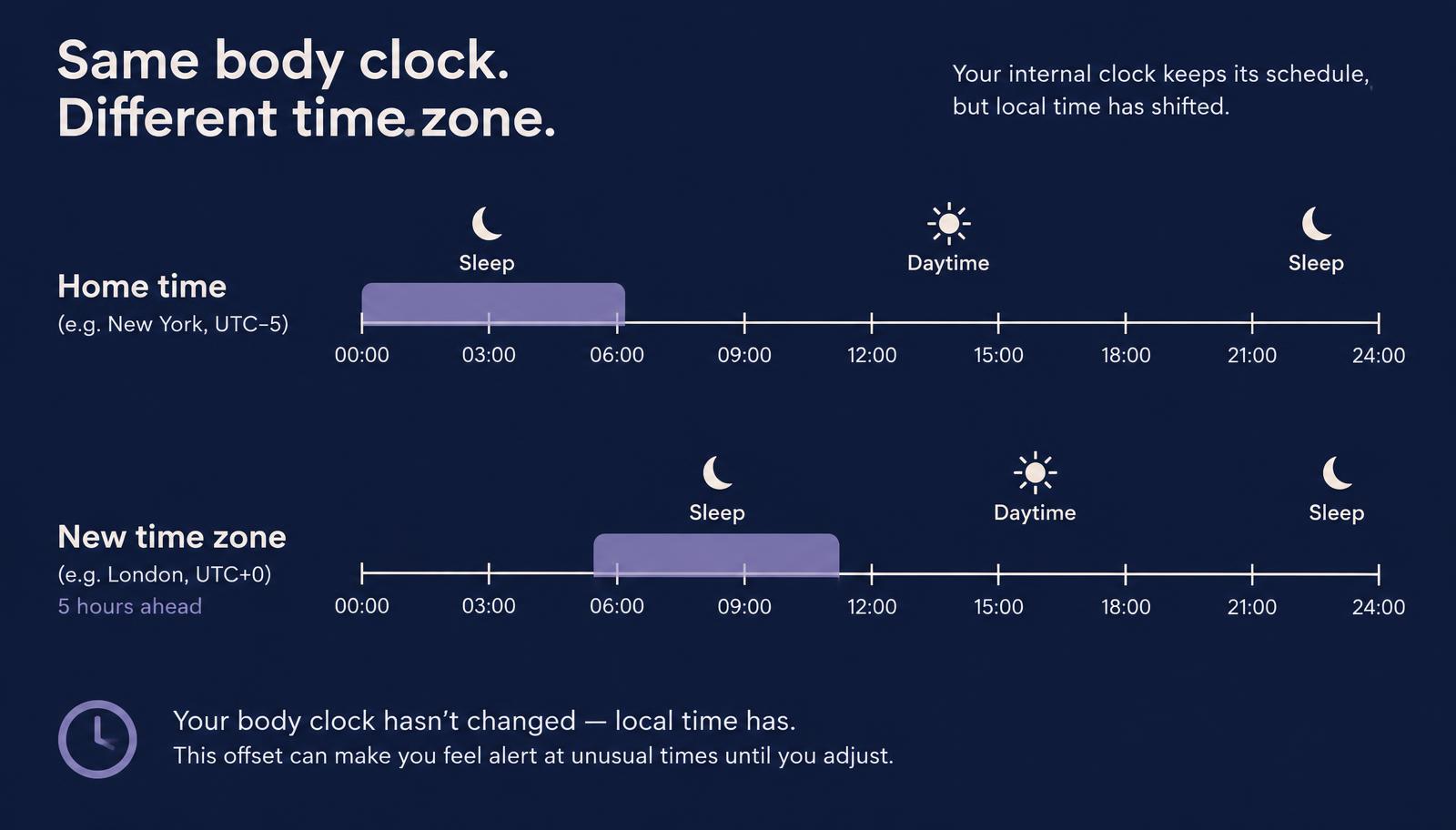
Jet lag happens because your internal body clock stays set to your home time zone while the outside world has moved on. Melatonin is one of the signals your brain uses to keep that clock synchronised, which is why researchers have studied it in relation to jet lag. The evidence is mixed and depends heavily on timing, so it's worth understanding the underlying biology rather than treating melatonin as a simple fix.
6 min readRead the guide →
The Body Clock
Why jet lag feels different when travelling east or west
Flying east asks your body clock to move forward in time, known as a phase advance, while flying west asks it to move backward, a phase delay. Most people's internal clocks find it easier to delay than to advance, which is why eastward travel is usually reported as harder to adjust to.
6 min readRead the guide →
The Body Clock
Morning light and your body clock
Morning daylight is one of the strongest signals for anchoring your body clock, helping set the timing for alertness during the day and melatonin release later that night. It is especially useful because it comes early in the light-sensitive window the body clock relies on. UK winters make this harder, but there are realistic ways to get more usable light.
6 min readRead the guide →