
The Body Clock
Why jet lag feels different when travelling east or west
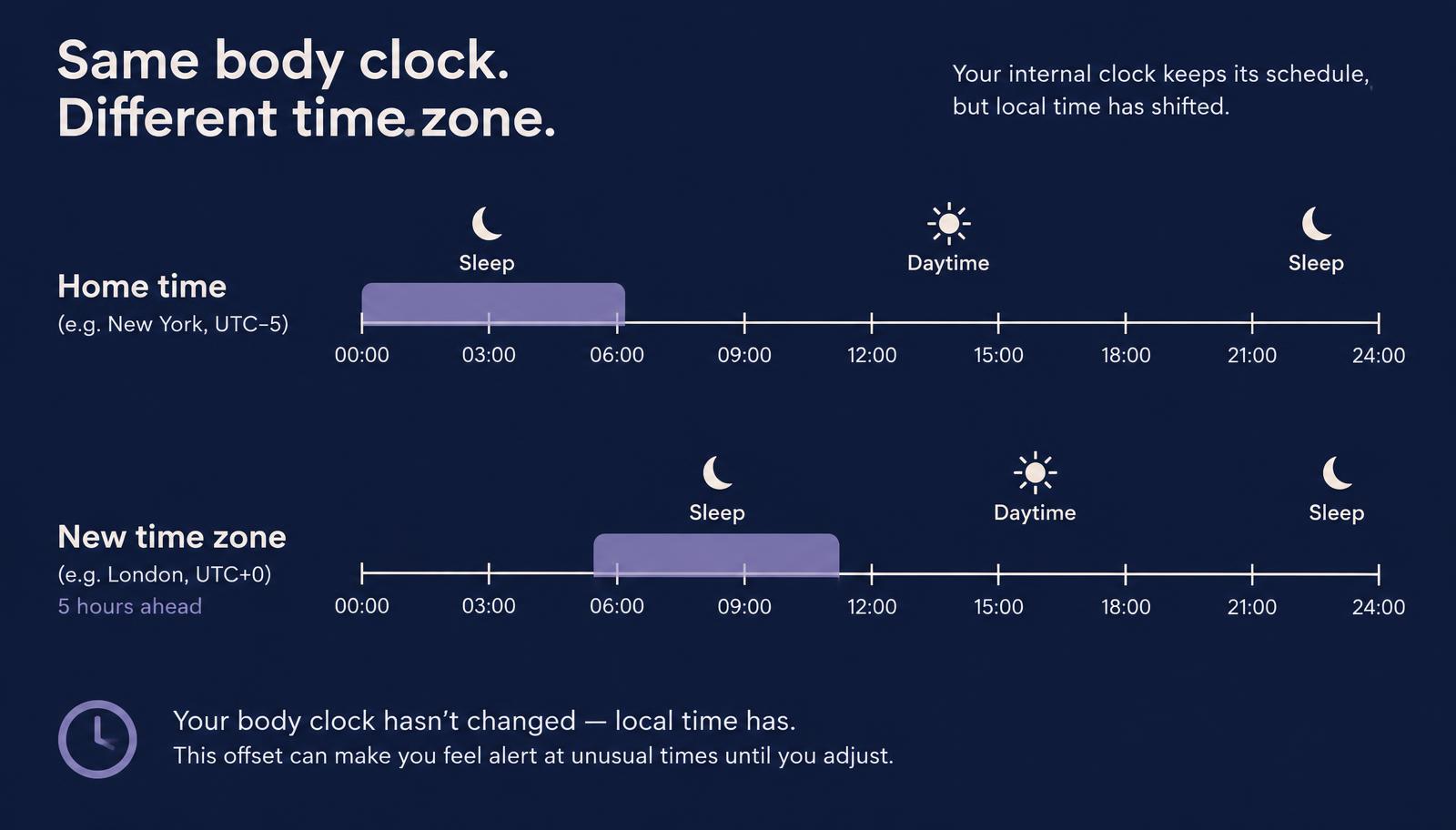
Flying east asks your body clock to move forward in time, known as a phase advance, while flying west asks it to move backward, a phase delay. Most people's internal clocks find it easier to delay than to advance, which is why eastward travel is usually reported as harder to adjust to.
6 min read · Published 24 September 2026
In short
- Jet lag severity depends on the direction of travel, not just the number of time zones crossed.
- Flying east requires a phase advance, meaning the body clock has to shift earlier.
- Flying west requires a phase delay, meaning the body clock has to shift later.
- Most people's natural body clock rhythm is slightly longer than 24 hours, making it easier to delay than advance.
- This is a general pattern, and individual experience can still vary.
Anyone who has flown long-haul in both directions may have noticed something curious: a flight east can leave you feeling far more disoriented than a flight west, even when the number of time zones crossed is similar. This isn't just a coincidence or something to do with flight length. It comes down to how your body clock is being asked to move.
What phase advance and phase delay actually mean
Your body clock, or circadian rhythm, runs on an internal schedule that governs when you feel alert or sleepy, when your body temperature rises and falls, and when hormones like melatonin are released. When you travel across time zones, this internal schedule has to be reset to line up with the new local time. There are only two directions it can be nudged: earlier or later.
Moving the clock to an earlier time is called a phase advance. Moving it to a later time is called a phase delay. These terms sound technical, but the everyday experience is simple: a phase advance feels like being asked to fall asleep and wake up earlier than usual, while a phase delay feels like being asked to stay up and wake up later than usual.
Why eastward travel means a phase advance
When you fly east, for example from the UK towards the Middle East or Asia, local time is ahead of the time at home. Landing somewhere where the clocks are further forward means your body clock needs to advance, essentially skipping ahead, so that your sense of night-time lines up with the destination's earlier evening.
In practice, this can mean trying to fall asleep before you feel remotely tired, and being expected to wake up while your body still insists it's the middle of the night. This is often the more uncomfortable direction of adjustment for most travellers.
Why westward travel means a phase delay
Flying west, for example from the UK towards North America, moves you into time zones that are behind home time. Your body clock now needs to delay, effectively staying up later than usual, so that it eventually lines up with the destination's later evening.
Staying awake for longer than usual and pushing bedtime later tends to feel more manageable for most people than being forced to sleep and wake earlier. This is a large part of why westward jet lag is commonly described as the gentler of the two experiences.

Why the body clock finds delaying easier than advancing
Left entirely to its own devices, without any external time cues, the human body clock tends to run on a cycle that's a little longer than 24 hours for most people. This natural tendency means the body is, in a sense, already biased towards drifting later rather than earlier from one day to the next.
That built-in lean towards a longer day makes it easier to stretch the day out further, which is essentially what a phase delay asks for, than to compress it, which is what a phase advance demands. This is one of the clearer, well-established explanations for why eastward travel is generally reported as the harder direction to adjust to.
- Eastward travel: local time is ahead, requiring a phase advance, often felt as the harder adjustment.
- Westward travel: local time is behind, requiring a phase delay, often felt as the more manageable adjustment.
- The body's natural cycle length, slightly over 24 hours, makes delaying feel more instinctive than advancing.
- Direction of travel is just as relevant as distance when it comes to predicting jet lag severity.
A worked comparison: London to Tokyo versus London to New York
Flying from London to Tokyo crosses roughly nine time zones eastward, requiring a substantial phase advance. Many travellers on this route report several days of very early waking, evening drowsiness in the middle of local social time, and disturbed appetite before the body clock catches up. Flying from London to New York crosses around five time zones westward, a phase delay, and while travellers still typically feel tired, the more common complaint is late-night alertness and slow mornings rather than a struggle to stay awake at dinner. The distance and number of zones differ in this comparison, but even at a similar number of zones, the direction consistently shapes what the first few days feel like.
How this understanding can help with planning
Knowing whether a trip will require a phase advance or a phase delay can help set realistic expectations. If you're travelling east, it may be worth accepting that the first few days could involve unwanted early waking and evening sleepiness, rather than assuming something has gone wrong. If you're travelling west, expect the opposite pattern of late-night alertness and slower mornings.
Practical steps around light exposure, meal timing and sleep habits can support the adjustment in either direction, and these are covered in detail in our guide on how to adjust to a new time zone. Understanding the direction of the shift you're asking your body to make is a useful starting point before applying any of those strategies.
When jet lag symptoms are more than tiredness
Most jet lag resolves within a matter of days, regardless of direction, as the body clock gradually catches up with local time. Occasionally, travellers experience digestive upset, low mood or unusually severe fatigue that goes well beyond typical adjustment, particularly on very long journeys or with pre-existing sleep or health conditions. If symptoms are severe, unusual for you, or do not begin to ease after a week or so, it is sensible to speak to a GP rather than assuming it is simply jet lag running its course.
How the number of time zones interacts with direction
Direction and distance work together rather than separately. A short eastward hop of one or two time zones, such as the UK to Eastern Europe, usually produces only mild jet lag because the phase advance required is small, even though it is still technically the harder direction. A long eastward flight across eight or nine zones asks for a much bigger advance, and this is where the direction effect tends to become most noticeable, since the body clock may struggle to advance quickly enough even over several days.
Westward travel follows a similar logic in reverse: a short westward hop is barely noticeable for most people, while a very long westward flight, say the UK to the west coast of the United States, still requires a substantial delay, just one that tends to feel more manageable per zone crossed than the equivalent eastward distance would.
Return journeys and why the trip home can feel different
Because the direction of travel reverses on the way home, the two legs of a round trip can feel quite different from each other even though the same time zones are involved. Someone who flew east to Asia and coped reasonably well with the outbound phase advance may find the return westward flight, now a phase delay, feels comparatively easy, or vice versa if their own body clock happens to respond better to advances than delays.
This asymmetry is also why some travellers report that a short trip barely feels worth adjusting for on the way out but leaves them surprisingly tired on the way home, or the other way around. Recognising that the outbound and return legs are, in body-clock terms, two separate and different challenges can help with planning rest and workload around both ends of a trip rather than assuming they will feel the same.
Multi-stop trips crossing several directions
Trips involving more than one leg, for example flying east to one destination and then further east or unexpectedly west to another before returning home, can compound the direction effect discussed above. Each leg asks the body clock to advance or delay again, sometimes before it has fully settled from the previous change, which is part of why multi-city itineraries across several time zones are often reported as more tiring than a single long-haul flight covering a similar total distance.
Common questions
Is eastward jet lag always worse than westward jet lag?
It's a common and well-documented pattern, but not a universal rule. Some travellers find the two directions similarly difficult, and factors such as how many time zones are crossed and personal sleep habits also matter.
Does flying north or south cause jet lag?
Travelling north or south without crossing time zones doesn't cause jet lag in the body-clock sense, because there's no shift in local clock time to adjust to, even if the journey itself is tiring.
How many days does it typically take to adjust?
This varies considerably between individuals and depends on the number of time zones crossed and the direction of travel, among other things. Rather than quoting a fixed number of days, it's more useful to expect the harder direction, typically eastward, to take a bit longer than the easier one.
Sources
Written by The Melatonin UK editorial team.
Published 24 September 2026. This article is general information about sleep and the body clock. It is not medical advice, and it does not replace a conversation with your GP or pharmacist.
Read next
The Body Clock
Melatonin and jet lag: understanding the connection
Jet lag happens because your internal body clock stays set to your home time zone while the outside world has moved on. Melatonin is one of the signals your brain uses to keep that clock synchronised, which is why researchers have studied it in relation to jet lag. The evidence is mixed and depends heavily on timing, so it's worth understanding the underlying biology rather than treating melatonin as a simple fix.
6 min readRead the guide →

The Body Clock
How to adjust to a new time zone
Adjusting to a new time zone is easier when you work with your body clock using light exposure, meal timing and consistent sleep habits, rather than against it. The right approach also depends on whether you're staying for a few days or several weeks.
6 min readRead the guide →
The Body Clock
What happens when your sleep schedule shifts?
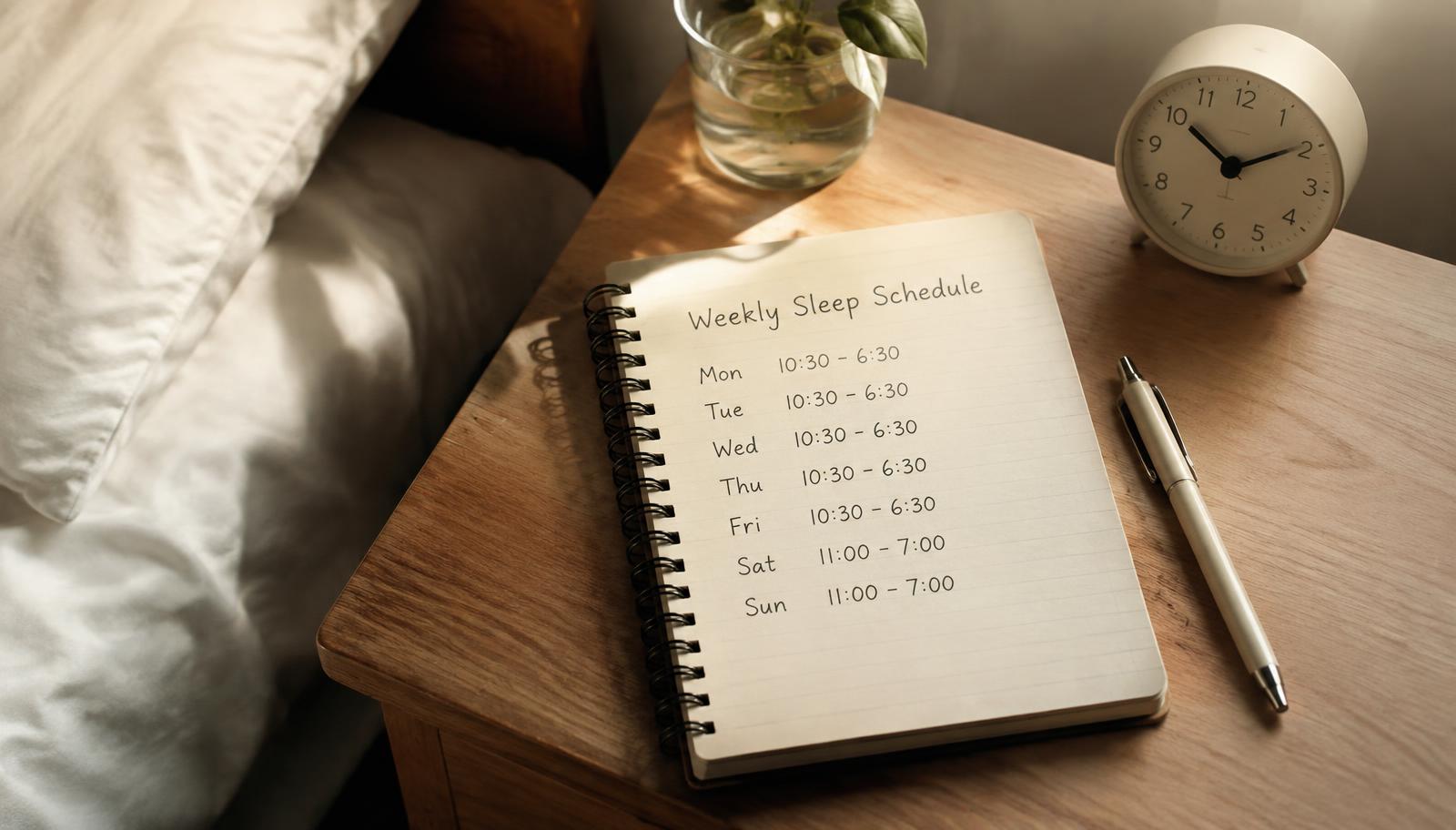
When sleep and wake times change from day to day, such as with weekend lie-ins or late shifts, the body clock and its light cues fall out of step with the actual clock time. This mismatch, sometimes called social jet lag, can leave you feeling tired and out of sorts even without crossing time zones. Because the body clock adjusts gradually, resetting it typically takes several days of consistent cues rather than happening overnight.
6 min readRead the guide →