
Sleep Questions
Does melatonin help you sleep?
Melatonin can help some people, but mainly by adjusting the timing of sleep rather than forcing it. Research shows the clearest benefits in situations where the body clock is out of step, such as jet lag and delayed sleep timing, and some benefit for certain older adults. For general insomnia in adults, average effects are modest, and UK guidance puts other approaches first.
7 min read · Published 24 September 2026

In short
- Melatonin mainly influences when you sleep, rather than acting as a sedative.
- Evidence is strongest for jet lag and for body-clock timing problems.
- Research in older adults with insomnia, often using prolonged-release tablets, has shown some benefit.
- For general adult insomnia, average improvements in falling asleep are small.
- NHS and NICE guidance recommend sleep habits and CBT for insomnia before medicines.
Melatonin is widely thought of as a sleep aid, so it can be surprising to learn how mixed the research is. The answer to "does it help you sleep?" depends heavily on why sleep is difficult in the first place. This guide sets out where the evidence is reasonably clear, where it is modest, and where it is uncertain.
Timing, not sedation
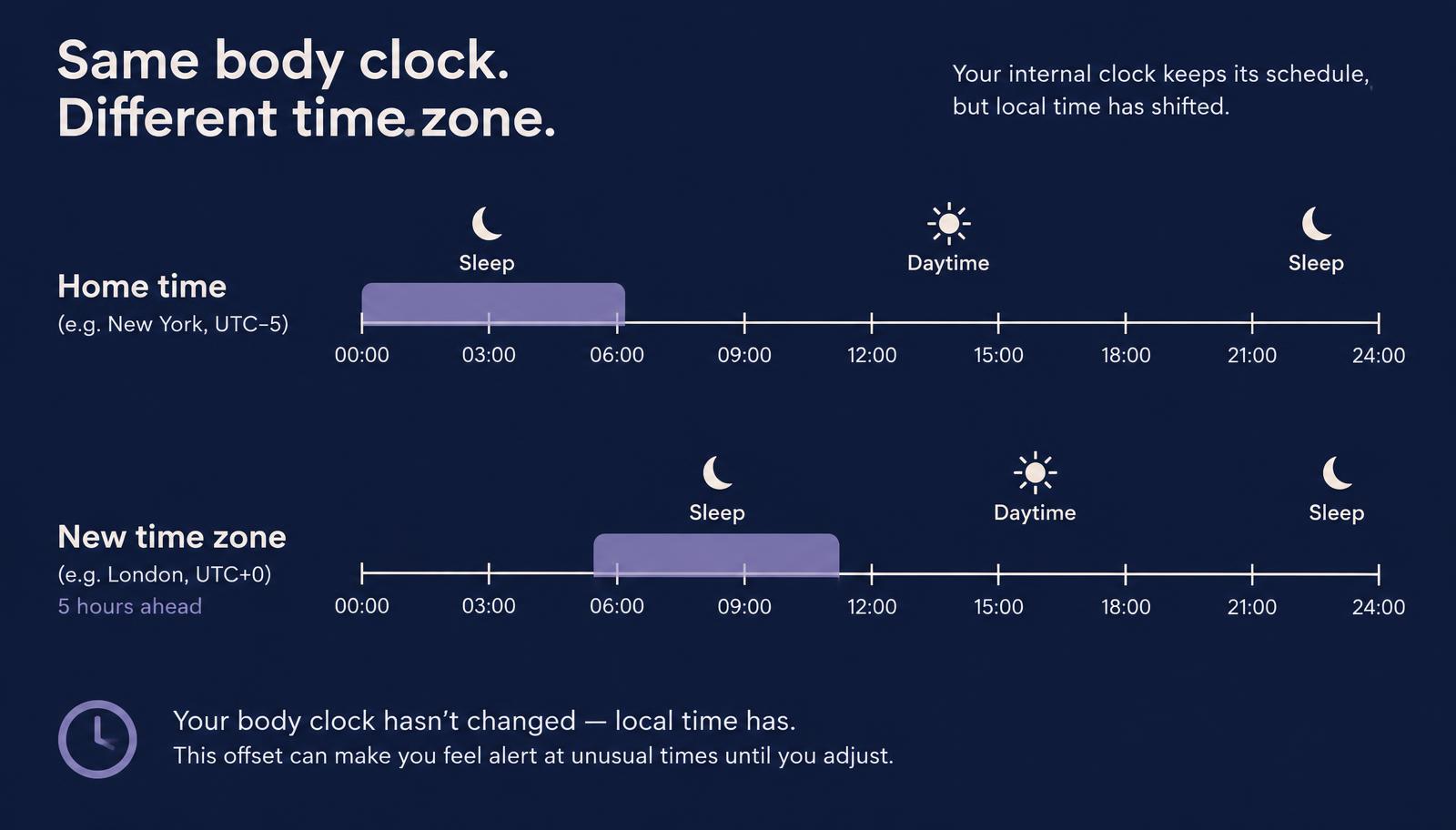
The body's own melatonin rises in the evening as light fades, signalling to the body clock that night has begun. Melatonin taken by mouth sends a similar signal. It can shift the clock earlier or later depending on when it arrives, and it may produce mild drowsiness for some people. It does not shut the brain down the way sedating medicines do. Melatonin versus sleeping pills: what is the difference? explains the contrast.
This matters because it predicts where melatonin is likely to help: problems of timing, rather than problems caused by worry, pain, noise or another condition.
Where the evidence is clearer
- Jet lag: a Cochrane review found melatonin reduced jet lag symptoms for many travellers, particularly when crossing several time zones eastwards.
- Delayed sleep timing: people whose body clock runs late, making them unable to fall asleep until the small hours, have shown earlier sleep timing in studies.
- Older adults with insomnia: research, largely with prolonged-release tablets, has shown modest improvements, possibly because the body's own melatonin tends to decline with age.
Melatonin and jet lag and Melatonin and sleep in older adults look at these findings in detail.
Where effects are modest
For adults with general insomnia, meaning trouble falling or staying asleep without an obvious timing problem, reviews have found average effects to be small. In some analyses, people fell asleep only a few minutes sooner on average than with a dummy pill, with little change in total sleep time. Some individuals notice more benefit than this, others none.
Staying asleep through the night is also less well supported than falling asleep, though prolonged-release forms were designed partly with this in mind. Why do I wake up during the night? explores the many other reasons people wake.
Why melatonin might not help you
- The cause of poor sleep is stress, anxiety, pain or a condition such as sleep apnoea.
- Bright light in the evening is working against the melatonin signal.
- Caffeine or alcohol is disrupting sleep, as described in Caffeine and sleep timing.
- The timing is not suited to the problem, which can even push the clock the wrong way.
- The product contains a different amount from its label.
What helps alongside, or instead
Because melatonin works through the body clock, the habits that strengthen that clock matter too: a consistent wake time, daylight in the morning, dimmer light in the evening and a manageable wind-down routine. How to build a consistent sleep schedule and Morning light and your body clock are good places to start. If sleep problems persist for weeks, What to do when sleep problems continue explains when to see a GP.
Common questions
Does melatonin help you stay asleep?
Evidence is weaker for staying asleep than for falling asleep. Prolonged-release forms have been studied for this, mainly in older adults.
Does melatonin work for everyone?
No. Responses vary considerably, and it is unlikely to help where the cause of poor sleep is not about timing.
Is it worth trying melatonin for insomnia?
That depends on the cause and your health. A GP or pharmacist can help you weigh it against approaches with stronger evidence.
A 2017 review in Sleep Medicine Reviews by Auld and colleagues concluded that the strongest evidence for melatonin is in shortening the time taken to fall asleep and in delayed sleep–wake phase disorder, with weaker evidence for other sleep problems.
A 2013 meta-analysis in PLoS One by Ferracioli-Oda and colleagues, pooling 19 studies, found that melatonin shortened the time taken to fall asleep by around seven minutes on average and slightly increased total sleep time, with no sign that the effect wore off over time.
Sources
- NHS – Insomnia
- NICE CKS – Insomnia
- Cochrane – Melatonin for the prevention and treatment of jet lag
- NCCIH – Melatonin: what you need to know
- StatPearls – Melatonin (NCBI Bookshelf)
- Ferracioli-Oda et al. (2013) – Meta-analysis: melatonin for the treatment of primary sleep disorders, PLoS One
- Auld et al. (2017) – Evidence for the efficacy of melatonin in the treatment of primary adult sleep disorders, Sleep Medicine Reviews
Written by The Melatonin UK editorial team.
Published 24 September 2026. This article is general information about sleep and the body clock. It is not medical advice, and it does not replace a conversation with your GP or pharmacist.
Read next

Research & Safety
What has research studied about melatonin and sleep?
Melatonin has been researched most extensively for jet lag, shift work adjustment, delayed sleep timing, and helping some people fall asleep faster. The evidence is stronger and more consistent in some of these areas than others, and important questions remain about long-term use, ideal timing, and how much individual response varies. Understanding the strength and limits of this research helps set realistic expectations.
6 min readRead the guide →
Sleep Questions
Insomnia or a shifted body clock?
Insomnia and a shifted body clock can both cause difficulty sleeping, but they are different problems with different explanations. Insomnia involves trouble sleeping even when the opportunity and timing are right, while a shifted body clock means the timing itself is out of step with the schedule you are trying to keep. Telling them apart matters because the approaches that help each one are not the same.
6 min readRead the guide →

Research & Safety
Melatonin versus sleeping pills
Melatonin mainly acts as a timing signal, telling the body clock that it is night. Sleeping pills, known medically as hypnotics, generally act on brain chemistry to promote sedation. As a result they differ in how strongly they cause sleepiness, how they feel the next day, and the risk of tolerance and dependence, which is a recognised concern with many sleeping pills and has not been a prominent finding with melatonin.
6 min readRead the guide →