
Research & Safety
What has research studied about melatonin and sleep?
Melatonin has been researched most extensively for jet lag, shift work adjustment, delayed sleep timing, and helping some people fall asleep faster. The evidence is stronger and more consistent in some of these areas than others, and important questions remain about long-term use, ideal timing, and how much individual response varies. Understanding the strength and limits of this research helps set realistic expectations.
6 min read · Published 24 September 2026

In short
- Melatonin research spans jet lag, shift work, delayed sleep timing, and general sleep onset.
- Evidence for jet lag is among the more established areas of melatonin research.
- Findings on shift work and delayed sleep timing are promising but less uniform.
- Individual response to melatonin varies considerably between people.
- Long-term use in adults has not been studied as extensively as short-term use.
Melatonin is one of the more widely researched substances in sleep science, partly because it is naturally occurring and partly because its role in timing the body clock makes it relevant to several distinct sleep-related situations. This guide looks at the main areas researchers have focused on, and is careful to separate what is reasonably well established from what remains uncertain.
Jet lag
Jet lag, caused by travelling quickly across time zones faster than the body clock can adjust, is one of the more established areas of melatonin research. A Cochrane review of the evidence found that melatonin can be helpful in reducing jet lag symptoms for travellers crossing multiple time zones, particularly on eastward journeys, though it also noted variation in how studies were designed and conducted. Melatonin and jet lag and Jet lag east versus west go into this evidence in more detail.
Shift work
Shift workers, particularly those on night shifts, often need to sleep at times that conflict with their natural body clock and with daylight. Research has looked at whether melatonin can help with sleep quality and daytime sleep duration in this context, with some studies suggesting modest benefit, though findings are less consistent than for jet lag and are complicated by the wide variety of shift patterns studied. Sleep and shift work covers the practical side of this in more depth.
Delayed sleep timing
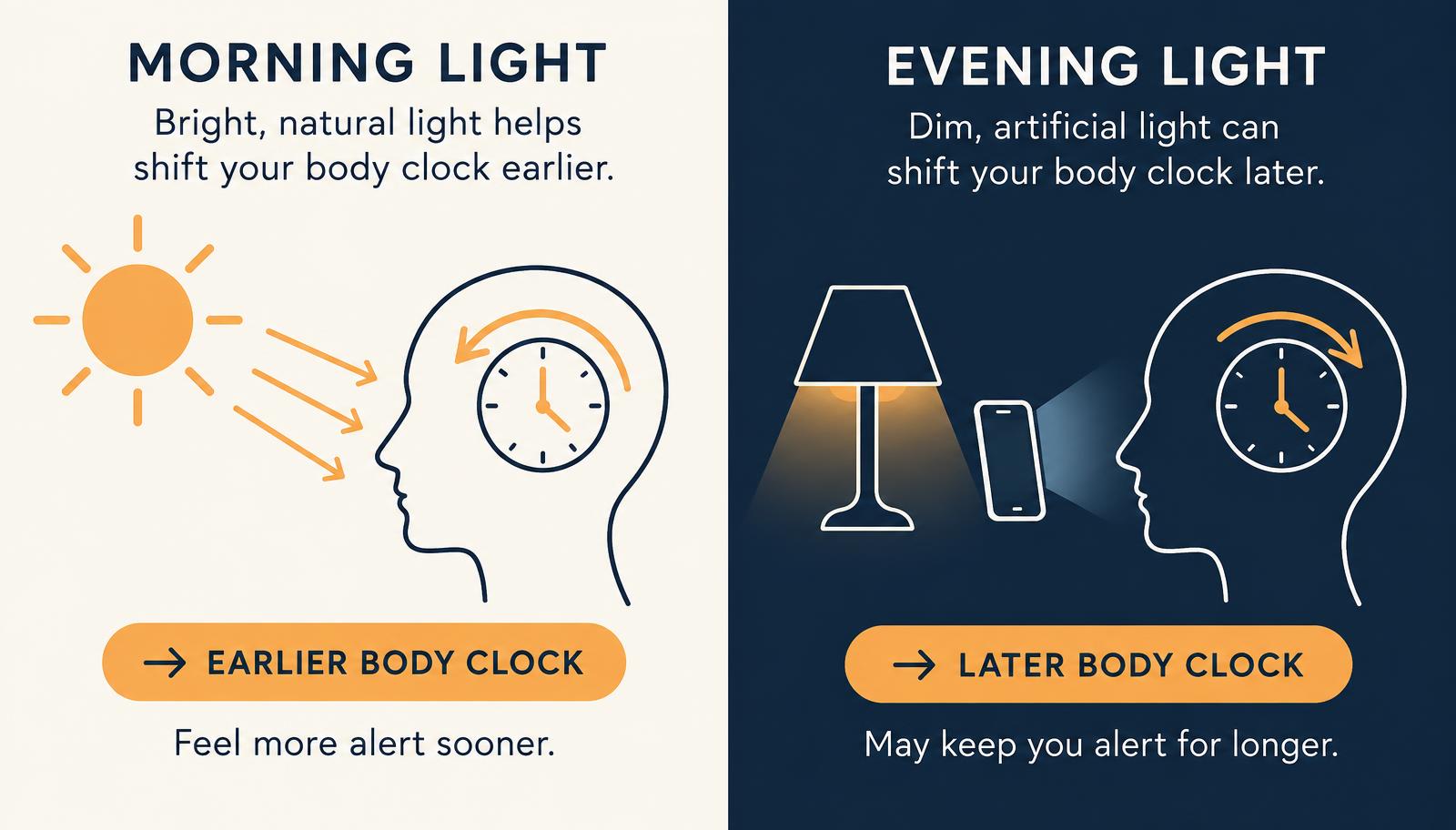
Some people have a body clock that runs consistently later than is convenient for daily life, sometimes described in more pronounced cases as delayed sleep phase. Research in this area has explored whether carefully timed melatonin can help shift the body clock earlier, generally alongside light exposure strategies. This is an area where timing relative to a person's own body clock appears to matter considerably, making self-directed use difficult to get right without guidance.
General sleep onset
Melatonin has also been studied for its effect on how quickly people fall asleep more generally. Some studies report modest reductions in the time it takes to fall asleep, though effect sizes vary between studies and populations, and melatonin's role here is generally understood as one of timing rather than sedation, as explained in What is melatonin?
Strength and limits of the evidence
Taken together, the research base is strongest for short-term situations with a clear circadian trigger, such as jet lag, and comparatively less developed for long-term or everyday use. Study quality also varies: differences in dose, timing, formulation, and how outcomes were measured make it difficult to draw single, sweeping conclusions across the whole field. Individual response also appears to vary considerably, which is one reason results in a research study do not always translate predictably to any one person.
Where uncertainty remains
Long-term use of melatonin in adults has not been studied as extensively as short-term use, so less is known about effects over months or years. Research in children and in pregnancy is also more limited, which is why these situations are approached with particular caution, as discussed in Melatonin and children and Melatonin in pregnancy and breastfeeding. Reported side effects and how commonly they occur are covered separately in Melatonin side effects.
How melatonin studies are typically designed
Understanding a little about how melatonin research is usually carried out helps explain why conclusions are often more cautious than headlines suggest. Many studies compare a group taking melatonin against a group taking a placebo, an inactive substance that looks the same, so that researchers can see whether melatonin's effect goes beyond what people would experience anyway from expectation or the passage of time. Some studies also compare different doses or timings against each other directly, which helps build understanding of how these variables matter, though such comparisons are less common than placebo-controlled designs.
Study length varies considerably too. Many melatonin trials run for a matter of days or weeks, which is well suited to short-term situations like jet lag but tells us comparatively little about what happens with use over months or years, an important gap discussed further below.
Dose and formulation differences across studies
Melatonin products and doses used in research vary considerably, and formulations such as immediate-release and prolonged-release preparations can behave differently in the body. This matters when comparing studies, because a finding based on one dose or formulation does not automatically apply to another. It is one reason researchers and clinicians are cautious about combining results from very different studies into a single, simple conclusion, and why product-specific information, such as that found via the BNF, is relevant alongside general research summaries.
Why the population studied matters
Melatonin research has been carried out in a range of different groups, including healthy adults, shift workers, travellers, older adults, and in some cases children with specific conditions, and findings from one group do not necessarily generalise to another. A study showing benefit in, say, healthy adult travellers crossing several time zones does not tell us with confidence what would happen for an older adult with a different set of health conditions, which is one reason Melatonin and sleep in older adults and Melatonin and children treat these groups separately rather than assuming the general research applies uniformly.
This is also why individual response is difficult to predict from research alone. Trials report averages and ranges across groups of people, but any one person's experience can reasonably fall outside the typical pattern reported, which is part of why a GP or pharmacist considering your specific situation is more useful than a general research summary on its own.
Reading research summaries carefully
News coverage and online summaries of melatonin research can sometimes present findings with more confidence than the underlying study supports, particularly when a single study is reported without the context of the wider research it sits within. A single positive result, especially from a small or short study, is best treated as one data point rather than a settled conclusion, and it is generally more informative to look at how a finding fits with reviews that draw together many studies, such as the Cochrane review on jet lag, than to rely on one study in isolation.
This is also why this guide deliberately avoids quoting specific percentages, effect sizes, or numbers of participants: doing so from memory or from a secondary summary risks misrepresenting a study, and specific figures are best checked directly against the primary source, such as the Cochrane Library or NCBI Bookshelf entries listed in the sources below, if you want that level of detail.
Publication and reporting biases
Like most areas of medical research, melatonin studies are subject to publication biases, where studies with a clear positive result are sometimes more likely to be published or reported prominently than studies finding little or no effect. Systematic reviews, which try to gather all relevant studies rather than only the most visible ones, are one of the tools researchers use to reduce this bias, which is part of why reviews such as the Cochrane assessment of jet lag evidence carry particular weight compared with any single trial.
What future research may help clarify
Ongoing and future research is likely to help refine understanding of optimal timing for different situations, long-term safety in adults, and how individual factors such as age or genetics affect response. Until that evidence matures, the sensible approach remains treating melatonin as one option to discuss with a GP or pharmacist rather than a settled, one-size-fits-all solution.
Common questions
Is melatonin's effect on jet lag well established?
It is one of the more established areas, supported by a Cochrane systematic review, though even here study quality varies and effects are not identical for every traveller or route.
Does research support melatonin for everyday insomnia?
Evidence here is more mixed than for jet lag, and UK guidance generally favours other first-line approaches for ongoing insomnia, as described in What to do when sleep problems continue.
Why do studies sometimes disagree with each other?
Differences in dose, timing, formulation, study length, and the population studied can all lead to different findings, which is why single studies are usually interpreted alongside the wider body of research rather than in isolation.
A 2017 review in Sleep Medicine Reviews by Auld and colleagues concluded that the strongest evidence for melatonin is in shortening the time taken to fall asleep and in delayed sleep–wake phase disorder, with weaker evidence for other sleep problems.
A 2013 meta-analysis in PLoS One by Ferracioli-Oda and colleagues, pooling 19 studies, found that melatonin shortened the time taken to fall asleep by around seven minutes on average and slightly increased total sleep time, with no sign that the effect wore off over time.
Sources
- Cochrane – Melatonin for the prevention and treatment of jet lag
- NCCIH – Melatonin: what you need to know
- StatPearls – Melatonin (NCBI Bookshelf)
- NHS – Melatonin
- Ferracioli-Oda et al. (2013) – Meta-analysis: melatonin for the treatment of primary sleep disorders, PLoS One
- Auld et al. (2017) – Evidence for the efficacy of melatonin in the treatment of primary adult sleep disorders, Sleep Medicine Reviews
Written by The Melatonin UK editorial team.
Published 24 September 2026. This article is general information about sleep and the body clock. It is not medical advice, and it does not replace a conversation with your GP or pharmacist.
Read next

Research & Safety
Melatonin side effects: what is commonly reported
Commonly reported effects associated with melatonin include next-day grogginess, headache, dizziness, and mild nausea, though not everyone experiences these and reports vary between individuals and studies. Differences in dose, timing, formulation, and personal sensitivity all help explain why. Anyone considering melatonin, or experiencing unwanted effects, should speak to a GP or pharmacist for advice specific to their situation.
6 min readRead the guide →
The Body Clock
Melatonin and jet lag: understanding the connection
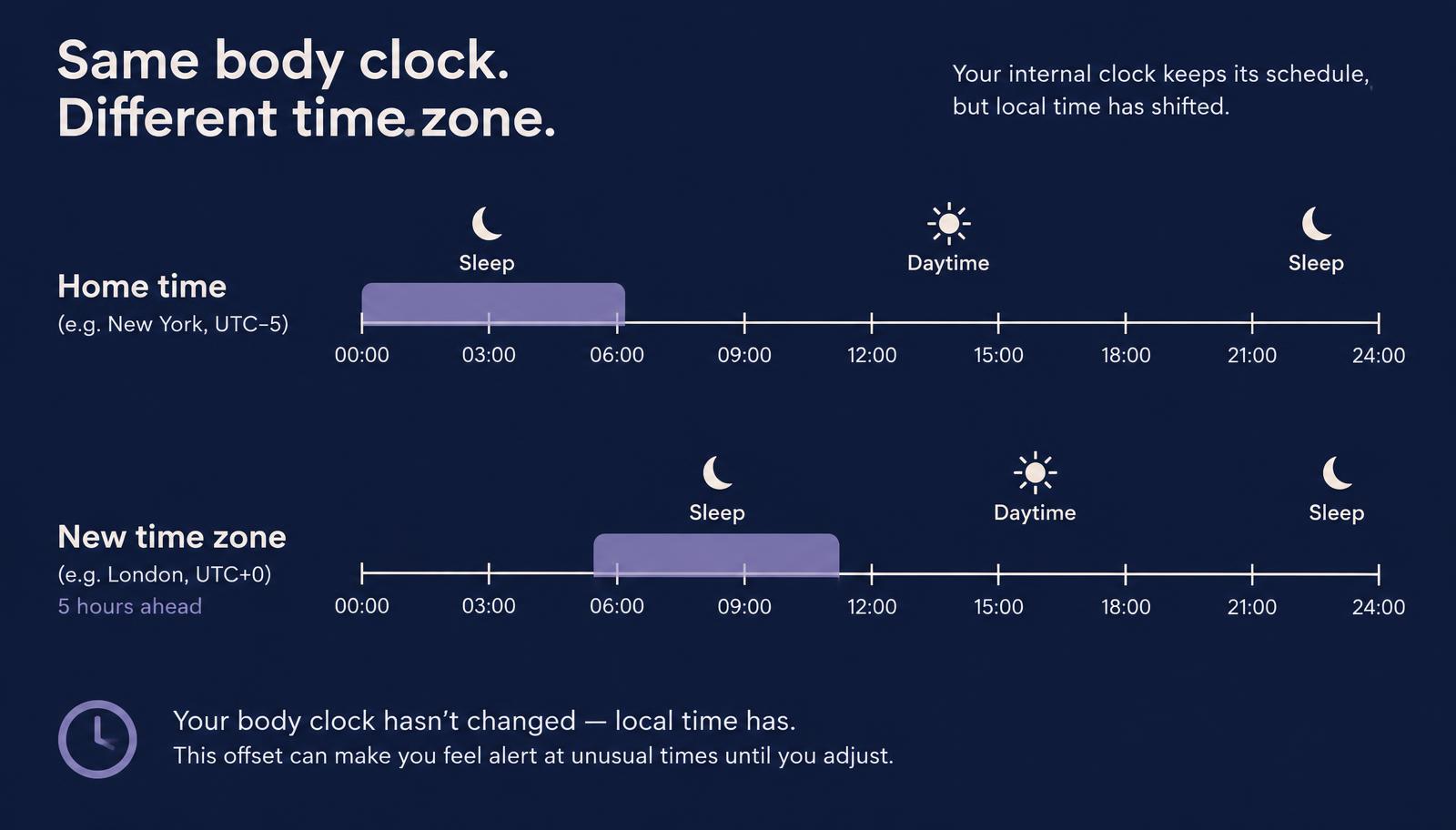
Jet lag happens because your internal body clock stays set to your home time zone while the outside world has moved on. Melatonin is one of the signals your brain uses to keep that clock synchronised, which is why researchers have studied it in relation to jet lag. The evidence is mixed and depends heavily on timing, so it's worth understanding the underlying biology rather than treating melatonin as a simple fix.
6 min readRead the guide →

Research & Safety
Melatonin myths and misconceptions
Melatonin is widely misunderstood, from the idea that it is a sedative, to the belief that more is always better, that natural means risk-free, or that it single-handedly cures jet lag. Understanding what melatonin actually does helps separate reasonable expectations from popular myths.
6 min readRead the guide →