
Better Sleep
Can relaxation exercises help you sleep?
Relaxation exercises can help some adults settle before bed by easing physical tension and mental busyness. They are best seen as a way to make room for sleep, rather than a technique that guarantees it.
5 min read · Published 16 October 2026
In short
- Relaxation can ease tension without making you fall asleep immediately.
- Gentle breathing, muscle relaxation and calming imagery offer different ways to unwind.
- Comfort matters more than following a technique perfectly.
- Practising at quieter moments can make exercises feel more familiar at bedtime.
- Persistent insomnia may need broader support, not simply more relaxation.
You have finished the day, put everything aside and climbed into bed — yet your shoulders are still tight and your thoughts are still busy. Feeling tired does not always mean feeling settled. Relaxation exercises offer a gentle way to ease that transition, without needing special equipment or a complicated bedtime ritual.
The useful shift is to stop treating relaxation as a test of whether you can fall asleep. Its immediate purpose is simpler: to feel a little more comfortable and less caught up in the day. Sleep may follow, but there is no need to watch for it.
How can relaxation make sleep easier?
Sleep depends on several things working together, including your body clock and the pressure to sleep that builds while you are awake. Relaxation does not replace those processes. Instead, it can help reduce something that gets in their way: feeling mentally or physically on alert.
That alert feeling might show up as a clenched jaw, restless planning or repeatedly checking whether you are sleepy yet. Trying harder to sleep can add another layer of pressure. A simple exercise gives your attention somewhere quieter to rest, without asking you to solve problems or achieve a particular result.
Relaxation is included in sleep advice and may form part of psychological approaches to insomnia. It can help some people, but no single exercise works for everyone. Evidence for a broader treatment such as cognitive behavioural therapy for insomnia, or CBT-I, should not be taken as proof that one breathing pattern will reliably bring on sleep.
Gentle breathing: keep it comfortable
Breathing exercises provide a straightforward focus when your mind keeps jumping between tasks. There is no need to take the deepest possible breath or copy a demanding online routine. Gentle, unforced breathing is a more comfortable starting point than trying to fill your lungs completely.
- Sit or lie somewhere comfortable, allowing your shoulders to settle.
- Notice your breathing before trying to change anything.
- Let each breath flow gently, without forcing a particular depth.
- If it helps, use a soft, steady count as you breathe in and out.
- When your attention wanders, return to the next breath without criticism.
Counting is optional, not a target. You do not need to hold your breath or match someone else's pace. If controlling your breathing feels uncomfortable or makes you light-headed, stop the exercise and return to your usual breathing.
Some people find that focusing on breathing makes them more watchful rather than calmer. That is a good reason to choose a different focus, such as the feel of the pillow or a peaceful imagined scene. Relaxation should not become an endurance task.
Muscle relaxation: notice where you hold tension
Progressive muscle relaxation involves gently tightening and then releasing different muscle groups. The aim is to become more aware of the contrast between tension and ease. It can be particularly appealing when winding down feels like a physical challenge rather than a stream of busy thoughts.
For example, you might gently tighten your hands, release them and notice the difference. You can then move through other comfortable areas, allowing time to notice each release. Strong squeezing is unnecessary, and any area that feels painful or uncomfortable can simply be skipped.
An alternative is a release-only body scan. Bring your attention to your forehead, jaw, shoulders, hands and legs in turn, noticing whether each area can soften without deliberately tensing it first. There is no need to complete a fixed sequence or make every muscle feel completely relaxed.
Neither approach requires perfect concentration. If you discover that you have spent a while thinking about tomorrow, you can simply return to a comfortable part of the body. Wandering attention is not a sign that the exercise has failed.
Calming imagery: give busy thoughts somewhere else to go
Calming imagery means picturing a setting that feels peaceful or undemanding. It might be a quiet garden, a familiar room or a gentle walk. The scene does not need to be especially vivid, and it certainly does not need a storyline.
Rather than ordering yourself to stop thinking, you give your attention something neutral to explore. You might imagine the texture of a chair, the sound of leaves or the warmth of sunlight. If another thought interrupts, return to one small detail instead of trying to rebuild the whole scene.
If visualising is difficult, a simple guided relaxation recording may feel easier. Choose something that does not encourage you to keep checking a screen. Alternatively, notice ordinary sensations around you, such as the support of the mattress. No particular image or sound has to feel calming to everyone.
Make relaxation an option, not another obligation
Choose one approach that feels manageable rather than combining every technique into a lengthy routine. Practising during a quieter moment in the day can help you become familiar with it, without the added expectation that sleep should follow straight away.
At bedtime, it helps to leave room for ordinary variation. An exercise may feel soothing one evening and distracting the next. You can change approach or stop; there is no need to repeat it until you get the “right” result.
Relaxation also has limits. It cannot fully compensate for an uncomfortable sleep environment or a schedule that clashes with your body clock. If sleep difficulties have lasted for months or are making everyday life hard to manage, professional support is worthwhile. CBT-I addresses the thoughts and behaviours that maintain insomnia and involves more than simply learning to relax.
Common questions
Which relaxation exercise is best for sleep? There is no universal winner. Breathing may suit someone who likes a simple focus, while muscle relaxation or imagery may feel more natural to someone else. An approach you find comfortable is more useful than one you feel obliged to master.
How quickly should an exercise work? There is no reliable countdown to sleep. You may notice a small change in tension, or you may not notice much at first. Checking the time repeatedly can turn a calming practice into a performance test.
Does feeling relaxed mean I have had enough sleep? No. Relaxation can make being awake feel more restful, but it does not replace sleep. Its practical value is helping you step out of the day's demands and into a quieter state — without needing to force what happens next.
Sources
Written by Melatonin UK editorial team.
Published 16 October 2026. This article is general information about sleep and the body clock. It is not medical advice, and it does not replace a conversation with your GP or pharmacist.
Read next
Better Sleep
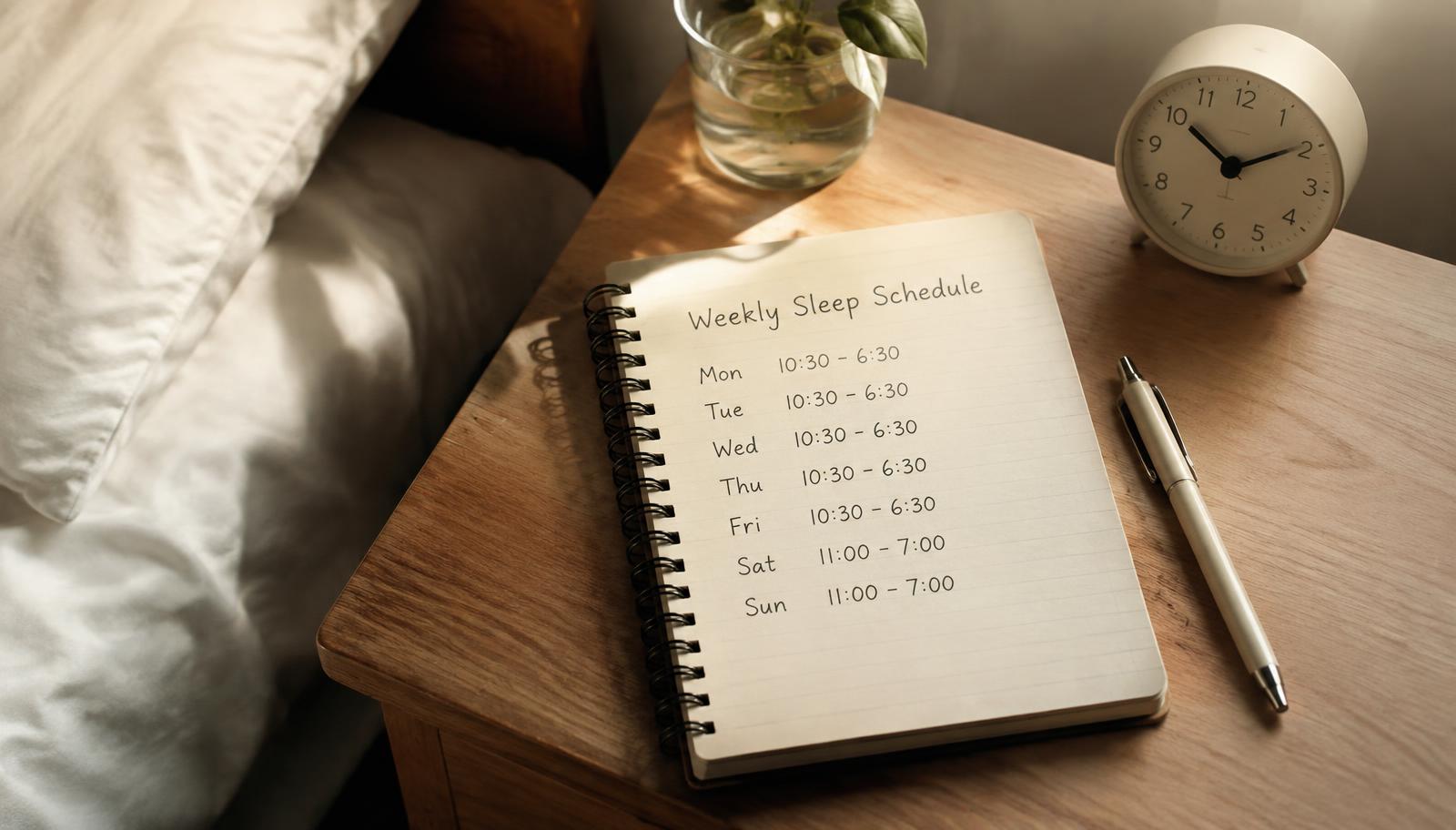
How to build a more consistent sleep schedule
A more consistent sleep schedule is usually best built gradually, anchored around a fixed wake time rather than a fixed bedtime, supported by consistent light exposure. Small, sustainable adjustments over days or weeks tend to work better than sudden changes. The goal is a rhythm the body clock can rely on, not a single perfect night.
6 min readRead the guide →

Better Sleep
Caffeine and sleep: why timing matters
Caffeine blocks a chemical called adenosine that builds up sleep pressure through the day, and it can remain active in the body for many hours after it is drunk. Cutting off caffeine in the early-to-mid afternoon is a sensible default for most people, though individual sensitivity varies considerably and hidden sources are easy to miss.
6 min readRead the guide →

Better Sleep
Alcohol and sleep quality
Alcohol can make falling asleep feel easier because it is sedating, but sedation is not the same as normal, restorative sleep. As the body processes alcohol overnight, sleep tends to become lighter and more fragmented in the second half of the night, which is why a nightcap often leads to earlier or more frequent waking.
6 min readRead the guide →