
Better Sleep
How to build a more consistent sleep schedule
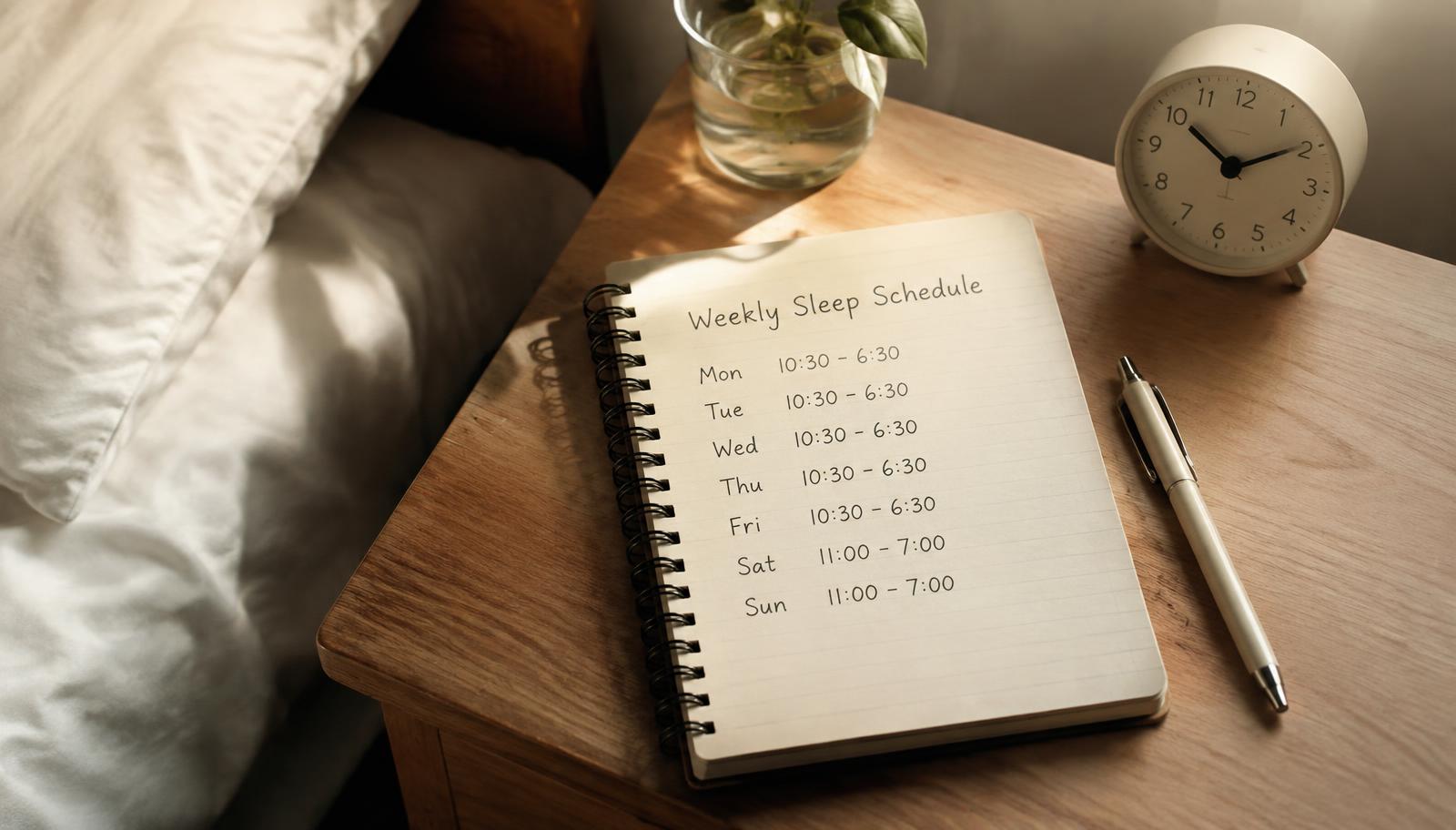
A more consistent sleep schedule is usually best built gradually, anchored around a fixed wake time rather than a fixed bedtime, supported by consistent light exposure. Small, sustainable adjustments over days or weeks tend to work better than sudden changes. The goal is a rhythm the body clock can rely on, not a single perfect night.
6 min read · Published 24 September 2026
In short
- A fixed wake time is generally a more reliable anchor than trying to force an exact bedtime.
- Morning light and evening dimming both reinforce the same underlying rhythm.
- Gradual shifts of small increments are more sustainable than sudden large changes.
- Weekend consistency matters, since large swings can undo progress made in the week.
- It typically takes days or weeks of consistency to feel a stable benefit, not one night.
A consistent sleep schedule is not about willpower on any single night; it is about giving the body clock reliable, repeated cues it can settle around. Because the body clock adjusts gradually, as explained in What happens when your sleep schedule shifts?, building consistency is a process measured in days and weeks rather than a single evening's effort.
Anchor on wake time, not bedtime
It is tempting to focus on getting to bed at a fixed time, but bedtime is heavily influenced by how sleepy you happen to feel on a given night, which varies. Wake time is easier to control directly and has an outsized effect on the whole rhythm, because it determines when you are exposed to morning light, described in Morning light and your body clock.
Choosing a wake time you can realistically maintain every day, including weekends, gives the body clock a dependable daily reference point. Over time, bedtime tends to naturally become more consistent as the body adapts around that fixed anchor.
Use light deliberately across the day
Since light is the body clock's main timing signal, as covered in Why does light affect melatonin?, using it deliberately is one of the more effective tools available. Getting daylight, or at least brighter light, soon after your chosen wake time reinforces the start of the day, while dimming lighting in the evening supports the wind-down towards sleep, a balance discussed further in Evening light, screens, and sleep.
- Get some natural or bright light within the first hour or so of waking, where possible.
- Keep daytime environments reasonably well lit to support alertness.
- Dim household lighting in the hour or two before your intended bedtime.
- Keep the bedroom dark and quiet during sleep itself.

Shift gradually rather than all at once
If your current schedule is quite different from where you would like it to be, for example wanting to wake an hour or more earlier, it is generally more sustainable to shift wake time by around fifteen to thirty minutes every few days rather than making the full change immediately. This mirrors how the body clock itself adjusts, roughly an hour or so per day at most, and reduces the sense of forcing an abrupt change the body is not ready for.
- Decide on a realistic target wake time that fits your life most days.
- Move your current wake time towards it in small steps every few days.
- Pair each step with morning light exposure to reinforce the new timing.
- Keep the new wake time steady for a week or two before making further changes.
A worked example: moving from midnight to eleven
Suppose someone currently falls asleep around midnight and wakes at eight, but would like to be asleep by eleven and up at seven to fit a new commute. Rather than attempting this in one night, they might set their alarm fifteen minutes earlier every three or four days, moving from eight o'clock to a quarter to eight, then half past seven, and so on, over the course of two to three weeks. Each earlier wake time is paired with getting outside or near a window as soon as possible afterwards, which helps the body clock's own bedtime drift earlier in step, rather than leaving the person lying awake for longer each night.
This slower approach tends to feel more comfortable than an abrupt jump, and it is also more likely to stick, since each small step is easier to maintain consistently than a large one that fights against the body's current rhythm.
Protect the routine at weekends
Large weekend shifts in wake time are one of the most common ways a consistent schedule gets undone, a pattern explored in What happens when your sleep schedule shifts? Aiming to keep weekend wake times within about an hour of weekday timing tends to preserve most of the benefit while still allowing some flexibility.
Supporting habits that reinforce the schedule
Alongside wake time and light, a handful of other daily habits tend to make a consistent schedule easier to sustain. Keeping caffeine to the earlier part of the day, as discussed in Caffeine and sleep timing, avoiding long or late naps that reduce natural sleep pressure by bedtime, and having a simple, repeatable wind-down routine in the evening all work in the same direction as a fixed wake time, reinforcing rather than competing with it.
Give the new pattern time to settle
It is easy to judge a new routine too quickly and assume it is not working after a rough night or two. Because the body clock shifts gradually, most people need at least one to two weeks of reasonably consistent timing before the benefits become noticeable and stable. Persisting through the early, less comfortable days is often the hardest but most important part.
Tracking progress without becoming obsessive
A simple written log of bedtime, wake time and roughly how rested you felt can be a useful way of seeing whether a new schedule is actually taking hold, since memory of individual nights is notoriously unreliable. A week or two of brief notes, nothing more elaborate than a few words each morning, often reveals a clearer pattern than trying to recall the past fortnight from memory.
That said, tracking can tip into counterproductive territory if it becomes a source of nightly anxiety, particularly with sleep-tracking apps and wearables that report detailed but not always reliable estimates of sleep stages. If checking a tracker first thing in the morning makes you more anxious about sleep rather than more informed, it is worth stepping back and relying on how you feel during the day instead.
When life disrupts the plan
Illness, travel, a new baby, or a demanding period at work can all knock a carefully built schedule off course, sometimes for weeks at a time. Rather than treating this as a failure that means starting from scratch, it is more realistic to view the earlier consistent period as groundwork that makes returning to a steady rhythm afterwards somewhat easier and faster than building it the first time.
When you are ready to return to a consistent schedule after a disruption, the same gradual approach described above tends to work better than trying to force the old routine back into place in a single night. Picking a realistic wake time and nudging towards it in small steps, exactly as when building the habit originally, respects the fact that the body clock still needs several days of consistent cues to settle.
Let the bedroom environment reinforce the schedule
A consistent schedule works best alongside a bedroom environment that reliably signals sleep, since the two reinforce each other. Keeping the room dark, quiet, and at a comfortable temperature, and reserving the bed mainly for sleep rather than working or scrolling through a phone, helps the brain build a strong association between that space and rest. Bedroom light, noise and temperature explores this in more detail, and it is a natural companion to the timing habits described above rather than a separate project.
Over time, walking into a bedroom that is set up this way, at a broadly consistent hour, becomes its own cue for winding down, working alongside the internal signals your body clock is already providing.
Adjusting the approach for a different body clock type
Not everyone starts from the same natural preference, and someone with a strongly later chronotype will generally find shifting their schedule earlier harder, and needing more patience, than someone whose natural rhythm already leans early. This does not mean the gradual approach described above does not apply to them, only that the small steps may need to be smaller, or held for slightly longer at each stage, before moving on to the next.
Common questions
Should I go to bed at the same time every night?
A consistent bedtime is helpful, but it is generally easier and more effective to anchor on a fixed wake time first, since bedtime naturally becomes more regular as your body adjusts around it.
What if I genuinely cannot fall asleep at my intended bedtime?
This is common in the early stages, and getting up briefly to do something calm in dim light rather than lying awake frustrated is a reasonable approach. If difficulty falling asleep persists over weeks, it is worth reading Why do I struggle to fall asleep? or speaking to a GP or pharmacist.
How long before a new sleep schedule feels normal?
Many people notice some improvement within a week or two of consistent effort, though this varies between individuals and depends on how large a change is being made.
Sources
Written by The Melatonin UK editorial team.
Published 24 September 2026. This article is general information about sleep and the body clock. It is not medical advice, and it does not replace a conversation with your GP or pharmacist.
Read next

The Body Clock
Morning light and your body clock
Morning daylight is one of the strongest signals for anchoring your body clock, helping set the timing for alertness during the day and melatonin release later that night. It is especially useful because it comes early in the light-sensitive window the body clock relies on. UK winters make this harder, but there are realistic ways to get more usable light.
6 min readRead the guide →
The Body Clock
What happens when your sleep schedule shifts?
When sleep and wake times change from day to day, such as with weekend lie-ins or late shifts, the body clock and its light cues fall out of step with the actual clock time. This mismatch, sometimes called social jet lag, can leave you feeling tired and out of sorts even without crossing time zones. Because the body clock adjusts gradually, resetting it typically takes several days of consistent cues rather than happening overnight.
6 min readRead the guide →

The Body Clock
Evening light, screens, and sleep
Evening light can delay the rise of melatonin and shift the body clock later, particularly when it is bright and prolonged. The evidence for screens specifically is more mixed than commonly assumed, and factors like stimulating content and general arousal often play as large a role as the light itself. Both light and what you are doing on the screen are worth considering.
6 min readRead the guide →