Better Sleep
Can sleep trackers really tell how well you sleep?
Sleep trackers can help you spot patterns in your sleep, but their scores and sleep-stage readings are estimates rather than a precise assessment. They are most useful alongside how you feel during the day, not as a nightly target you need to achieve.
5 min read · Published 13 November 2026
In short
- Consumer sleep trackers estimate sleep rather than measuring it directly.
- Patterns across several nights are more useful than a single score.
- Sleep-stage readings should not be treated as exact measurements.
- Daytime alertness and wellbeing matter alongside the numbers.
- Taking a break from tracking is sensible if it makes sleep more stressful.
A watch says you slept brilliantly, but you feel exhausted. Or you wake feeling refreshed, only to discover that an app has given your night a disappointing score. Which should you believe? Sleep trackers can offer useful clues, but they do not tell the whole story. Understanding what sits behind the numbers can help you enjoy the practical benefits of tracking without turning bedtime into a performance test.
What does a sleep tracker actually measure?
Consumer sleep trackers include watches, rings, phone apps and devices placed beside or under a mattress. Depending on the device, they may collect information about movement, heart rate, breathing-related signals, skin temperature or sound. Software then uses those signals to estimate when you were asleep and, sometimes, which sleep stage you were in.
The important word is estimate. Most everyday trackers do not record the brain activity used to identify sleep stages in a clinical sleep study. Instead, they look for patterns that tend to accompany sleep. Remaining very still while reading in bed, for example, can be difficult for a movement-based device to distinguish from sleeping.
Different devices also use different sensors and calculations. Two trackers worn on the same night may produce different results without either being faulty. Device fit, missing readings and software changes can all affect what appears in the morning report.
How much should you trust sleep stages and scores?
Colourful charts can make sleep look neatly divided into precise blocks of light sleep, deep sleep and dreaming sleep, often labelled REM. In reality, the tracker is assigning labels based on the signals it receives. Those labels are not equivalent to having your sleep stages measured in a sleep laboratory.
It is particularly unhelpful to treat a reported amount of deep sleep as a target to beat. Sleep changes from night to night, and its pattern also changes with age. One low reading does not prove that your body missed out on recovery or that something needs fixing.
An overall sleep score adds another layer of interpretation. It may combine estimated sleep length, movement, timing and other measurements into one number. That can be convenient, but there is no single universal meaning behind a score of 80, for example. Comparing scores across different products may therefore tell you very little.
A more balanced question is: does the broad pattern match your experience? If a tracker repeatedly shows shorter nights during a busy working week, that may be worth noticing. A single unusual sleep-stage reading is much less useful on its own.
What can sleep tracking be useful for?
The practical upside is often awareness rather than precision. Tracking can make it easier to see that bedtime has gradually drifted later, or that early starts leave less room for sleep than you realised. It can also provide a convenient record when weekdays, weekends or working hours differ.
The most useful details are often straightforward:
- Your approximate bedtime and getting-up time.
- Whether you regularly leave enough time for sleep.
- Large changes between working days and days off.
- How rested, alert or sleepy you feel during the day.
- Whether a pattern persists rather than appearing for just one night.
Adding a short note about your day can give the numbers context. Travel, illness, an unusually late evening or a demanding week may help explain a change. However, seeing two things together does not prove that one caused the other. A better score after one particular evening routine is a clue, not a reliable experiment.
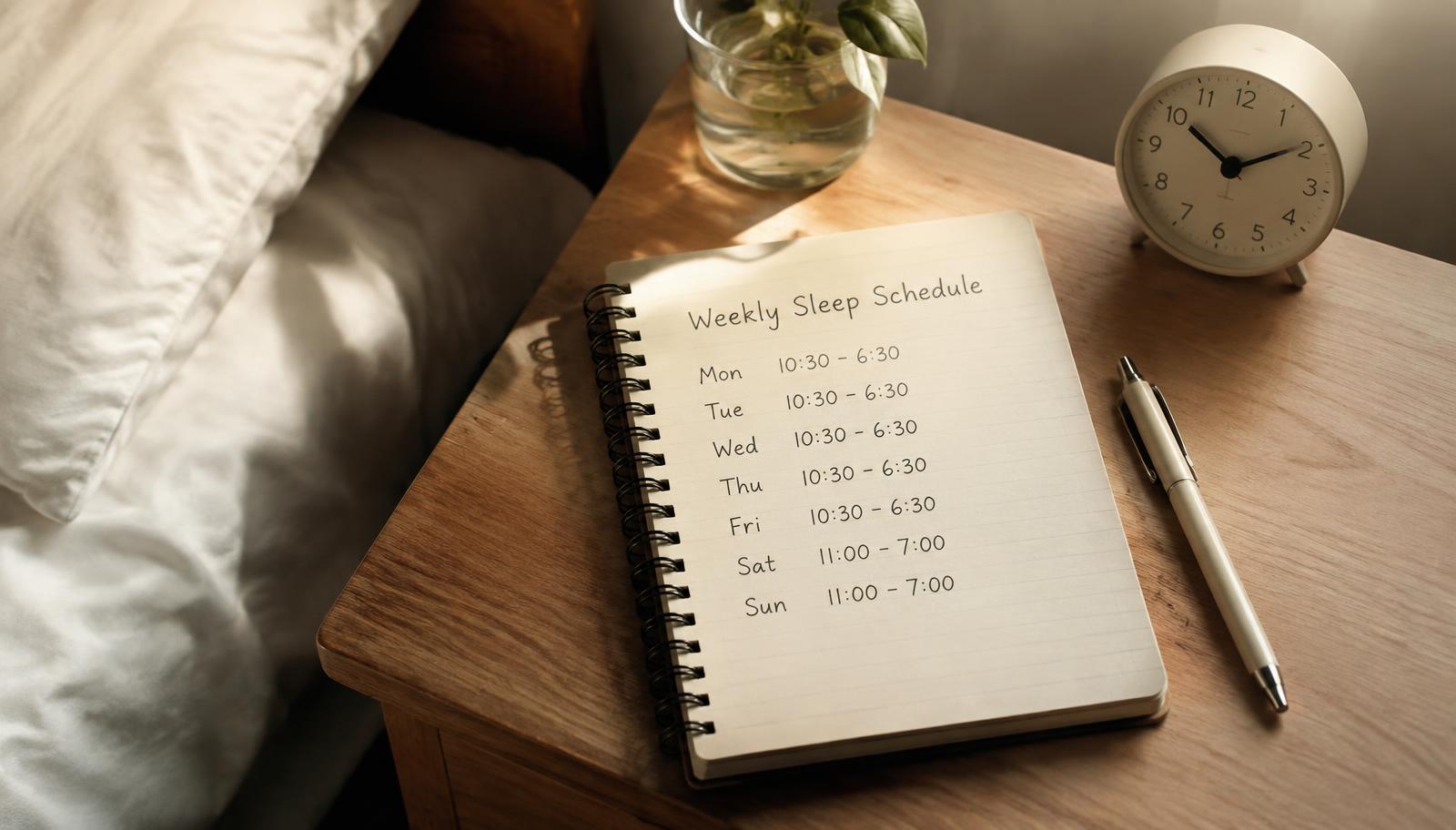
You also do not need a wearable to gain this perspective. A simple written record can capture sleep timing and daytime wellbeing without estimating sleep stages at all.
How can you use a tracker without chasing perfect sleep?
Start with one practical question, such as whether your evenings allow enough time for sleep. That gives tracking a purpose beyond collecting a higher score. Look at patterns across several nights rather than treating each morning as a pass-or-fail result.
It can also help to notice how you feel before opening the app. Are you reasonably refreshed? Can you concentrate? Are you struggling to stay awake? Your answers add information that a wrist sensor cannot fully capture. Feeling well should not automatically be dismissed because a chart looks disappointing.
Keep any routine changes simple and comfortable. Allowing time to wind down and keeping broadly regular sleep hours are sensible foundations; they do not need a device to validate them. Avoid repeatedly checking the time or live readings during the night, which can turn attention back towards whether you are managing to sleep.
There is no requirement to track every night indefinitely. If a weekly review feels calmer than daily checking, that may be a more useful way to engage with the information.
When is it better to look beyond the numbers?
Tracking becomes less helpful if a low score spoils your morning, makes you anxious about bedtime or encourages you to spend extra hours in bed trying to repair the next result. Taking a break, hiding sleep-stage details or switching to a brief written record can reduce that pressure.
Equally, a reassuring score should not override ongoing symptoms. Persistent sleep difficulties, unexplained tiredness or daytime sleepiness that affects everyday life deserve attention regardless of what the app reports. Loud snoring accompanied by gasping or pauses in breathing is another reason to seek professional assessment rather than rely on a tracker.
If you discuss sleep with a healthcare professional, a broad record of your routine and symptoms may be useful context. The data can support the conversation, but it does not establish a diagnosis. Never use a favourable score as proof that you are alert enough to drive if you feel sleepy.
Common questions
Can a sleep tracker measure melatonin? Ordinary consumer sleep trackers do not measure melatonin levels. An app may estimate your sleep timing, but that is not the same as measuring the hormone or precisely identifying the timing of your internal body clock.
Does a good sleep score mean I had enough sleep? Not necessarily. A score depends on how the device combines its measurements. Consider your actual opportunity for sleep and how you function during the day as well.
Do I need a tracker to sleep better? No. A tracker is optional. Its value lies in whether it helps you understand your habits without adding worry. The aim is sleep that supports everyday life, not a perfect graph.
Sources
Written by Melatonin UK editorial team.
Published 13 November 2026. This article is general information about sleep and the body clock. It is not medical advice, and it does not replace a conversation with your GP or pharmacist.
Read next
Better Sleep
How to build a more consistent sleep schedule
A more consistent sleep schedule is usually best built gradually, anchored around a fixed wake time rather than a fixed bedtime, supported by consistent light exposure. Small, sustainable adjustments over days or weeks tend to work better than sudden changes. The goal is a rhythm the body clock can rely on, not a single perfect night.
6 min readRead the guide →

Better Sleep
Caffeine and sleep: why timing matters
Caffeine blocks a chemical called adenosine that builds up sleep pressure through the day, and it can remain active in the body for many hours after it is drunk. Cutting off caffeine in the early-to-mid afternoon is a sensible default for most people, though individual sensitivity varies considerably and hidden sources are easy to miss.
6 min readRead the guide →

Better Sleep
Alcohol and sleep quality
Alcohol can make falling asleep feel easier because it is sedating, but sedation is not the same as normal, restorative sleep. As the body processes alcohol overnight, sleep tends to become lighter and more fragmented in the second half of the night, which is why a nightcap often leads to earlier or more frequent waking.
6 min readRead the guide →