
Sleep Questions
What are the stages of sleep, and why do they matter?
Sleep moves through light sleep, deep sleep and REM sleep in repeating cycles, with each stage contributing to a healthy night's rest. You do not need to achieve a perfect percentage of any stage: allowing enough time for sleep is more useful than chasing a tracker score.
5 min read · Published 4 November 2026

In short
- Light sleep is a normal, useful part of sleep, not wasted time.
- Deep sleep is usually more concentrated earlier in the night.
- REM periods generally become longer towards morning.
- Sleep cycles vary rather than following an exact 90-minute timetable.
- Consumer trackers estimate sleep stages; they do not measure them directly.
Sleep can feel like one long pause between switching off the light and waking up. Under the surface, though, your brain and body move through several different states. Some are relatively easy to wake from; others involve slower brain activity or the vivid mental activity associated with dreaming.
Understanding these stages can make sleep feel less mysterious, especially if a watch or app presents you with a colourful morning chart. The reassuring starting point is that healthy sleep includes variety. You are not supposed to remain in deep sleep all night, and a little wakefulness does not automatically mean you have slept badly.
How do sleep stages fit together?
Sleep has two broad categories: non-rapid eye movement sleep, usually shortened to non-REM, and rapid eye movement sleep, or REM. Non-REM sleep has three stages, called N1, N2 and N3. N1 and N2 are commonly described as light sleep, while N3 is deep sleep.
A typical night contains several cycles through non-REM and REM sleep. The pattern is not perfectly tidy: you can move back into a lighter stage, briefly wake or spend different amounts of time in each stage. The balance also changes as the night progresses.
You may have heard that every sleep cycle lasts exactly 90 minutes. That is a useful shorthand, not a dependable timetable. Cycle length varies between people and across the same night. Counting backwards in fixed 90-minute blocks cannot guarantee that an alarm will catch you at the ideal moment.
What happens during light sleep?
N1 is the short transition from being awake to being asleep. Your muscles begin to relax and your brain activity changes. You may still notice sounds around you, experience drifting thoughts or have the impression that you were not really asleep when someone wakes you.
N2 is a more established stage of sleep. Your heart rate and breathing generally slow, and body temperature falls. Brain recordings show distinctive bursts and patterns of activity called sleep spindles and K-complexes. These are part of normal sleep, rather than signs that something is wrong.
Despite the name, light sleep is not second-rate sleep. Adults normally spend a substantial part of the night in N2. Research links some of its brain activity with memory processing, so a chart showing plenty of light sleep is not, by itself, a reason to worry.
What happens during deep sleep?
N3 is also called slow-wave sleep because of the large, slow brain waves seen during this stage. It is generally harder to wake someone from deep sleep than from lighter sleep. If you are woken from it, you may feel temporarily muddled or slow to get going.
Deep sleep forms part of the body's normal overnight recovery processes. It is associated with growth hormone release and contributes to memory processing. However, describing it as the only restorative stage oversimplifies sleep: the benefits of a night's rest depend on more than one stage.
Deep sleep is usually more concentrated in the earlier part of your sleep period. Its amount also changes with age, with older adults generally having less than younger adults. This does not mean everyone should aim for the same number of minutes, or that a low estimate from a watch proves a problem.
What happens during REM sleep?
During REM sleep, brain activity becomes more like waking activity in some respects, and the eyes move rapidly behind closed lids. Breathing and heart rate can become more variable. Most voluntary muscles are temporarily much less active, helping limit the movements you might otherwise make while dreaming.
Vivid, story-like dreams are particularly associated with REM sleep, although dreaming can happen during non-REM sleep too. Remembering a dream does not tell you exactly how much REM you had. Equally, waking without any dream memories does not mean you missed this stage.
Research suggests REM sleep contributes to learning, memory and emotional processing. These functions overlap with those of other stages, rather than belonging exclusively to REM. There is still much to learn about how the different parts of sleep work together.
REM periods generally become longer later in the night. That means regularly cutting sleep short can remove some of this REM-rich part of your rest. The practical takeaway is to protect enough time for the whole night, rather than assuming that the first few hours provide everything you need.
Can a sleep tracker accurately measure your stages?
In a sleep laboratory, stages are identified using measurements that include brain waves, eye movements and muscle activity. Most watches and rings do not collect all of these signals. Instead, they estimate stages using information such as movement and heart rate.
These estimates can offer an interesting overview, but they are not equivalent to a clinical sleep assessment. Devices may mistake quiet wakefulness for sleep or disagree about which stage you were in. Accuracy varies, so individual minutes and percentages deserve caution.
- Look for broad patterns across several nights rather than judging one result.
- Pay attention to how alert and able to function you feel during the day.
- Avoid treating another person's stage percentages as your personal target.
- If checking the figures makes sleep feel stressful, consider taking a break from the stage display.
The most useful question is often not “Did I get enough deep sleep?” but “Am I regularly giving myself enough opportunity to sleep, and how do I feel?” Persistent difficulties deserve attention even if a tracker gives you an excellent score.
Common questions
Is deep sleep better than REM sleep? No. They have different features and both belong in a normal night's sleep. Light sleep matters too. Trying to maximise one stage misses the value of the changing pattern as a whole.
Does melatonin create more deep sleep? Melatonin is primarily a signal about biological night, not a switch for a particular sleep stage. Research suggests it can help with sleep timing and some sleep difficulties, but it should not be viewed as a reliable way to increase a tracker's deep-sleep score.
Are brief awakenings between cycles normal? Yes. Short awakenings can happen during a normal night, and you may not remember them. Repeated long periods awake or ongoing daytime sleepiness matter more than a few small wake periods on a graph.
Can I choose which stage I wake from? Not reliably. Stage timing varies, and smart alarms rely on estimates. A comfortable wake-up routine and enough time asleep are more dependable priorities than trying to engineer the perfect final stage.
Sources
Written by Melatonin UK editorial team.
Published 4 November 2026. This article is general information about sleep and the body clock. It is not medical advice, and it does not replace a conversation with your GP or pharmacist.
Read next

Sleep Questions
Why do I struggle to fall asleep?
Difficulty falling asleep usually comes from a mismatch between several systems: how much sleep pressure has built up, how alert or wound-up your mind and body are, and whether your body clock is timed for sleep at that hour. Caffeine, alcohol, and worry about sleep itself can all make things worse. Working out which factor fits you best is more useful than assuming a single cause.
7 min readRead the guide →
Sleep Questions
Why do I wake up during the night?
Waking briefly during the night is a normal part of how sleep is structured and most people do not remember it happening. Problems tend to arise when those wakings become long, frequent, or hard to settle back from, which can be influenced by alcohol, needing the toilet, or a body clock nudging you towards early waking. Understanding which pattern fits your situation helps point towards what might help.
6 min readRead the guide →
Sleep Questions
Insomnia or a shifted body clock?
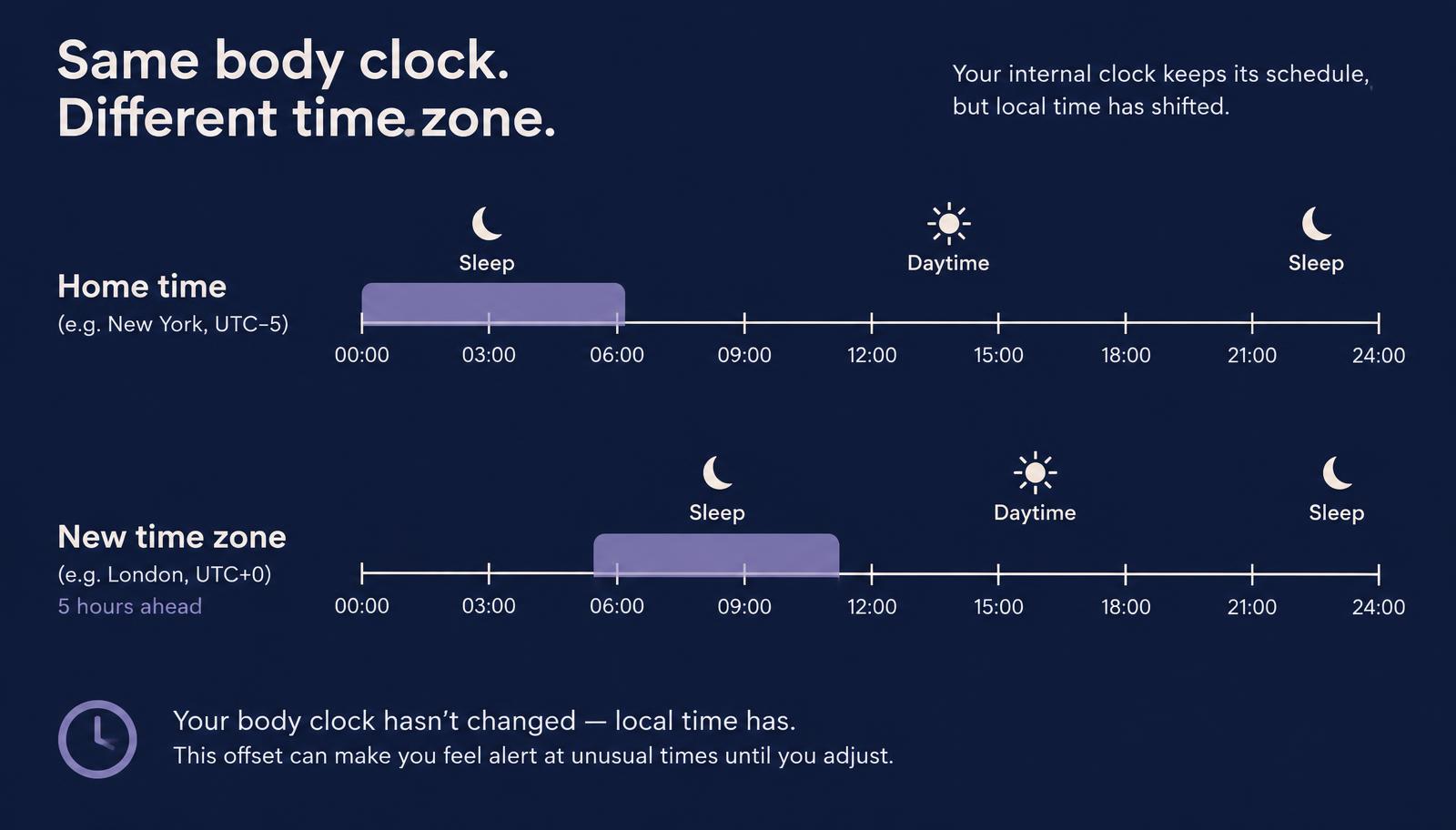
Insomnia and a shifted body clock can both cause difficulty sleeping, but they are different problems with different explanations. Insomnia involves trouble sleeping even when the opportunity and timing are right, while a shifted body clock means the timing itself is out of step with the schedule you are trying to keep. Telling them apart matters because the approaches that help each one are not the same.
6 min readRead the guide →